
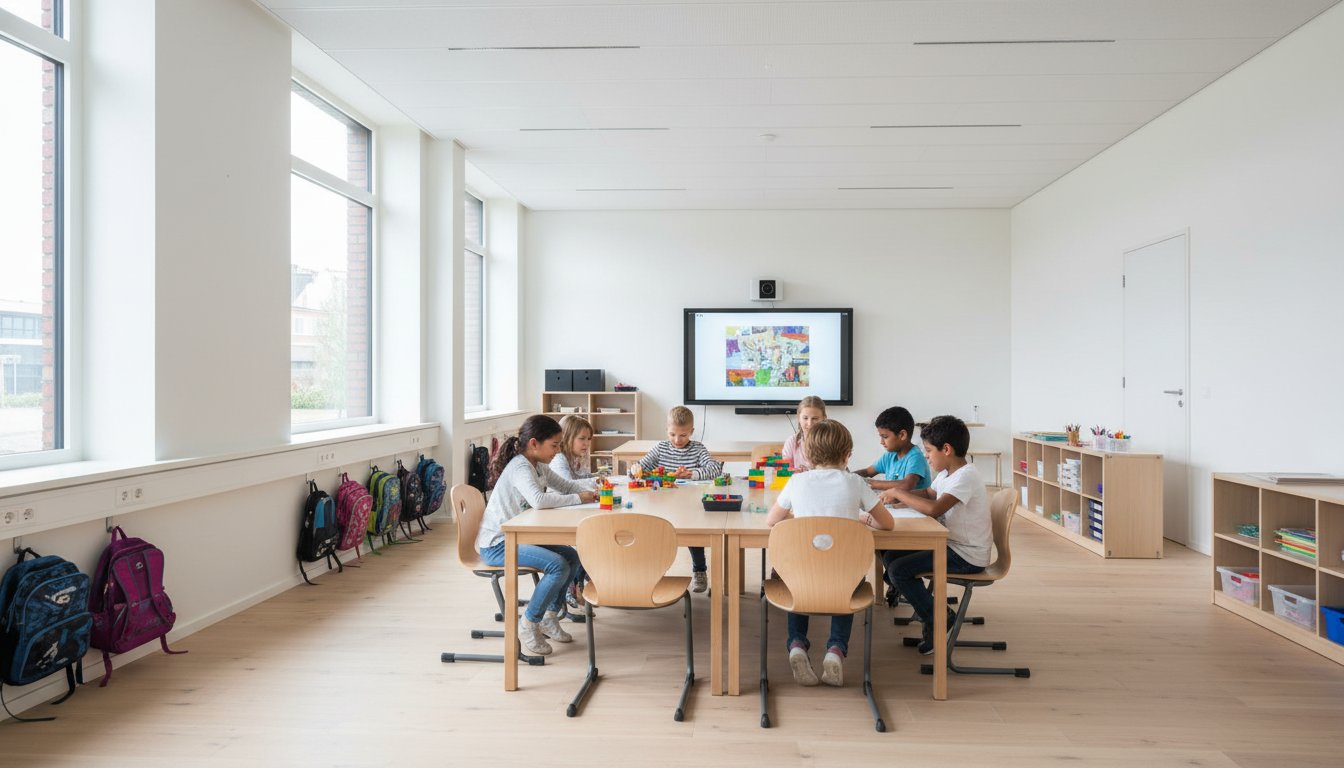
Schools need comfort during lessons, proper ventilation and manageable costs. Assess heating with insulation, air handling, electrical capacity and timetables. Infrared panels may be an option; they do not guarantee better learning, healthy air or lower bills.
Key considerations
Calculate each room’s heat demand, compare complete systems and check safe mounting around pupils. Agree controls, monitoring and maintenance. Assess halls, corridors, sports spaces and offices separately.
Assess sustainability objectives and conditions
Energy targets and building, grant or tax conditions apply to the specific project. Installing panels does not automatically establish compliance with Paris Proof, BENG or other requirements. Have applicable frameworks and schemes assessed by a qualified adviser. Ventilation and air quality must be designed and checked independently of the heat emitter chosen.
Radiant heat in a classroom
Panels heat exposed people and surfaces; convection and air warming also occur. Direction, distance, furniture, occupancy and cold windows affect comfort. There is no fixed warm-up time or temperature reduction with equal comfort. Presence detectors can miss seated pupils. Match programmes to actual use and test behaviour after connection loss.
Compare systems and total costs
Compare radiators, infrared and heat pumps at the same heat demand, ventilation and schedules. Distinguish resistance heating from heat-pump seasonal performance. Include purchase, installation, electrical supply, controls, energy, maintenance and replacement. There is no universal investment ratio or payback period. Solar panels do not automatically make operation carbon-neutral; winter demand and simultaneous generation differ.
From calculation to commissioning
Start with insulation, glazing, ventilation and occupancy data. Have output and distribution assessed, choose approved wall or ceiling mounting and check supports, fixings, cable routing and total load. Suspended ceilings are not automatically suitable to support panels. Check thermostat and building-management compatibility; monitoring or local adjustment are not standard. Test heating and ventilation together and hand over settings and fault procedures.
Products and project support
Compare metal, glass, printed and any illuminated versions using exact documentation. School logos, educational prints, impact resistance and lighting are model-dependent. Install hot surfaces as prescribed to prevent accidental contact and covering. Clean and inspect appliances, fixings and controls. Low maintenance is not maintenance-free.
A proposal for your school
Share plans, occupancy, lesson times, existing equipment and electrical capacity. We support school boards, business end users, installers and wholesalers with selection and quotations. Agree supplied items, installation, acceptance criteria and management beforehand. A trial classroom can help assess comfort and actual consumption before expansion.
Frequently asked questions
A standard wattage per square metre does not establish suitability for the whole school. An IP rating or temperature limiter does not make every installation safe: follow the exact manual and have fire and electrical safety assessed. Ventilation heat loss remains; panels do not clean air or guarantee learning or health improvements. Savings require a whole-building comparison under equivalent use.