
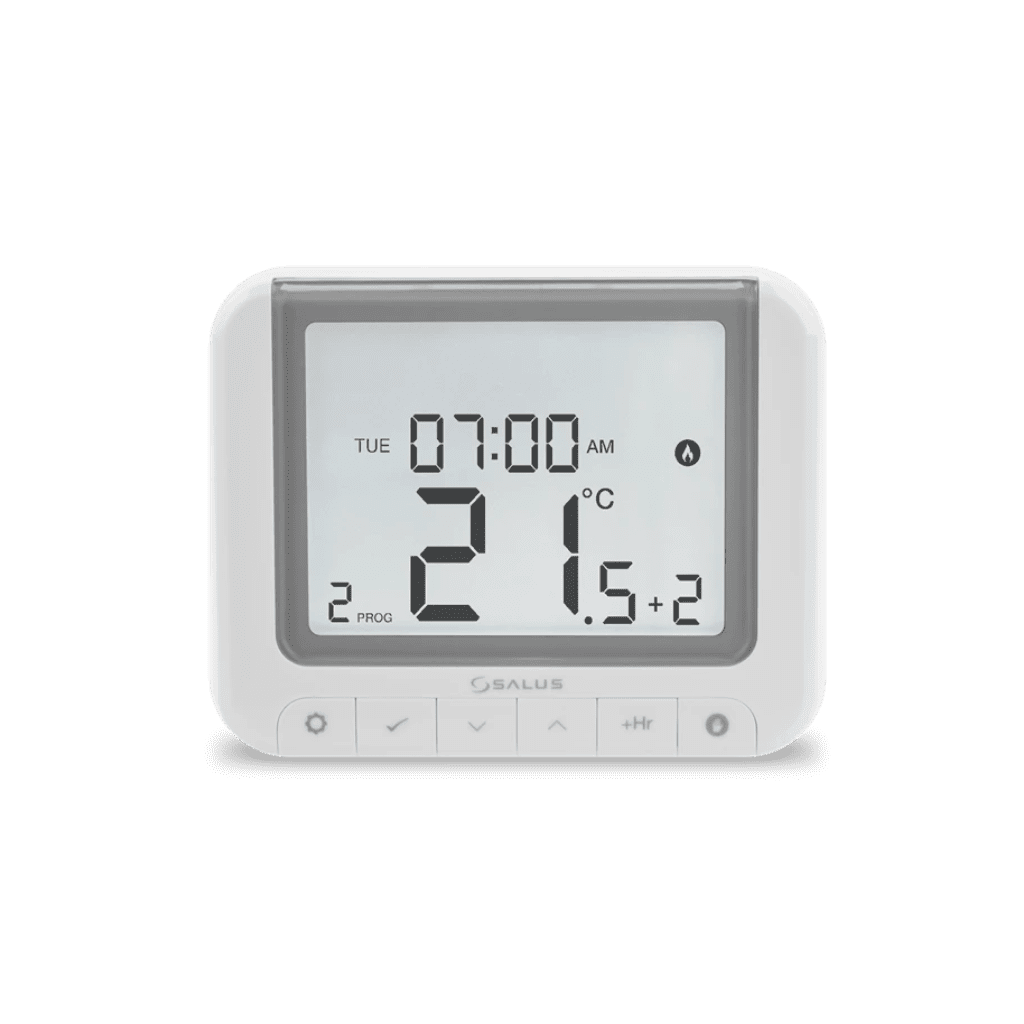
Choose a Salus thermostat based on the complete combination of panel, receiver, power supply and desired operation. The brand name alone does not tell you which devices work together or what load is permitted. This guide helps you gather the right information before choosing, replacing or extending a control system.
What must the thermostat control?
Distinguish between temperature measurement, the control contact and the component switching the heating load. A boiler thermostat may have a different output type from that needed for an electric panel. A panel with built-in electronics cannot automatically be switched through any receiver either. Have both device manuals assessed together.
Decide whether you want to control one room, several separate zones or a group of panels in the same room. A single central temperature measurement is not automatically representative of several enclosed rooms. Also establish who will operate the controls: residents, employees, visitors or only the manager.
Understanding control settings
Available control methods and settings differ by model. Hysteresis uses switching thresholds; time-proportional control distributes operating time across cycles. Use only a method and settings supported by the relevant manual for the application. Display resolution, a small setting increment or the name of a control algorithm does not guarantee that temperatures throughout the room stay within the same margin.
Switching on and off can be normal control behaviour. Do not expect a constant panel surface temperature or immediate compensation for every draught. A programme can reduce unnecessary heating hours if it matches actual use. It does not automatically change heat demand or guarantee a fixed savings percentage or longer service life.
Comparing models and connections
Record the full model numbers of thermostat, receiver and any gateway. For RT, Quantum or other ranges, use the documentation for the exact version; similar names do not mean identical functions. Check power supply, output type, supported receivers, protocol, app requirements and any subscriptions before ordering.
Wireless describes communication, not the panel’s power supply. The receiver and heater still need the specified electrical connection. Actual radio range depends on construction, positioning and sources of interference. Devices sharing a frequency or protocol name cannot necessarily be paired.
Choose local or remote operation based on the actual need. Check which functions of the exact combination keep working without internet, what a gateway does and what happens during network or power failure. Do not assume universal retention of settings, automatic restart or a fixed battery life.
Installation and commissioning
Have an installer assess total connected load, receiver contacts, permitted load type, wiring and protection. A current rating on a receiver is not universal permission to connect every panel up to that limit. Any additional contactor or relay must be technically suitable; an arbitrary smart module does not replace that assessment.
Position the sensor according to the manual in a representative location. Where specified, avoid direct radiation, sunlight, draughts and heat from equipment. Follow the specific pairing procedure and give every zone a clear name. Test heat demand and switching off for each receiver, check the measured temperature and document the programme and failure behaviour.
Choosing a suitable combination with us
We advise private and business end users, installers and wholesalers. Send model numbers, photographs of existing equipment, the number of panels and your desired zone plan. We discuss a demonstrably suitable combination; not every product of the same brand automatically forms one system. Existing installations still require technical assessment before components are replaced.
Handing over operation and management properly
Keep model manuals and explain the programme, temporary changes, battery checks and fault reporting to the user. Regularly check whether settings still match occupancy. Electric underfloor heating also depends on the specified floor temperature limit, sensors and product combination; a room thermostat does not replace those requirements.
Request advice and a quote for your controls
Frequently asked questions
What should I do if the connection is lost?
Check visible messages and follow the fault instructions for the exact devices. Check batteries only according to the manual. Do not open an electrical receiver or bridge contacts. Repeated resetting can erase settings; contact the installer if the fault persists.
Does frost mode protect every pipe?
No. The setting responds to the sensor used and only works with power available and a functioning installation. Concealed or more distant pipes may be colder. Have frost-sensitive locations assessed separately and follow model-specific instructions.