
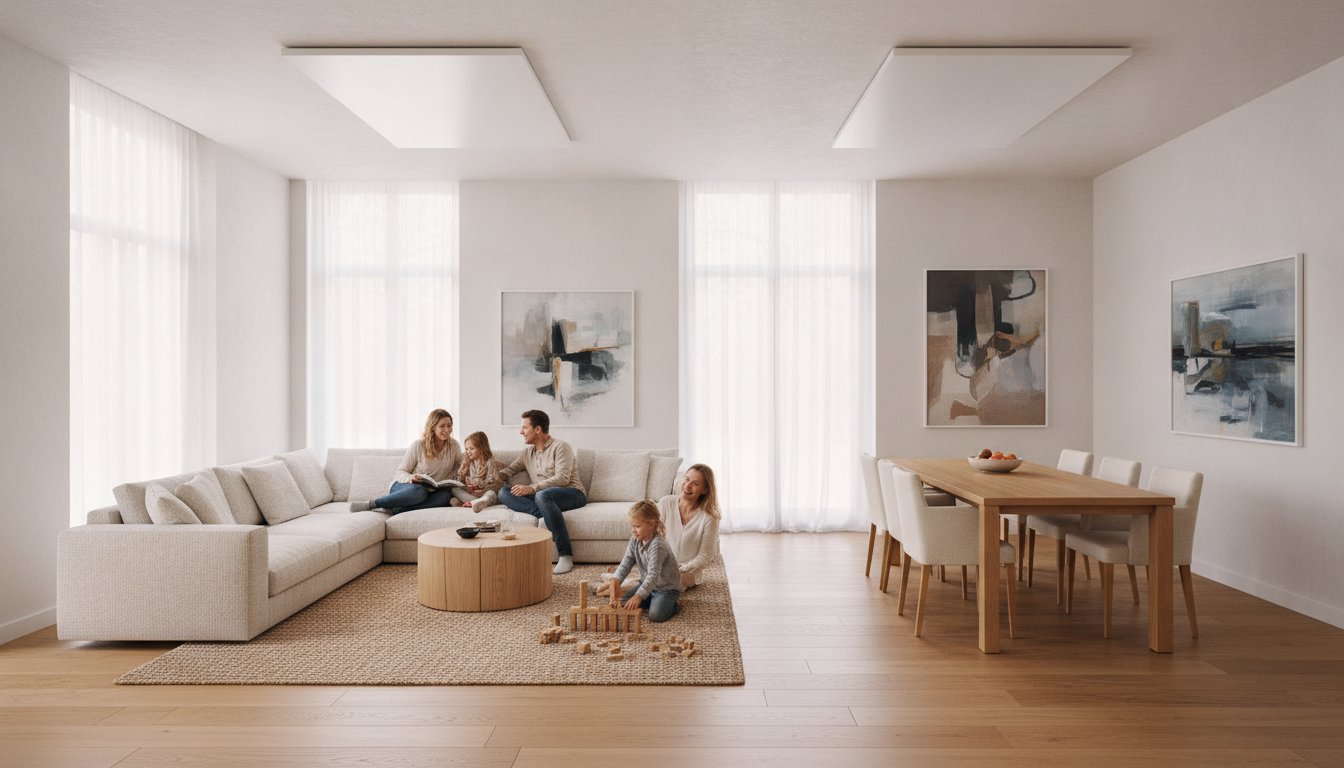
Ceiling-mounted infrared panels can preserve wall space and direct warmth towards a desk or seating area. Suitability depends on ceiling structure, layout and use. This guide helps identify when overhead mounting is practical and what technical information is needed first.
Key points
Choose a model approved for ceiling use. Check structural support, coverage, clearances and connection. Radiation can transfer heat downwards, but the appliance also emits convective heat. Ceiling positioning does not guarantee warm floors, even room temperature or lower costs.
Why radiation can work downwards
Warm air can rise, but infrared radiation uses a different transfer mechanism. Surfaces and people receiving radiation can absorb part of it. Furniture, light fittings and obstacles alter coverage. Reflection and surface properties also matter.
The panel also heats air by convection, so air movement and ventilation losses remain. Floor and wall thermal mass can store and release heat but creates no extra energy. An irradiated floor is not the same as an installed underfloor heating system.
Space and layout: practical benefits
Ceiling positioning can keep a panel away from normal wall furnishings, useful with many cupboards or little free wall space. Check pendant lights, tall furniture and distance to people. A fixed 120-degree radiation angle or universally better coverage than wall mounting does not apply to every model.
Wall mounting may suit a particular seat just as well or better. Compare both options by comfort and approved mounting, not appearance alone. Whole-home heating needs room-by-room sizing against demand.
Ceiling panel designs
Metal and glass panels can differ in weight, finish and warm-up behaviour. Compare actual model data; material alone does not prove lower consumption. Suspended-ceiling panels also need suitable support: fitting the grid does not automatically mean the grid can carry their weight.
For LED models, check connections, light output and separate controls. One combined product does not always mean one simple connection. RAL colours, printing and recessed mounting depend on model. Recessing or covering is permitted only with explicit manufacturer approval.
Structure, mounting and connection
Have substrate and fixing assessed for weight and load. Concrete, wood and plasterboard each need suitable fixing; no substrate automatically suits every panel. Use specified brackets and clearances. Generic 2–5 cm gaps or 2.5–3 metre heights do not replace the manual.
Assess electrical capacity, controls and sensor location. Conceal wiring only by approved methods and keep connections accessible where required. Fixed wiring or installation changes require a competent installer. Bathroom positioning requires assessment of overall electrical safety.
Our advice for a suitable ceiling solution
We help private and business end users, installers and wholesalers. Send a layout, ceiling photographs, height, insulation and use details. We advise on panels and controls. Sound heat-loss assessment matters more than fixed watts per m³ or a standard number of living-room panels.
Balance design and operating costs
Calculate electricity use as kW times actual on-hours. For main heating, compare alternatives such as heat pumps too. High electricity-to-heat conversion does not automatically mean a low annual bill. Cleaning, checks and possible repairs remain necessary as instructed.
Ceiling heating questions
Is ceiling mounting always safe on wood?
Only models and mounting methods approved for that substrate are candidates. Rear insulation does not automatically make the mounting side cool or fire-safe. Have clearances, heat exposure and fixings competently checked.
Does a ceiling panel automatically improve indoor air?
A panel is a heater, not air treatment or a medical device. Ventilation, cleaning and moisture management remain necessary. Different heat distribution can feel pleasant but does not guarantee protection from dust, allergies or damp.