
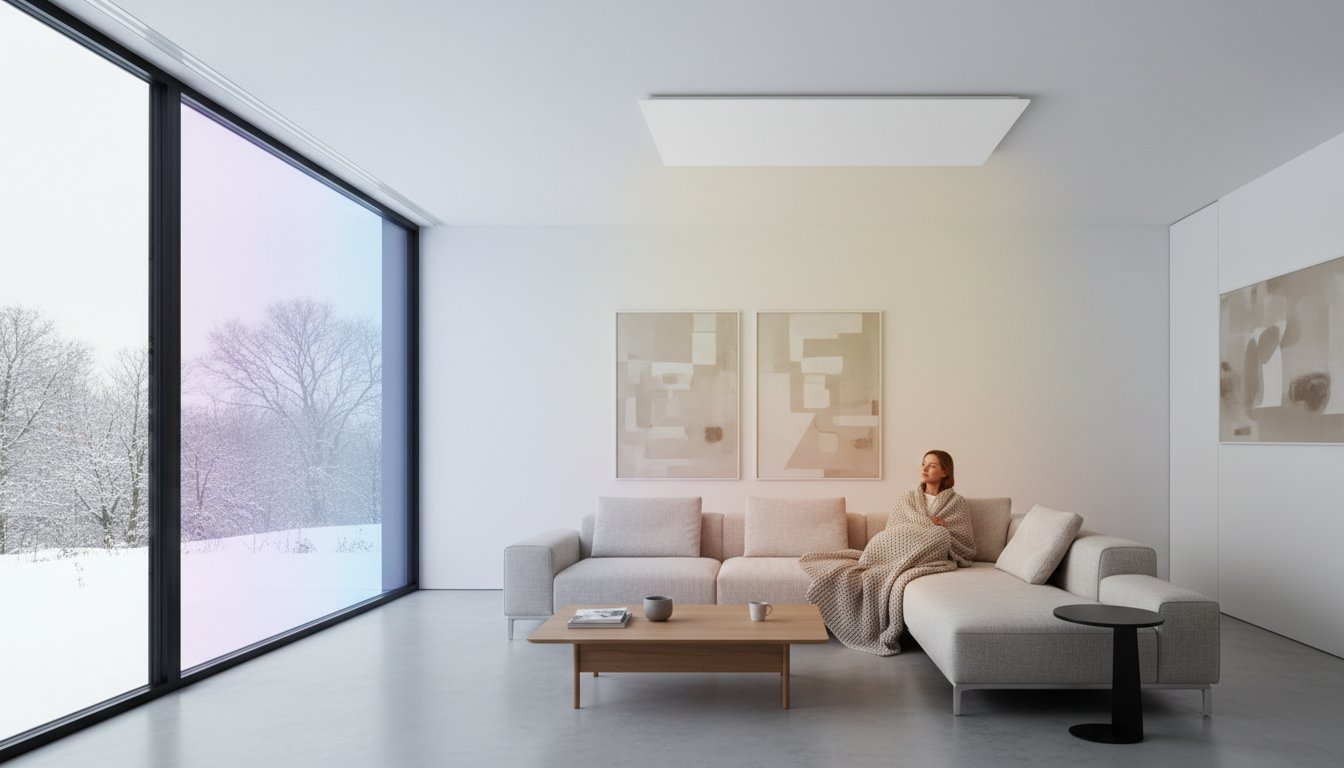
Does a window, external wall or back door feel cold despite the thermostat reading? First investigate heat loss and the existing system. Extra heating can improve local comfort, but cannot repair a gap, thermal bridge or ventilation problem.
Key considerations
Compare air and surface temperatures, check draughts and investigate moisture problems. Then assess insulation, draught-proofing, balancing or supplementary heating. Maintain necessary ventilation. Savings and comfort depend on the complete plan, not a generic wattage.
Where does the cold come from?
Thermal comfort depends on air, surrounding surfaces, air movement, clothing and activity. Air cooled by cold glass can descend towards the floor; gaps also cause draughts. Thermal bridges can increase local heat loss. Warm air may collect higher up, but there is no fixed temperature increase per metre. A central thermostat does not necessarily represent adjoining rooms.
Radiation, convection and existing heating
Radiators emit both radiant and convective heat; infrared panels do too, in proportions depending on the model. Obstacles can block direct radiation. A panel may warm exposed surfaces but does not guarantee warm floors or eliminate downdraughts. Ventilation losses and natural air movement remain. First assess existing radiator controls and balancing.
From measurements to a suitable plan
Map cold spots and occupancy times. Measure air temperature with a suitable sensor; an infrared thermometer measures surfaces and can mislead on glass or shiny materials. A temperature difference alone does not prove a building defect. Seek expert investigation where needed. Address suitable building measures, assess heat loss, then select output, position and compatible controls. Follow the manual for structural support, clearances and electrical load.
Different rooms need different choices
Assess seating in living rooms and workstations, glazing and extraction in kitchens. Wall or ceiling models must be approved for their mounting and not obstructed excessively. In bathrooms check exact position and electrical requirements; an IP rating alone is insufficient. A heated mirror does not replace ventilation. Bedrooms still need ventilation and cleaning; heating does not treat allergies or remove airborne dust.
Consumption, maintenance and own electricity
Calculate consumption from kilowatt input and actual operating hours, using your tariff. Include existing heating, purchase, installation and maintenance. Less gas plus more electricity is not automatically cheaper. Solar panels do not automatically provide enough winter electricity or make a home carbon-neutral. Follow cleaning and inspection instructions; low maintenance is not maintenance-free, and expected lifespan is not a warranty.
Our help with the decision
Send plans, cold-spot photos and details of insulation, ventilation, occupancy and heating. We support private and business end users, installers and wholesalers with selection and heating plans. Agree which measurements and installation assessments are needed.
Frequently asked questions
A warm thermostat reading does not rule out cold surfaces or draughts. Panels do not always resolve cold feet: direction, obstructions and floor construction matter. Required output, distance and warm-up time depend on model and circumstances. A plug does not make every mounting suitable for DIY; have fixed wiring and circuit load assessed. Panels and convectors have no universal operating-cost difference. Coordinate supplementary and existing heating and assess the result at the same comfort level.