
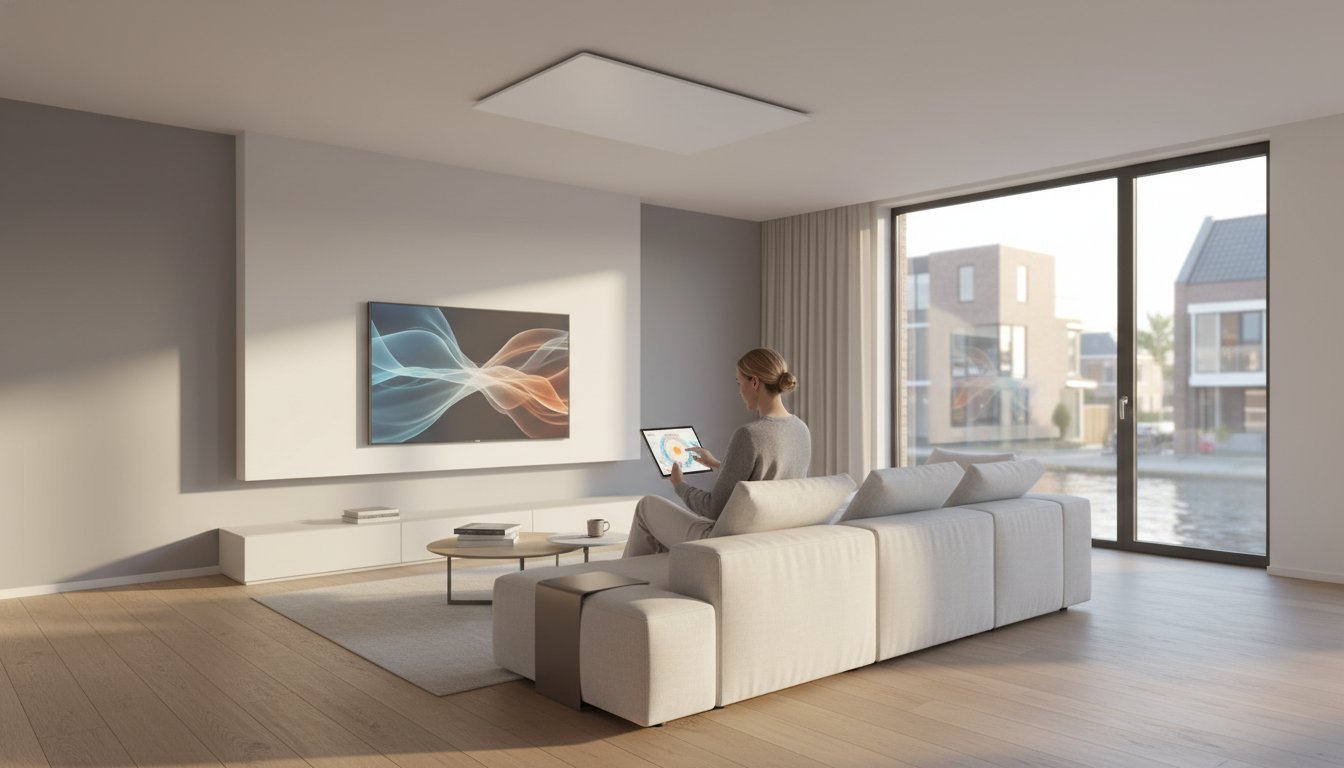
Monthly infrared heating costs depend on the electricity actually used and your energy tariff. The wattage on the label is only the starting point. You also need to know how long the heating actually switches on and which rooms or seating areas you heat. There is no fixed monthly amount that applies to every home.
This guide makes the calculation verifiable with clearly fictional examples. They are not a price offer, consumption forecast or sizing recommendation. We help private and business end users, installation companies and wholesalers gather the necessary data and compare different solutions for the same comfort requirements.
Calculating infrared heating costs
Calculate kilowatt-hours from kilowatts multiplied by actual heating hours, then apply the tariff. With a variable tariff, use the relevant time periods. Keep consumption costs, fixed charges and purchase costs separate. State what you measure and what you estimate, and do not compare one winter month with an average annual amount.
The basis of a monthly calculation
Watts describe power; kilowatt-hours describe energy. Divide watts by one thousand to obtain kilowatts. An appliance actually drawing 1,000 watts for one hour uses 1 kilowatt-hour. A thermostat can switch the appliance off intermittently. The time a room is used is therefore not automatically equal to the time electricity is drawn for heating.
For several panels, use the sum of actual power draw and heating time for each appliance or zone. With output control, an appropriately measured average may be needed. Include receivers and other relevant components when measuring the whole system. An app displaying an on symbol or an estimate is not the same as an electricity meter.
Which costs should be included?
Consumption costs are not the full costs of ownership. Show purchase, mounting, electrical alterations, maintenance and possible replacement separately. Fixed gas charges disappear only if the connection is actually discontinued and gas is no longer needed elsewhere. For business calculations, use the same VAT basis consistently and account for your own tax circumstances.
What affects actual heating hours
Heat loss, outdoor temperature, ventilation, desired room temperature and use determine heat demand. The installation must have sufficient capacity for this. Simply assuming a fixed heating time of twenty to forty minutes per hour is not substantiated. In cold conditions, a suitable system may operate much longer; in mild weather, less.
Determine output through a suitable heat loss assessment, not just an energy rating or a fixed watts-per-cubic-metre figure. More installed power does not guarantee less consumption, and a smaller panel is not a savings solution if the room remains too cold. Always compare the same achieved comfort. Radiant share and emissivity alone do not produce a monthly cost.
Tariff, sunshine and season
Use your contract tariff and make clear which taxes it includes. With dynamic prices, consumption must be matched to the correct time period. Solar electricity counts only when production and demand coincide; include the export income forgone as well. Heat demand can be high in winter while solar generation is low. Additional preheating is not automatically advantageous.
Verifiable calculation examples
All the following amounts use only the fictional assumptions of €0.30 per kilowatt-hour and thirty days. Replace these with your own tariff and measured or substantiated heating time. The selected outputs are not recommendations for a particular floor area. The examples only demonstrate the calculation and do not include fixed charges or investment.
Example of an occupied seating area
With an actual total power draw of 1.5 kilowatts and two heating hours per day, monthly consumption is 1.5 × 2 × 30 = 90 kilowatt-hours. At the fictional tariff, that is €27. At five hours per day, it becomes 225 kilowatt-hours and €67.50. This result does not demonstrate savings on existing heating; these must be measured or calculated separately.
Example for a bathroom panel
An actual power draw of 0.8 kilowatts for one hour a day gives 0.8 × 1 × 30 = 24 kilowatt-hours and €7.20 in this example. This does not tell you whether one hour is sufficient for your bathroom. Warm-up time, desired temperature, moisture, ventilation and permitted positioning require separate assessment. A mirror surface does not change that calculation.
A separate calculation for a whole home
If a system actually drawing 4 kilowatts totals 120 equivalent full-load hours in a month, that is 480 kilowatt-hours and €144 at the fictional rate. Those 120 hours are not a forecast for an apartment or house. Heat demand and an annual profile are needed for the whole building; also include hot water and cooking when making a complete gas-free comparison.
Ways to limit unnecessary consumption
Set suitable schedules, check a representative sensor position and keep the radiation path clear within the mounting conditions. Do not heat unused rooms unnecessarily high, but maintain suitable comfort and moisture management. Zones in an open room are not independent, and an occupancy sensor needs to recognise people sitting still. Simple, suitable controls may be sufficient.
For primary heating, also compare insulation and suitable alternatives. A resistance panel makes heat from electricity; a heat pump moves environmental heat and can deliver several units of heat per unit of electricity. High electrical conversion efficiency therefore does not automatically demonstrate lower costs than a heat pump or gas installation.
From product data to a substantiated plan
Use traceable data and comparable measurement methods when comparing products. A material name, European origin or higher purchase price does not demonstrate a lower electricity bill. Check mounting, controls, warranty, cleaning and possible replacement. Ask us for available information on the version you are considering rather than relying on a general efficiency claim for the range.
Preparing a monthly estimate for your situation
Share dimensions, insulation, usage hours, desired temperatures and existing heating. Add meter readings and your tariff if relevant, without sharing account credentials. We discuss suitable products and assumptions with you and, where desired, your installation company or wholesaler. Have the estimate clearly state assumed hours and tariffs and excluded costs.
Frequently asked questions
Can I use an average monthly amount?
Only if it is clear which building, annual consumption, tariff and usage that average is based on. An advance payment on your energy bill does not measure one heating system. Compare actual seasonal consumption and billed figures, and update the estimate when occupancy, settings or your energy contract change.
Are there maintenance costs in addition to electricity?
A panel without a fan or liquid circuit may need limited maintenance, but cleaning and inspection according to the manual remain necessary. Thermostats, receivers and connections also count. Expected service life is not a warranty period, and low-maintenance does not mean service or replacement never costs money.