
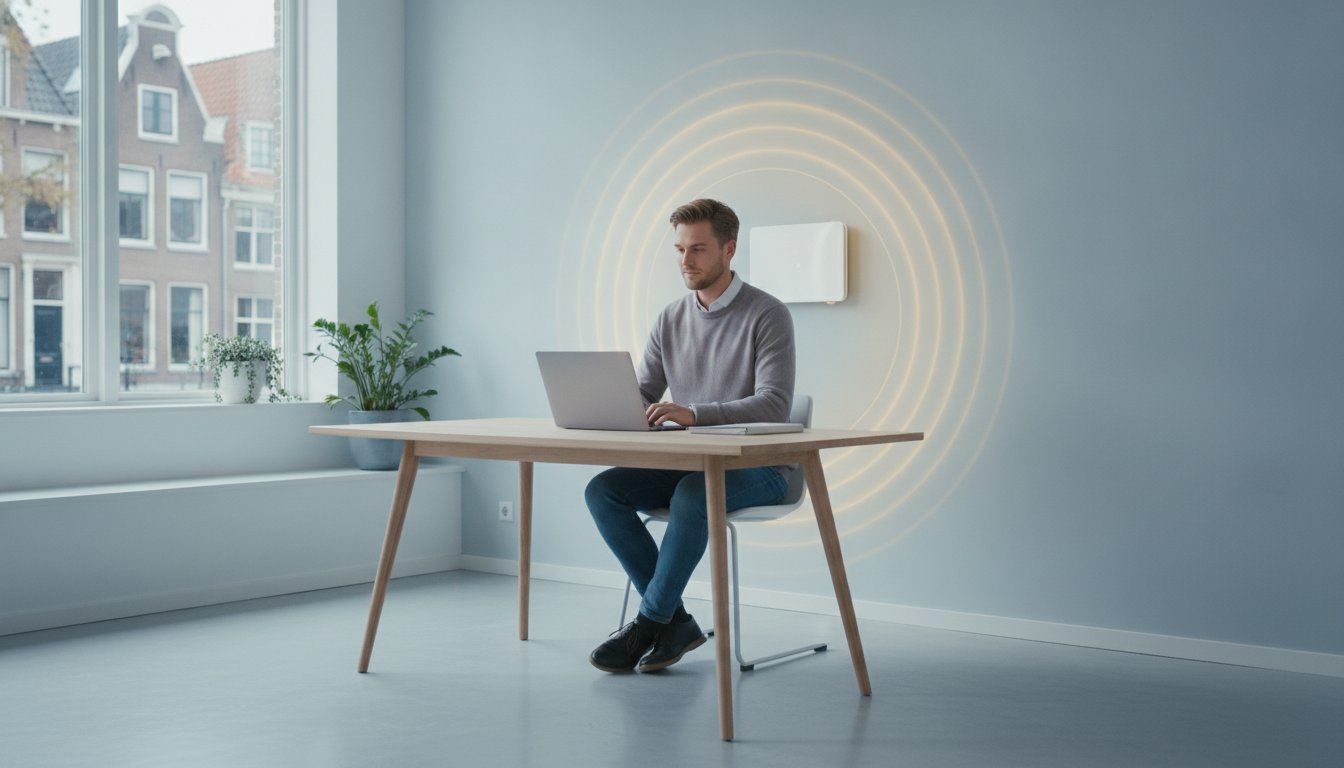
A small infrared heater may provide extra warmth in a limited area, such as a home-office desk. Small dimensions do not automatically mean low consumption, a cool surface or suitability for every recess. Choose for the intended use and check required clearances.
We discuss compact panels for home and work and the limitations of local supplementary heat. Private customers, business users, installers and wholesalers can ask us about suitable versions.
Key points
Match the small heated zone to distance, posture, obstacles and existing temperature. Use only a model permitted for the desired location. Heating a whole room requires heat-loss assessment; additional power is not an automatic saving. Consider hot surfaces and cables even with compact appliances.
What is small infrared heating?
A compact panel turns electricity into heat at a surface, releasing energy through radiation and convection. A person may receive some radiation before the whole room reaches the same temperature. The rest of the room still loses heat and does not automatically become comfortable. Draughts and cold surfaces may affect the result.
Compact panel or intense radiant heater?
A flat panel and a glowing-element appliance have different temperatures, light emission and permitted distances. Do not use a patio heater at a desk because it looks small. Even a panel without visible glow may get hot. The manual determines operating conditions, not appearance or wavelength name alone.
The right output for a small room or workstation
First establish whether you need extra warmth for one person or heating for an entire room. A workstation depends on line of sight and local demand; room heating also depends on insulation, ventilation and desired temperature. Fixed rules of 20–35 watts per cubic metre or 100–300 watts per application do not replace assessment.
A higher rated output does not automatically reduce total consumption. A 200-watt panel running continuously at full power for five hours uses approximately 1 kWh. Multiply actual consumption by your tariff and include other heating. A lower central-heating setting may save gas, but additional electricity also determines whether the total bill falls.
Controls for local use
Check whether the appliance has its own controls or requires or permits an external thermostat. A timer may limit forgotten operation but does not replace correct positioning or temperature monitoring. Presence and window detection are model-dependent and do not guarantee unnecessary heating never occurs.
Applications at home and in the office
At a desk or reading spot
Use beneath a desk only a model intended for that position. Maintain instructed distances from legs, cables, paper and furniture and prevent contact with hot surfaces. A freestanding version must be stable and create no trip hazard. At shared desks consider accidental movement or covering by another user.
Toilet, hobby room and bathroom
A small room may have little mounting space yet substantial heat loss. A garage or hobby room may need dust, moisture and impact resistance. In a bathroom, appliance, position and electrical protection must suit one another. A heated mirror may combine functions, but demisting is not the same as sufficient room heating.
Installing and positioning a compact panel
Wall, ceiling and under-desk positions each require approved mounting. Do not treat a general distance of one to one-and-a-half metres or a 120-degree angle as a product specification. Furniture may intercept radiation. Glass properties also vary by wavelength and construction; a claim that a window transmits almost all thermal radiation is not a reliable positioning basis.
Check weight, substrate and prescribed fixings. Maintain required clearances and cable routes. Have fixed electrical connections and total load assessed by a competent installer. A plug-in version is ready for use according to its manual only when position, socket and any controls are suitable too.
Our support with your compact heating solution
Tell us where and when extra warmth is needed and send photos or a floor plan. We discuss what a compact appliance can contribute with private and business customers. With installers and wholesalers, we coordinate application, components and available documentation. Finish, origin and warranty are confirmed by product.
Make the small heated zone part of the whole plan
Local supplementary heat may be useful when positioning, use and existing heating work together. Ask us for advice or a quote and assess comfort alongside total costs.
Frequently asked questions about small infrared heaters
Can brief touching cause a burn?
Yes. Do not rely on a withdrawal reflex for protection, particularly for children or people who react less quickly. Surface temperatures vary by model. Maintain required clearances, prevent accidental access and do not cover the panel. An overheat cut-out does not automatically make touching safe.
Is it suitable as the only heating?
That depends on heat demand, permitted application and positioning, not the word small. Have a calculation made for complete room heating and discuss any project requirements separately. Product terms govern lifespan and maintenance: cables, fixings and electronics also need checking.