
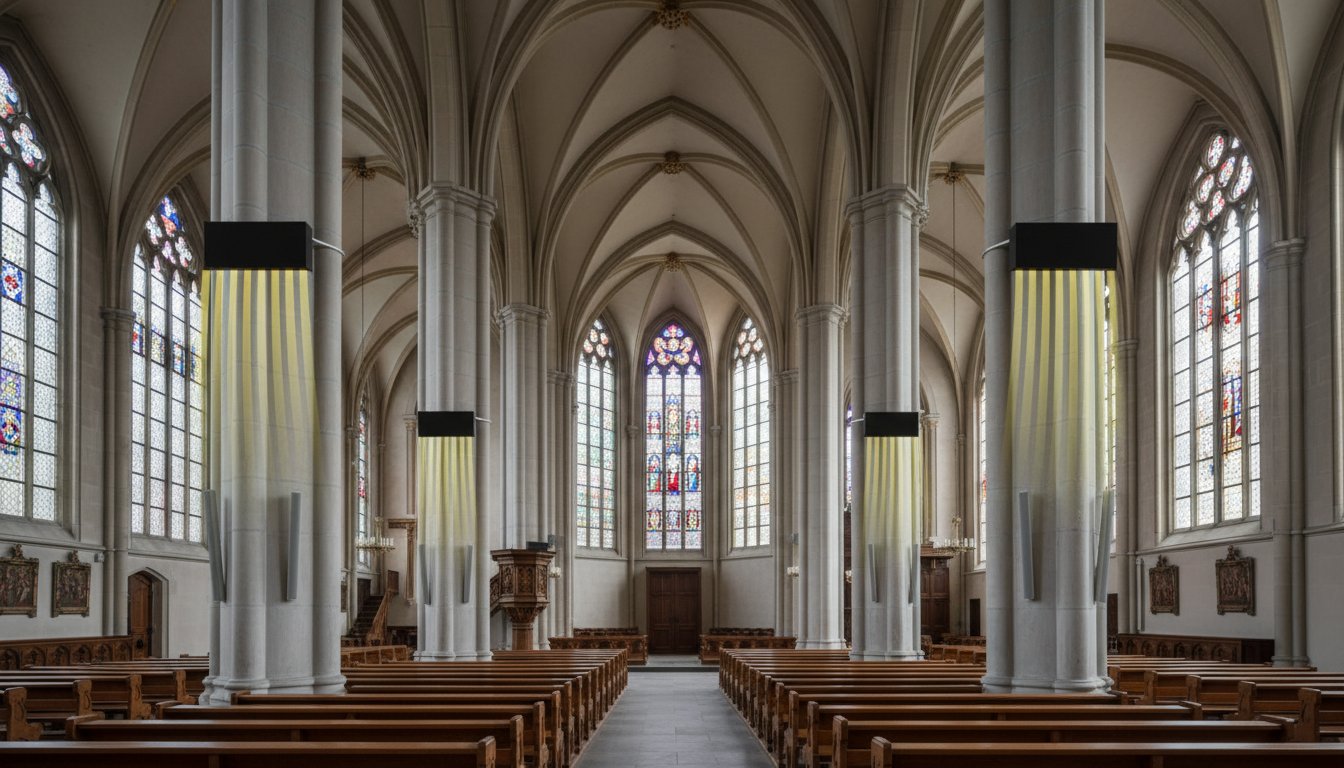
A church with high vaults, cold walls and changing occupancy needs its own heating plan. Infrared heaters can direct warmth towards occupied seating but do not replace assessment of the building, collection and indoor climate. In a historic building, involve its responsible manager and a heritage specialist.
Key considerations
Map services, concerts and smaller meetings. Separate visitor comfort from conditions required by organs, artwork and timber. Compare existing air heating, radiators and possible supplementary heaters for the same objectives.
High spaces and historic fabric
Warm air may collect overhead and air cooled by glass can descend. Effects vary by building; a fixed temperature increase per metre is no calculation. Assess heat loss, draughts, moisture and existing balancing. Insulation or fixings affecting historic fabric need suitable review. Infrared is not automatically simpler, more economical or permitted in every historic building.
Radiant heat and protecting the interior
Panels and heaters warm exposed people and surfaces; convection also occurs. Distance, direction, obstructions and appliance determine exposure. There is no universal warm-up time or even coverage. Local warming can affect sensitive materials. Have temperature, relative humidity and their changes assessed; infrared does not automatically protect organs or paintings. Dust, soot and ventilation require separate management.
Compare air heating and zoning
A chapel, selected pews, pulpit or vestry may have different schedules from the nave. Zoning can reduce unnecessary operating hours when controls suit the use. Calculate purchase, installation, energy, maintenance and replacement. Less gas plus additional electricity is not automatically cheaper. Expected lifespan is not a warranty; no technology eliminates every fault or risks in other building pipework.
From survey to installation
Share plans, seating, heights, occupancy, materials and supply details. Have demand and radiant distribution assessed without generic watts per pew or square metre. Choose the exact model for approved distance and mounting; long- and short-wave heaters have no universal height limit. Check fixings, combustible materials and clearances. An installer assesses supply, total load and possible upgrades. Wireless controls do not remove power cables. Calendar or building-management integration must be expressly confirmed and tested.
Products and support
Discuss available colours, dimensions and fixings per version. Not every RAL colour or special heritage bracket is standard. We support church managers, installers and wholesalers with selection and quotations; agree surveys, installation and service. Have grant and heritage conditions checked for the exact project before including funding.
Assess a trial installation
A suitable trial can help assess comfort from pews and effects on the interior. Measure actual consumption, existing heating and climate conditions too. Agree acceptance criteria with managers and advisers. Follow model instructions for cleaning, inspection and safe shutdown; low maintenance is not maintenance-free.
Frequently asked questions
Heater count and perceived warm-up depend on model and layout. There is no universal pew-length, output or time rule. Do not expose organs or collections to heating without assessment. Supplementary heating may be an option, but required background conditions remain. Colour choice, heritage status or a grant does not automatically establish technical or financial suitability.