
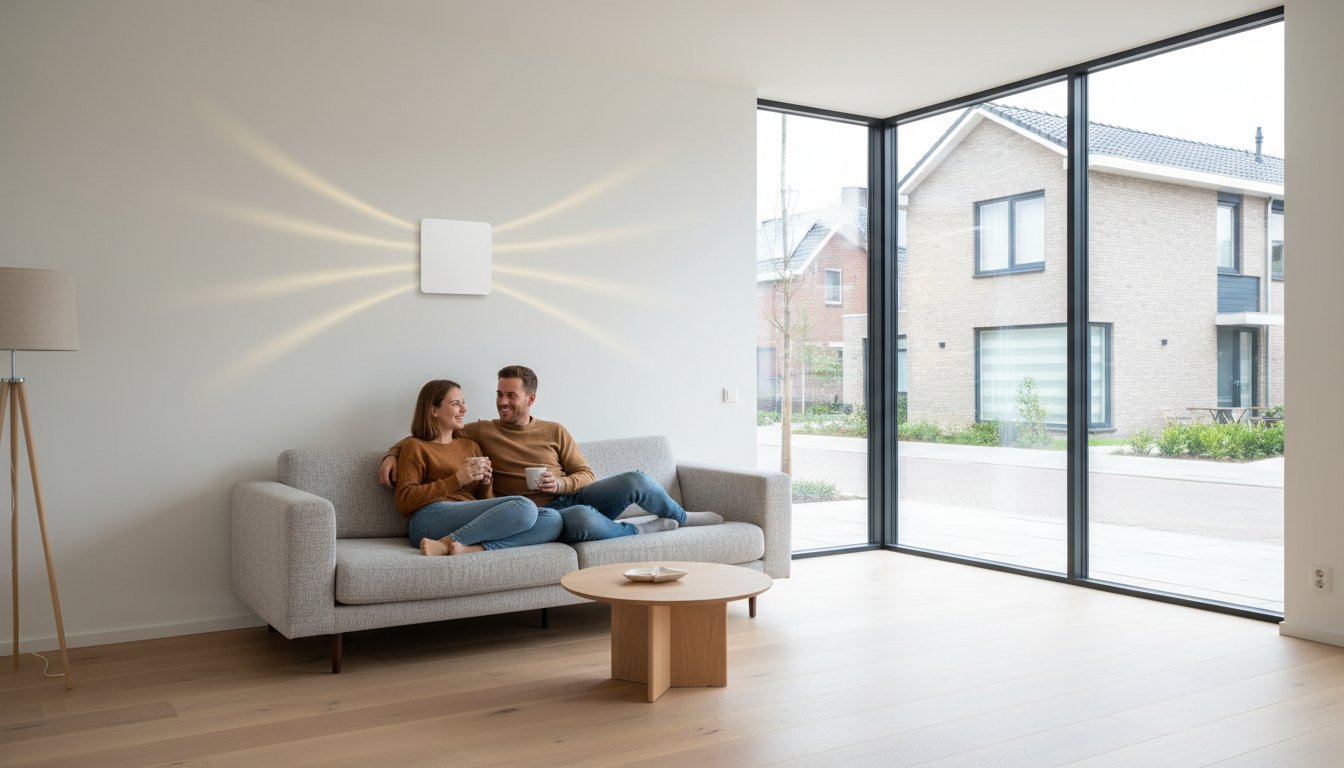
Illustration: the yellow lines have been added to represent heat transfer. They show neither visible light from the panel nor a measured heat distribution.
Ceramic heating is an umbrella term, not a complete technical description. It may mean a fan heater with a ceramic PTC element or a panel with a ceramic finish or substrate. These products are not equivalent. Start with the exact model and the function you need.
This guide helps you compare operation, comfort and requirements. We advise private and business end users and support installation companies and wholesalers. The material name alone does not prove lower consumption, better air quality or suitability for a damp or industrial environment.
Key points
Distinguish the electrical element from the outer surface. Check heat distribution, the fan, controls and the approved application. PTC behaviour does not replace complete product protection or a thermostat. Assess capacity and energy use for the same comfort requirement and follow the model instructions for mounting, use and maintenance.
PTC and ceramic panels are different concepts
PTC means that electrical resistance increases as temperature rises within the relevant operating range. An element designed for this purpose can therefore limit its current draw. This does not automatically measure the desired room temperature or rule out faults, incorrect connection or covering. The complete heater needs appropriate controls and protective devices.
A ceramic surface on an infrared panel says nothing by itself about the internal element. Like other heated surfaces, the panel can transfer heat by radiation and convection. Material thickness, mass, insulation and element construction affect warm-up time and residual heat. More stored heat does not mean free energy or general savings.
Ventilation, dust and humidity
A ceramic element does not prove that dust can never scorch or that odours cannot occur. A fan model moves air; a panel without a fan still does not make a room dust-free. Heating is not a treatment for allergies or asthma. Ventilation, cleaning and limiting dust sources remain necessary.
Relative humidity is related to temperature, moisture production and ventilation. Warmer surfaces can reduce condensation under some conditions, but ceramic material does not regulate the moisture balance on its own. Persistent condensation or mould requires investigation of the cause. Research into PTC in another appliance is not evidence of health benefits from a room heater.
Comparing a fan heater and a panel
A fan heater can actively distribute warm air and produce noise. A panel without a fan can provide a different local sensation of warmth. Compare actual warm-up time, heat distribution, controls and noise for the same task. Having no fan does not automatically make every component silent or guarantee a longer service life for the whole system.
Both resistance appliances ultimately convert almost all the electricity they draw into heat. A ceramic exterior or PTC element does not prove that less electricity is needed for the same heat demand. A heat pump works differently: by moving environmental heat, it can deliver several units of heat per unit of electricity. Include that alternative when considering primary heating.
Calculating consumption
An appliance actually drawing 2,000 watts for one hour uses 2 kilowatt-hours. Multiply this by your tariff. With thermostat control or variable current draw, use actual operating time and a suitable measurement. The PTC label does not tell you how much your monthly bill will fall or whether the room has already reached the desired temperature.
Applications in homes and businesses
For a living room, bedroom or workplace, assess coverage, positioning options and operating duration. Compare the output with the exact dimensions of the version and the prescribed clearance around the appliance. A panel may suit targeted heat, but a whole room requires sufficient capacity. A high hall, dusty workshop or shared space raises additional questions. Ceramic material is not automatically scratch-resistant, impact-resistant or suitable for combustible dust and vapours.
For a bathroom, assess the model, mounting location, IP protection, connection and electrical safeguards together. The ceramic surface does not automatically make the complete unit moisture-resistant. An IP44 rating is not general permission to fit it anywhere near a bath or shower. Follow the manual and have the specific combination checked.
From supplementary heating to a complete design
First establish whether you want to heat a seating position or the whole room. For primary heating, use an appropriate heat-loss assessment covering insulation, glazing, external surfaces, ventilation and the desired temperature. The construction year or a fixed wattage per cubic metre is insufficient. Check electrical capacity alongside all other appliances operating at the same time.
A suitable thermostat can control the room; whether it is built in or external depends on the model and application. Also check programmes, sensor position and restarting after a power failure. Solar electricity can meet part of the demand when generation and consumption coincide, but winter demand and export terms remain important. Choosing a material does not guarantee free or entirely sustainable heat.
Follow the product instructions for fixing, clearances and use. A heavy ceramic panel needs a suitable substrate and fixings. Have fixed electrical work carried out by a competent professional. A plug does not make every socket, extension lead or location suitable, and protective devices do not replace preventing covering and unwanted contact.
Suitable advice and ongoing care
Tell us about the space, its use and the chosen or existing model. We discuss the available product information with you and, where relevant, the installer or wholesaler. Ask for clear mounting conditions, delivery details and warranty terms. Include cleaning, inspection and possible replacement of controls; low maintenance does not mean no future costs.
Frequently asked questions
Can ceramic heating stay on at night?
You cannot tell from the word ceramic or PTC. Check whether the exact appliance is intended for that operating duration and those conditions, and follow all requirements for supervision, distances and controls. A portable supplementary heater is not automatically suitable for unattended or overnight use. Have a complete heating installation properly designed.
What should I do if I notice a burning smell?
Stop using the appliance if there is an unusual burning smell, damage, deformation or a recurring fault, and have it assessed. Do not assume that ceramic material makes this impossible or that the smell must be normal. Clean only with the appliance safely switched off and cooled down, following the manual, and do not open electrical components.