
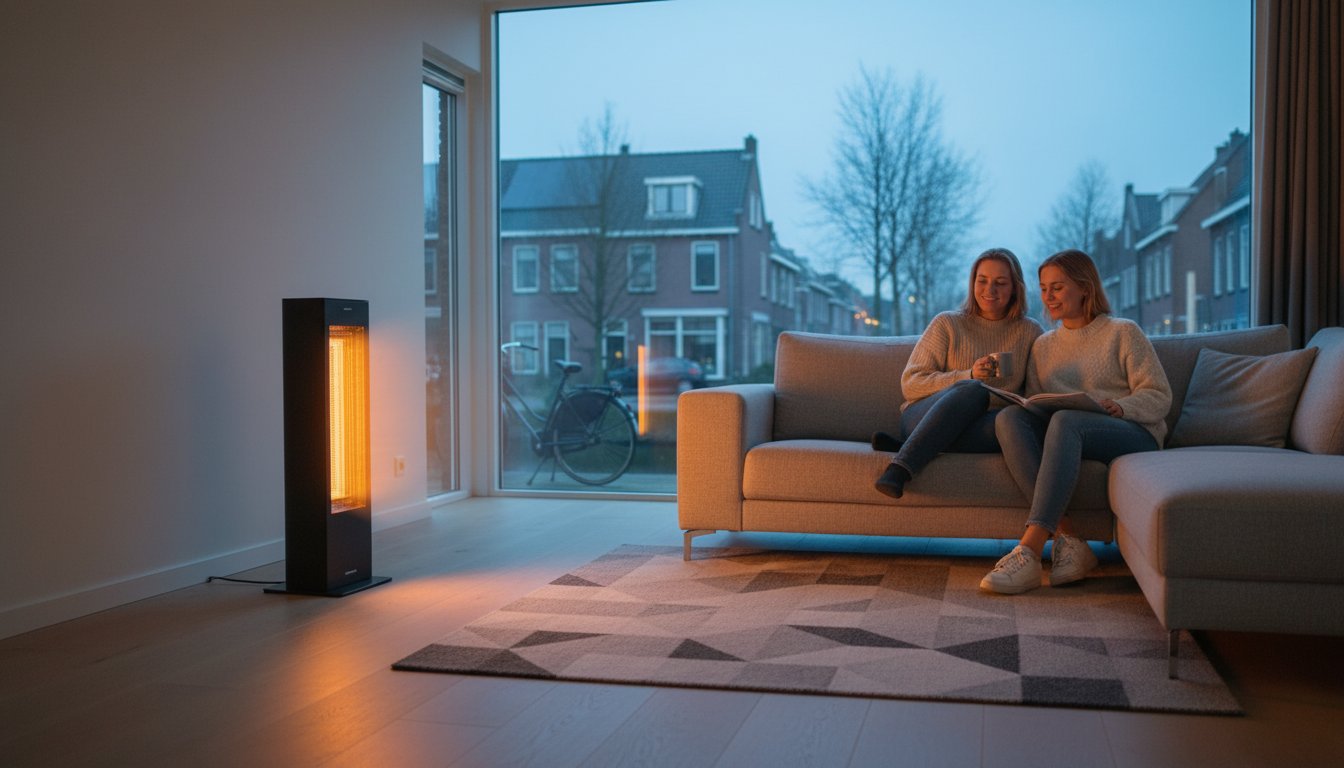
Ceramic heater often means an electric fan heater with a ceramic element. This differs from an infrared panel with a ceramic face. Identify the product being compared: material, distribution, fan, controls and permitted use determine its function together.
Key points
PTC elements can change resistance as their temperature rises, but do not thereby automatically regulate room temperature. Construction and protection still matter. Compare equal comfort and actual use; ceramic material alone guarantees neither savings nor general fire safety.
Understanding PTC and air heating
PTC means positive temperature coefficient: within its intended range, resistance may rise with temperature. Behaviour depends on element and supply. In a ceramic fan heater, a fan moves air over the hot element to distribute room heat.
Element self-limiting is not a room thermostat, tip-over switch or safe casing. Check provided protections and conditions. No universal tip angle, cutoff temperature or safe-touch claim applies to all ceramic heaters.
Practical advantages and limits
Compact models may suit temporary warmth where permitted. Airflow and noise may be noticeable. Weight, sound, modes and warm-up vary. Use model data and realistic placement, not generic seconds or room sizes.
Keep inlet and outlet clear as instructed. Position stably with required clearances to curtains, bedding, furniture and textiles. Route cables safely. No glowing wire does not mean no fire risk or hot surfaces.
Compare with infrared panels
Fan heaters distribute heat mainly through air. Infrared panels radiate to accessible people and surfaces and also convect. Neither is always cheaper or more comfortable. Compare aim, distance, obstruction, noise and permitted duration.
Insulation and ventilation affect demand for both. Fanless panels do not make rooms dust-free, and ceramic elements do not guarantee clean air. These are comfort heaters, not medical treatment. Maintain ventilation and cleaning.
Assess energy use and capacity
An actual continuous 2 kW input over one hour is 2 kWh. Use your tariff. Real input can vary with mode, controls and element temperature. Fans or electronics may use power after element cutoff; check data rather than assuming zero.
For room heating, assess losses and target temperature with insulation, ventilation and schedules. Fixed volume rules or standard living-room wattage are not calculations. Check full electrical loads and connection suitability.
Local supplementation may help when heating elsewhere truly falls; otherwise energy is added. Compare total cost at equal comfort. Ceramic, PTC or lower settings do not automatically save. Include equipment, works, maintenance and parts.
From temporary warmth to a suitable plan
Use only models approved for the environment. Bathrooms require model, moisture and full connection assessment; generic distances or IP alone are insufficient. Overnight or unattended use must remain within explicit conditions. Protections are not blanket permission.
We advise private and business end users and support installers and wholesalers. State whether you need temporary, workplace or room heat. We assess options without assuming one technology is best for all.
Check controls and maintenance
Follow cleaning and checks as instructed, switched off and cooled where required. Not all models have removable filters or the same method. Do not access internal parts unless permitted. Assess cable, casing or protection damage before reuse.
Ceramic heater questions
Is a burning smell always normal on first use?
No. Do not automatically treat burning smells, smoke or abnormal operation as harmless commissioning. Switch off if unsure and follow fault instructions. Check only permitted areas and assess persistent or unexplained symptoms. Generic instructions to keep heating for a number of minutes are not appropriate.