
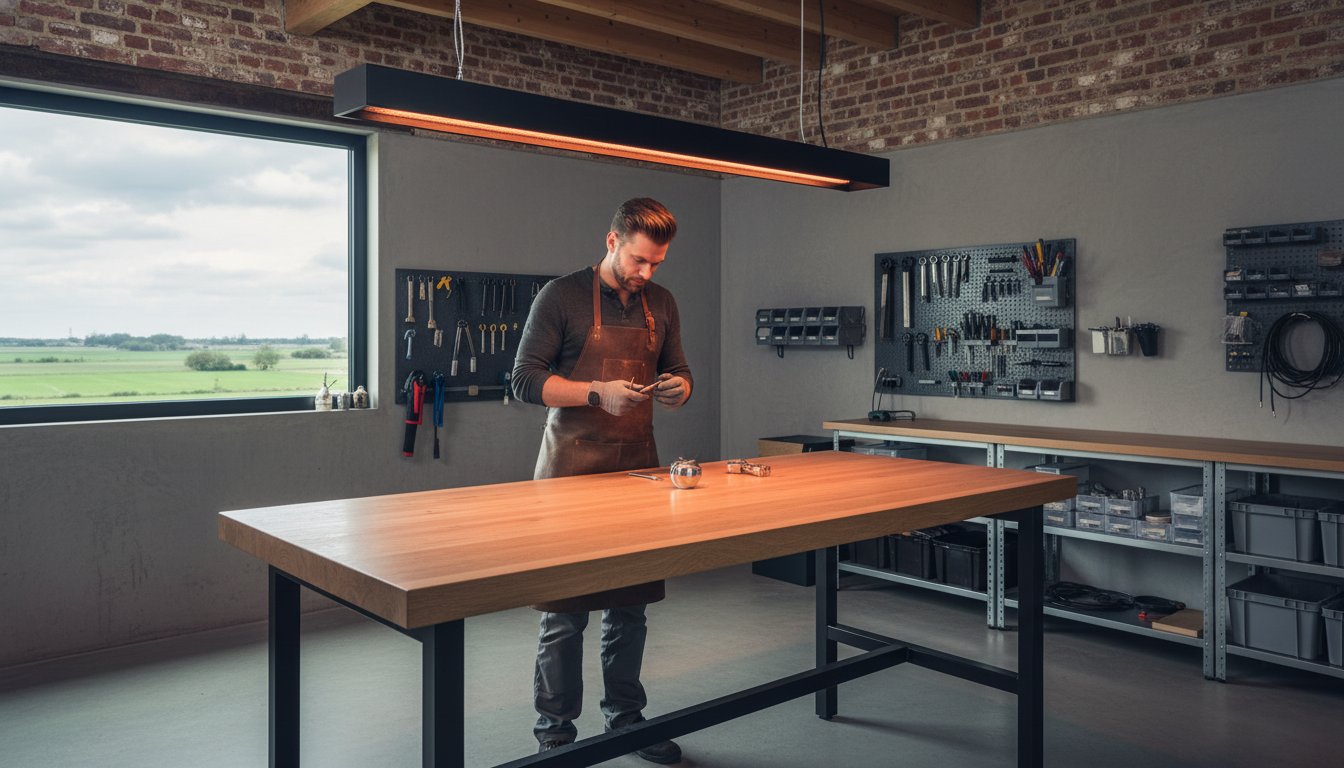
Choose a shed heater only after clarifying its use. Working at a bench for an hour, heating an entire workshop daily and protecting frost-sensitive pipes are different requirements. They do not automatically need the same appliance, controls or output.
This guide helps you assess the space and risks beforehand. We discuss solutions with private and business end users and support installation companies and wholesalers with product selection. With moisture, wood dust, paint or flammable storage, the environment is a decisive part of the choice, not a detail to resolve after buying.
Assessing a shed heater
Distinguish working comfort, space heating and frost protection. Investigate insulation, gaps, moisture sources and ventilation. Check model suitability, electrical load and clearances from stored goods and work materials. An infrared panel does not bypass heat loss and is not automatically suitable for every dusty or damp shed.
Insulation, moisture and intended use
A shed built for storage can lose substantial heat through its roof, floor, walls and doors. First assess whether simple building improvements are worthwhile and maintain necessary ventilation. A new heater does not undo poor insulation. Extending existing central heating, installing a separate system or heating only a workstation must be compared for each situation.
Moisture can come from leaks, the ground, wet materials or insufficient ventilation. Warmer surfaces can sometimes reduce condensation, but heating does not remove the moisture source. Do not rely on a panel as a guarantee against rust, mould or tool damage. Investigate the cause and, where needed, choose a suitable approach to ventilation, building repairs or dehumidification.
What infrared can offer at a workstation
Radiant warmth can heat an accessible workstation directly, while the appliance also releases heat to the air. Positioning determines which body parts and surfaces are reached. A workbench, machine or stored material can obstruct direct radiation. Test not only in the middle of the shed but in your actual working position.
A panel without a fan does not create forced airflow, but does not prevent dust from sawing, sanding or natural air movement. It does not replace extraction, ventilation or cleaning. Heat losses through gaps and cold building elements also remain. Heat stored in walls or the floor is not a loss-free battery.
Which heater suits the shed?
A convector or fan heater, a non-glowing panel and a targeted radiant heater have different heat distributions and operating conditions. For the same comfort requirements, compare purchase, electrical supply, operation, noise and actual consumption. Lower nominal wattage is not general evidence of lower energy use. With high daily heat demand, a suitable heat pump may also be an alternative.
Choose a product by its stated suitability, not just metal or glass. A metal housing does not prove impact, dust or vibration resistance. Large or tall workshops require their own design for coverage and exposure. A more powerful appliance is not automatically the right solution if it becomes too intense at the workstation or the environment does not permit it.
Flammable substances and combustion appliances
With wood dust, sawdust, paint mist or flammable vapours, a specialist must assess the environment and any potentially explosive zones. Hot surfaces and electrical parts can be ignition sources; an IP code does not demonstrate explosion safety. Gas, wood or paraffin appliances additionally involve combustion, flue arrangements and ventilation. Do not use them as an arbitrary alternative in an enclosed shed.
Determining output, connection and mounting
For a fully heated shed, use a heat loss assessment including dimensions, insulation, glazing, doors, ventilation and desired temperature. Fixed figures of 100 watts per square metre or 40 to 60 watts per cubic metre are no substitute. Even for a 15 m² shed, output does not follow from floor area alone. Clarify separately whether local warmth is sufficient.
Also have the connection assessed when machinery, chargers or other equipment share the supply. The installer considers simultaneous loads, start-up behaviour, wiring and protection. A dedicated circuit above an arbitrary wattage is not a universal rule. Use only suitable controls and keep cable routes clear of tools, traffic and mechanical damage.
Check moisture, dust, corrosion and the model’s permitted ambient temperature. IP44 is not a general standard for every shed and does not grant full permission for water exposure. Maintain minimum distances from wood, stored goods and work materials. Choose wall or ceiling mounting according to coverage, load-bearing capacity and manufacturer instructions, not a general preference.
Controls and frost-sensitive locations
A thermostat must measure a representative location and suit the installation. Wi-Fi is not essential; check how the selected controls work without a connection and after a power failure. A frost setting at one sensor does not guarantee that every pipe and storage location stays frost-free. Have vulnerable points and any additional measures assessed separately.
Product advice for your shed or workshop
Send dimensions, photos, operating hours and information on insulation, work and stored materials. State whether pipes need protection and what electrical supply is present. We use this to discuss possible products and conditions with you and, where relevant, your installer or wholesaler. Specific suitability for harsh conditions must be demonstrated in product data.
From selection to checked operation
After installation, test the actual workstation and controls and check that safety clearances remain unobstructed during work. Clean and inspect according to the manual after safely switching off and cooling the appliance. Reassess when activities or storage change. A shed later converted to spraying or woodworking does not automatically retain the same conditions.
Frequently asked questions
Does a heater work in freezing weather?
First check the permitted ambient temperature and conditions for the appliance and controls. Radiant warmth can be felt locally while other areas remain cold. That does not prove protection for every pipe or comfort throughout the space. Capacity, distance and warm-up time must match the chosen objective.
How do I calculate consumption for occasional work?
Multiply actual power draw in kilowatts by heating hours and then by your electricity tariff. Include any background heating separately. Do not compare only low power at a workbench with a fully heated shed; describe the difference in comfort and use honestly.