
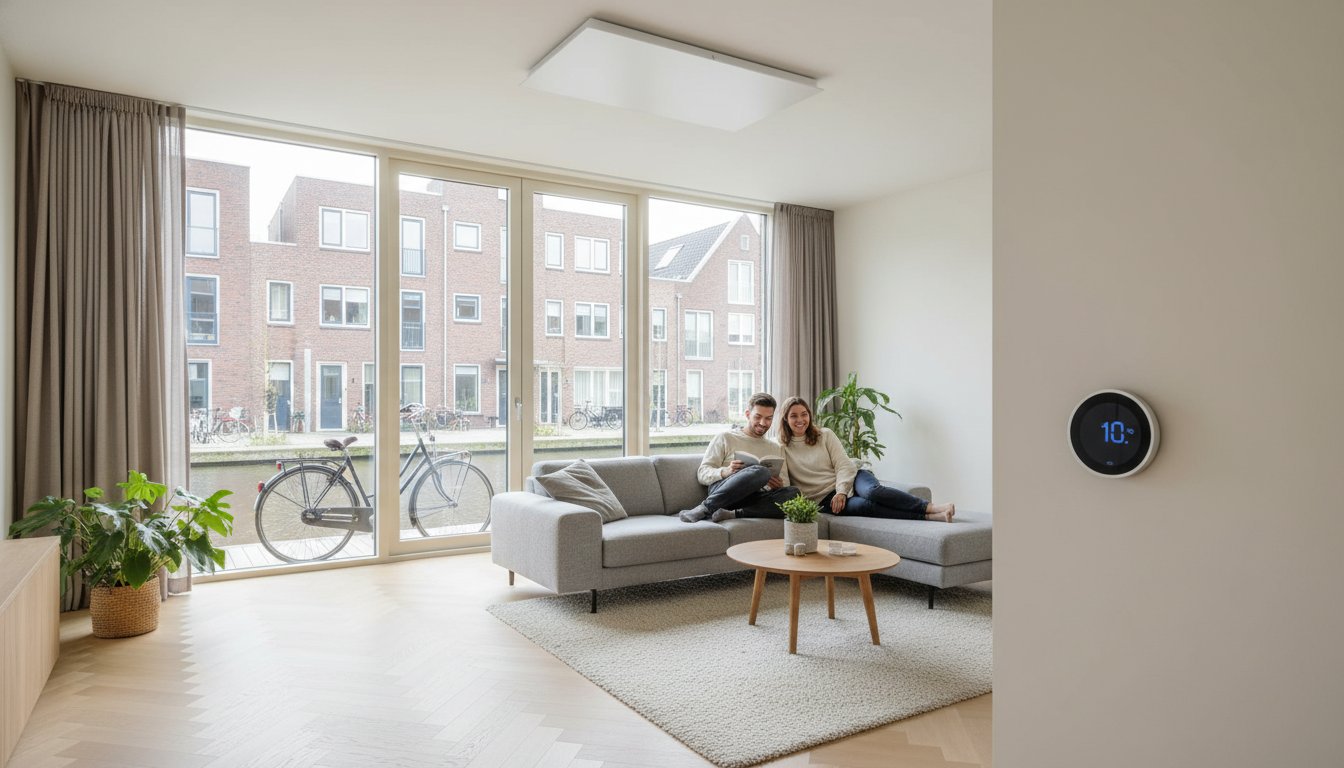
Illustration: the controller display is schematic. The value shown is neither a measurement nor a recommended room temperature.
IR heating panels are electrical appliances that can provide thermal comfort on a wall or ceiling. A useful comparison looks beyond material and watts. We help assess operation, version, installation and controls together for your space or customer project.
Key points
Check application, heat demand, mounting and controls using the exact model. Electrical conversion efficiency, radiant fraction and savings differ. An attractive or expensive panel does not suit every room, and low price does not prove poor operation.
Operation and the meaning of efficiency
A panel converts electricity into heat and releases it through radiation and convection. People and surfaces absorb radiant heat directly; air warms too. Ordinary radiators also use both. The difference is not simply heating objects versus heating air.
Resistance heating converts nearly all input electricity into heat. A product’s radiant share needs separate measurement. The public description of IEC 60675-3:2020 concerns radiant-performance measurement methods. Referencing this standard is neither a complete heating plan nor evidence of lower running costs. Even a high radiant share is not a fixed savings percentage: useful distribution, demand, controls and operating time determine results.
Walls and furniture store previously supplied heat and release it later. This creates no energy and does not remove the need for insulation or ventilation. Radiation may change the sensation at a lower air temperature, but fixed equivalence between 18 and 21 degrees cannot be promised generally.
Comparing versions and finishes
Metal, glass and mirror differ in appearance, weight and construction. Compare input power, exact dimensions, weight and permitted mounting. Use product data for warm-up and lifespan rather than inferring from material alone. A hybrid may have a different heat ratio, but ordinary panels emit convection too.
Prints, colours and lighting frames must be available and approved for the heater. Check whether a mirror heats the room or only its surface. With lighting combinations, heat and light must each suit the space and, where needed, operate independently.
The room has its own requirements
Bathrooms need assessment of moisture, position and electrics. Bedrooms and living rooms need distribution matching occupancy and hours. Panels do not treat allergies or eliminate dust. Use towels only on versions expressly designed for them.
Comparing other heating systems
Local electric heating may suit a briefly used spot if sufficient heating elsewhere is avoided. Primary heating needs heat-loss and total-cost calculations. Compare a heat pump too: under suitable conditions it can deliver more heat per kWh than resistance heating.
A socket alone is not always enough for safe installation. Mounting, controls, cables and electrical capacity may need work. Low maintenance does not remove all inspection or repair. Check warranty and expected lifespan per version.
Supporting installation and positioning choices
Calculate heat loss at the intended temperature first. Include windows, external walls, insulation, ventilation and use. Then select output and distribution. Fixed watts per cubic metre or building age alone are not a complete plan.
Wall or ceiling mounting must be permitted. Use suitable fixings and keep coverage clear. No fixed radiant angle applies to every panel. Include windows and external walls in heat loss and check coverage and safety clearances; no general glass rule replaces a positioning plan.
Have fixed connection, protection and simultaneous load checked by a qualified installer. Use only instructed mounting and connection. A panel must not be recessed or covered merely for appearance. Hot surfaces can burn.
Controls and the energy balance for later use
Choose compatible controls with a representative sensor. Wireless, apps or self-learning functions are not necessarily needed or better. Check actual features and offline operation. Solar panels do not cover demand at every moment, particularly cold winter evenings.
We help private and business users, installers and wholesalers. Share plan, photos, insulation and use and finish preferences. We discuss suitable versions, documents and a proposal clearly describing parts and work.
Assess the complete proposal
Compare purchase, installation, expected electricity and maintenance under equal conditions. Include hot water and cooking for full gas-free use. A positive choice follows the complete plan, not universal claims of maximum efficiency or health benefits.
Frequently asked questions
How do I calculate consumption?
Multiply input power in kilowatts by actual hours. A 1 kW panel operating continuously for one hour uses 1 kWh. Multiply by your tariff for cost. Compare savings only at the same heating performance and count extra local heat when primary heating stays unchanged.