
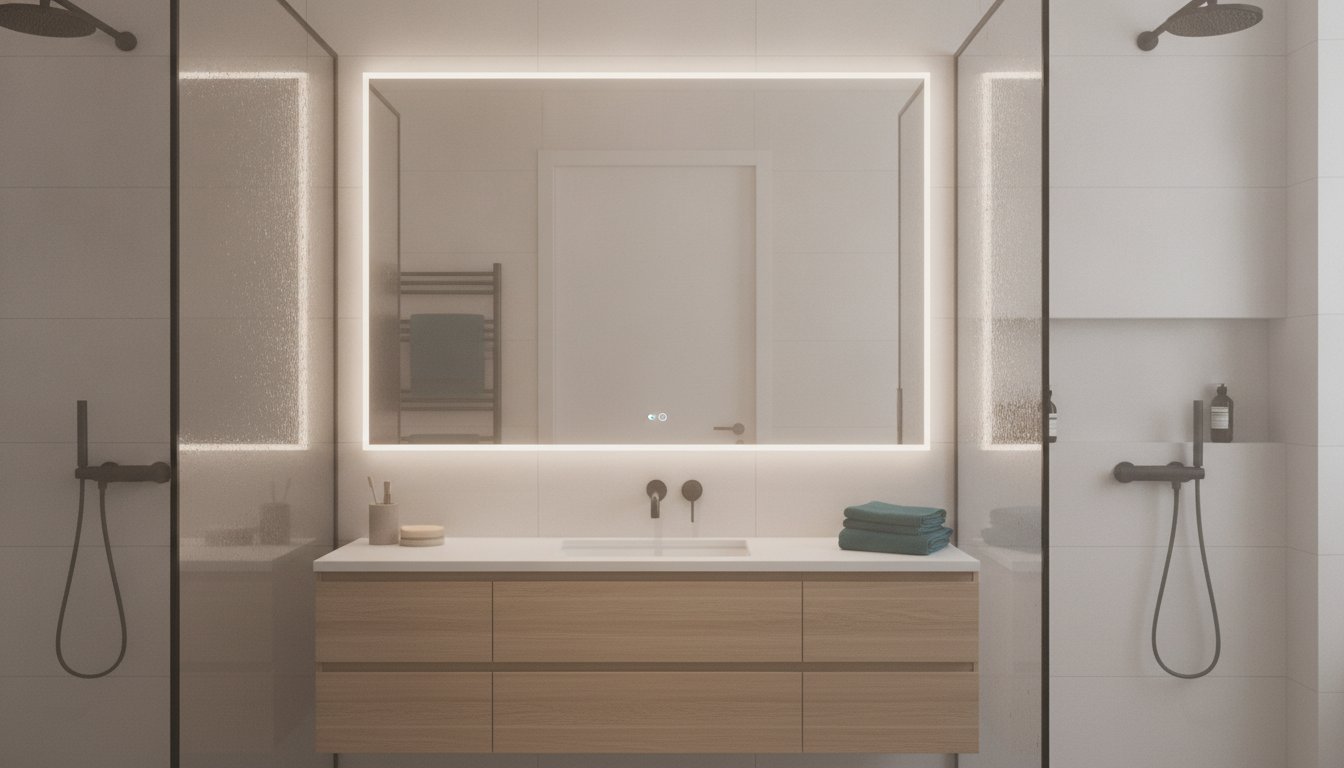
A comfortable bathroom needs more than a new heating panel. Heat, ventilation, moisture production and building quality work together. Infrared heating can play a role, but does not automatically make a bathroom dry or mould-free. Start by assessing what the existing room needs.
This guide focuses on the relationship between bathroom comfort and moisture. We advise private and business end users and support installers and wholesalers in selecting and applying suitable products.
Key points
Warmer surfaces may be less prone to condensation, but moisture causes remain a separate concern. Compare panels using actual data. Assess heat loss and match mounting and controls to use. Have the complete electrical arrangement assessed for the actual bathroom.
What is infrared bathroom heating and how does it work?
An electric element heats the panel, whose surface releases radiant and convective heat. People, tiles and other surfaces absorb some energy, while the air also warms. Those surfaces subsequently exchange heat with their surroundings. This does not automatically eliminate ventilation losses or cold downdraughts.
Matching warm-up time to the routine
The time until the panel is warm differs from the time until the entire bathroom is warm. Construction, insulation, starting temperature and ventilation influence both. A general five-to-fifteen-minute promise therefore does not suit every project. Check your room’s actual warm-up time and schedule accordingly without unnecessarily maintaining a high temperature all day.
Understanding bathroom moisture and condensation
Condensation may occur when moist air meets a surface cold enough relative to the dew point. A warmer surface may limit this locally. Radiation does not, however, guarantee drying a wall from within or remove water vapour from the room. Ventilation removes moisture; leaks, thermal bridges or other causes may require additional measures.
Persistent mould requires investigation of its cause. Extra heating alone may be insufficient and increase energy costs. A panel is not an air purifier and provides no medical benefits. Even without a fan, natural convection, dust and cleaning requirements remain.
Assessing mirror demisting
A heated mirror may mist less on its heated area if temperature is sufficient. Moisture load and warm-up time also matter, and edges may behave differently. Distinguish demisting film from a room-heating mirror panel. A clear patch is not evidence of adequate bathroom moisture removal.
Comparing bathroom panel versions
Glass, metal and mirror have different design and maintenance characteristics. Check weight, glass safety, surface temperature and cleaning products by model. Glass is not automatically immune to limescale, and a metal panel does not suit every ceiling. Ask for actual construction and permitted mounting.
Wall or ceiling mounting follows both heating design and product permission. Furniture, shower screens and towels may obstruct radiation. A ceiling panel does not guarantee a warm floor like floor heating. A lighting combination also needs suitable light distribution, connections and separate controls. Colours and print options vary by product.
Matching output and installation to the room
For complete bathroom heating, determine heat loss from construction, glazing, ventilation and target temperature. Volume or area alone does not give reliable wattage. A six-square-metre bathroom therefore does not automatically need 1050–1500 watts. A larger panel does not automatically reduce consumption and may require extra supply capacity.
Have the actual position and electrical installation assessed by a competent installer. Panel, receiver, switch, protection and connections must be suitable together. Do not infer suitability from an IP marking alone. Follow the manual for moisture exposure, clearances and accessibility. Removing a plug or putting a box behind the panel is not permitted merely because it looks tidier.
Control by use and measure in the right place
Choose a compatible thermostat and place its room sensor where temperature is representative. Schedules may follow morning and evening use but must allow warm-up time. Wi-Fi or window detection is not required for every effective control. Check functions and behaviour after power or connection failures.
Our advice for your bathroom
Send photos, a floor plan and information on ventilation, insulation and existing heating. Tell us whether you want extra comfort or replacement of the full heat supply. We help private and business end users weigh options and coordinate documentation and products with installers and wholesalers.
Plan heating and moisture management together
Ask us for a heating proposal and discuss moisture or ventilation problems with the relevant specialist too. A suitable panel may form part of the solution, with clear limits to what it can achieve alone.
Frequently asked questions about infrared bathroom heating
Does a mirror always consume less than a radiator?
No. Compare the same heat demand and operating times and calculate costs using your tariffs. Existing radiator controls matter too. Mirror shape does not prove lower consumption, and less gas may coincide with more electricity.
What maintenance is needed for ongoing use?
Follow product instructions for cleaning, cooling, fixings and checks of cable and controls. Avoid unsuitable cleaning products. Lifespan, repair options and warranty vary by version; European origin or absence of a pump does not replace those conditions.