
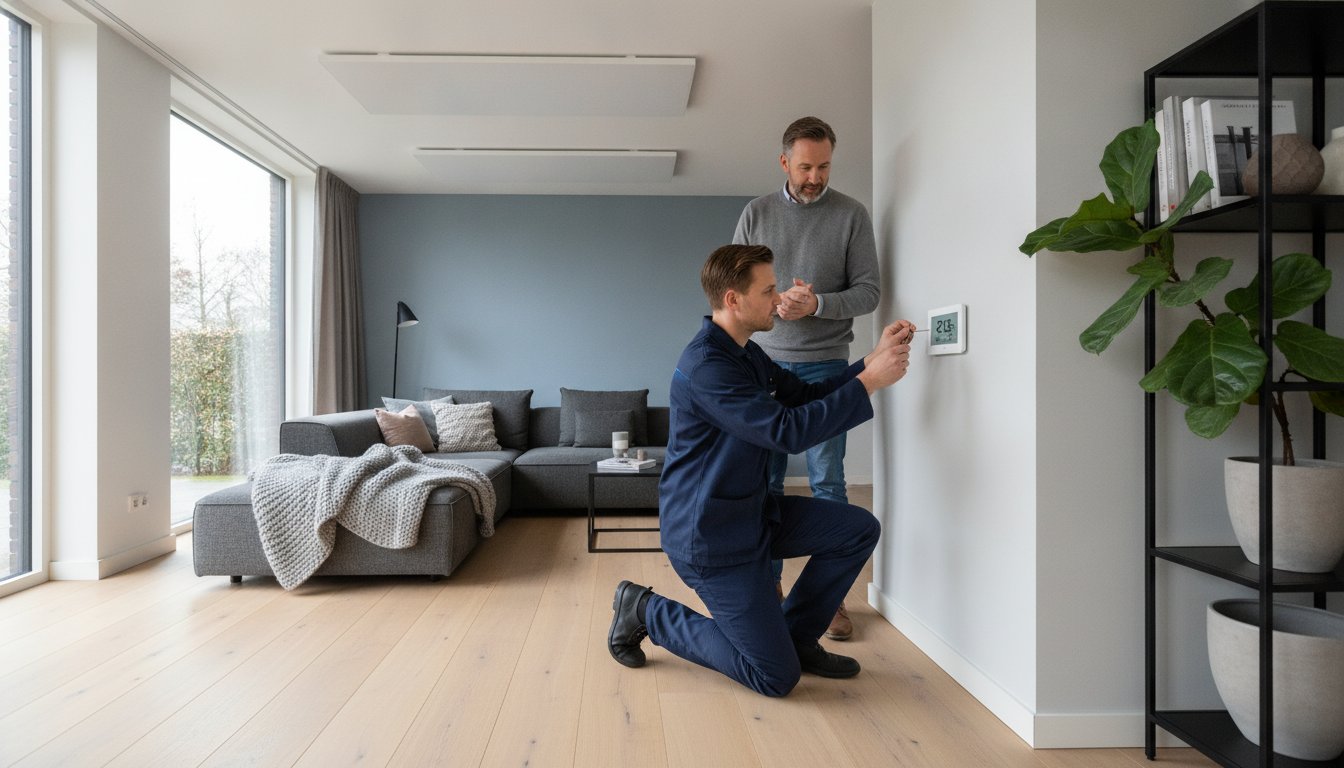
Infrared heating with a thermostat involves more than a panel and a dial. A usable system needs sufficient heating capacity, an appropriate temperature sensor and switching equipment suitable for the panel. With a complete kit, check which components are included and what is still required.
This guide follows the complete combination, from sensing and switching to room controls and handover checks. Smart thermostats can limit unnecessary running hours but cannot compensate for insufficient insulation or an unsuitable panel. Fixed savings or perfect temperatures are not universal product promises.
Key points
Assess panel, sensor, controller and receiver together. Ask about permitted loads, mounting positions, compatible communication and fault behaviour. Judge built-in sensors by their specified application rather than rejecting them automatically. Have installation and initial operation checked demonstrably.
Control means managing heat demand
Room controls compare a measured temperature with a setpoint. The output switches a panel or commands a suitable receiver. Not every thermostat reduces voltage or modulates power: many combinations switch the supply on and off. Controls mainly change when and for how long the panel heats.
Consumption depends on heat loss, comfort demand and running time. One degree does not produce the same percentage saving in every building. Even accurate thermostats cannot guarantee no fluctuations. Check specifications and current documentation for the intended combination; Wi-Fi or a weekly timer alone does not prove complete compliance with all applicable requirements.
From temperature sensor to switching output
A built-in thermostat may be part of a purpose-designed panel. An external room thermostat provides a separate sensing point. Neither is inherently always better: assess position, design and instructions. Separate sensors should measure representatively without strong sun, draught or nearby heat effects. Follow manual heights and clearances.
For receivers, check output type, supply voltage, load type and maximum permitted load. Multiple panels require total-load and supported-receiver checks. Circuit and wiring matter too. A plug-in panel is not automatically suitable for control by any external switch.
Comparing communication and operation
Wired systems have a physical connection; RF uses compatible transmitters and receivers; Wi-Fi may enable remote operation. Capabilities vary by combination. Sharing a frequency or mentioning Zigbee or Matter does not guarantee every function works with every platform. Check supported models, gateways, functions and any account requirements.
Ask what works after internet or radio loss. Check low-battery warnings and recovery after power failure. Wireless controls are not inherently unreliable, but have no universal indoor range of thirty to fifty metres. Test the actual location and recheck after layout changes.
Matching controls to each room
Several living-room panels may share a zone if use and technology support it. Separate rooms often need individual schedules. Independent air temperatures do not automatically arise within one open room. Coordinate different heat sources to prevent unnecessary overlapping operation.
For bathrooms, check each component at the exact position. An IP code or concealed receiver does not prove safe use. Assess instructions, zone, connection, access and protection together. With mirrors, distinguish room heating from demisting; switching off may reduce glass warmth.
At work, schedules or presence sensors can help if they recognise actual use. Someone sitting still at a desk should not be mistakenly treated as absent. Electric floor-heating controls and limits must match the system and floor; floor and room sensors are not interchangeable.
Ordering the complete combination
We help private and business end users, installation companies and wholesalers. Provide room details, panel models, quantities, existing wiring and control preferences. Ask whether receivers, sensors and other necessary components are included. This clarifies the purchase and remaining installation checks.
Check the system at handover
Test heat demand, shutdown and schedules per zone. Keep manuals and label which receiver serves each room. Assess comfort during typical use and change one setting at a time. Follow cleaning, battery and connection-check instructions. Service life and warranty are different and vary by version.
Frequently asked questions
Which temperature should I set?
Choose a suitable starting point for room use and assess comfort at the occupied location. There is no universal 18-to-20-degree setting or fixed equivalence with central heating. Setbacks must also consider moisture, frost and other occupants.
Can I make the connections myself?
Follow instructions for an approved plug-in combination and check suitability and load. Have fixed wiring, additional switchgear and installation changes carried out by a qualified installer. Do not cut off plugs or connect boiler controls based on appearance alone.