
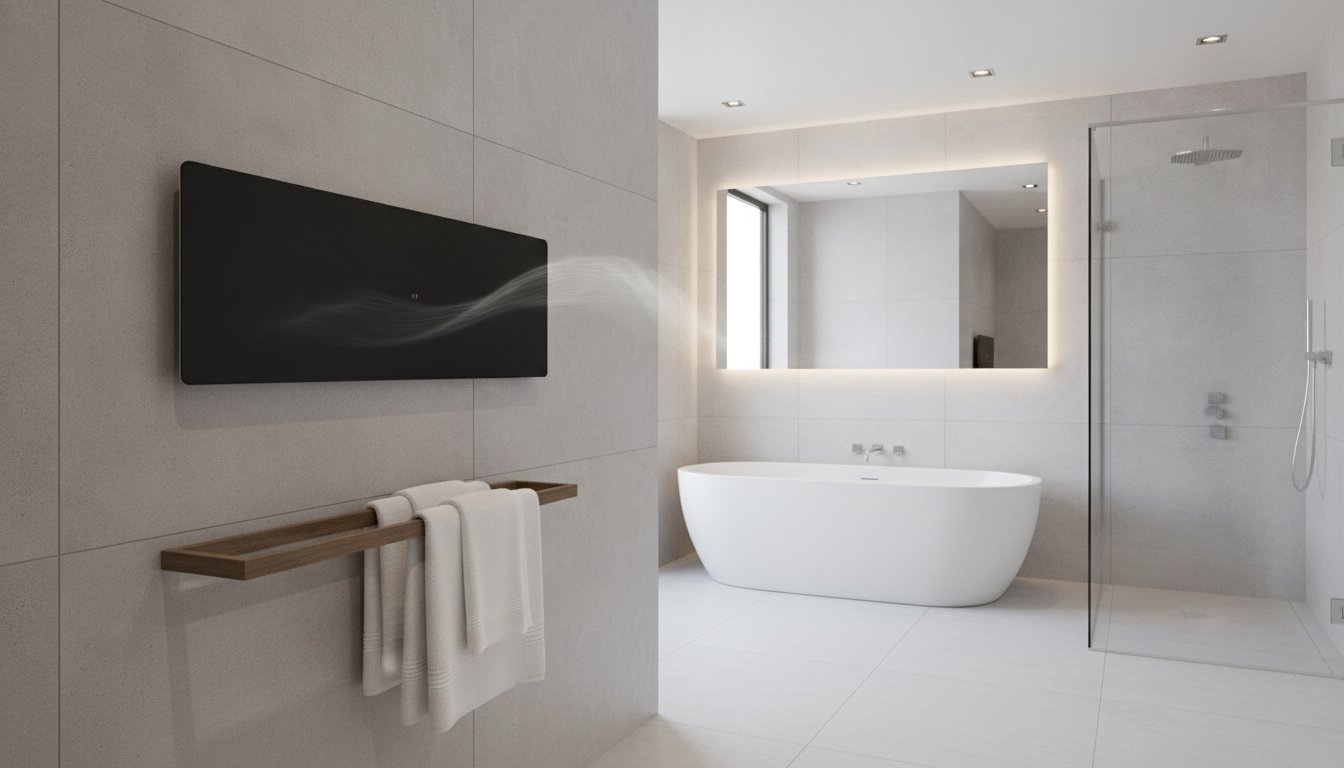
Illustration: the lines beside the panel have been added. Infrared radiation is not visible. Follow the chosen appliance’s instructions for installation.
If you are looking for an infrared heater for the bathroom, first examine the exact appliance. A compact panel, a heater with a visibly hot element and a mirror panel may differ greatly in warmth and installation conditions. The right choice follows from where you want warmth and the application the manufacturer permits.
This guide helps assess differences without declaring one type best in advance. We advise private and business end users and support installers and wholesalers with a suitable bathroom plan.
Key points
Choose by product application and heat demand, not the word infrared alone. Check mounting, clearances and electrical conditions together. Retain ventilation and address moisture problems separately. A radiant heater can provide local comfort but does not guarantee a lower bill or the same temperature everywhere.
When is an infrared bathroom heater suitable?
Extra heat at the basin or while drying can feel pleasant, especially where existing heating provides insufficient comfort. First see whether adjusting that installation or its operating times helps. For a new source, determine whether it should provide supplementary or complete bathroom heating. These tasks require different assessments.
A source may emit radiant heat before the whole room warms up. Still, warm-up time and intensity vary by model. A fixed lower air temperature with unchanged comfort does not apply to everyone. Include clothing, damp skin, position and distance, and match desired temperature to users.
The technology behind radiant heaters: safety and heat emission
A hot element or panel surface emits radiation and also causes convection. Spectrum and surface temperature relate to construction. Wavelength terminology alone does not determine suitability for a particular bathroom position. Check intended application, distance, mounting height and permitted operating time in documentation.
Have the complete safety design assessed
Have a qualified installer assess the exact room and mounting. Water exposure, product approval, protection, connection and controls belong together. An IP rating is just part of that assessment. Do not use an abbreviated zone table as permission to place a heater near a shower or bath.
Hot surfaces and intense exposure need attention even when correctly connected. Consider children and other vulnerable users. A towel may only rest on an appliance or holder if the manufacturer permits it. Overheat protection does not replace clearance and correct operating duration.
Comparing types of bathroom heating
A radiant heater may target a limited zone; a panel system may form part of a whole-room plan. The name does not automatically determine capability. Complete heating requires a heat-loss calculation. For local warmth, assess sight lines and desired duration. More installed output is not inherently more economical.
Mirror panels and towel functions
A mirror panel can save space by combining functions. Demisting and space heating remain separate properties. Heated glass may mist less depending on temperature and moisture, but does not remove water vapour. A towel dryer is likewise not automatically an adequate room heater. Check actual product functions for every combination.
Positioning an infrared bathroom heater
Draw occupied spots: basin, drying area and other comfort zones. Check door movement, shower screen, tall cupboards and other obstacles. Choose only a wall or ceiling position permitted for the model and follow specified clearances. The centre of the ceiling is not the best answer for every bathroom.
A ceiling panel does not automatically make the floor comparable to electric underfloor heating. Results depend on radiation received, floor construction and operating time. Have substrate, fixings, cable route and heat load at connections assessed. Fixed electrical work requires suitable execution by a qualified installer.
Controls for short and longer use
Match programme and sensor position to warm-up time and desired temperature. Presence control is useful only if the source delivers heat in time and stationary users remain detected. Wifi is a control option, not evidence of compatibility or savings. Also check fault behaviour and manual operation before choosing the combination.
Our advice for your infrared heater and bathroom
Send a drawing, photos and information about existing heating and ventilation. We discuss comfort goals with private and business customers. We support installers and wholesalers with available product data and project coordination. Together we check available version, dimensions, warranty and supply for the specific model.
Request a proposal matching application and installation
A good heating plan describes not only a heater type but also placement, controls and conditions. Ask us for advice or a quotation you can assess with the installing contractor.
Frequently asked questions about infrared bathroom heaters
Does the heater prevent mould on walls?
This cannot be guaranteed. A warmer surface may experience less condensation, but the heat source does not remove moisture or repair leaks. Assess ventilation and building causes in persistent problems. Infrared does not replace cleaning or provide general health treatment.
How do I compare consumption and maintenance?
Use total input power and actual on-time. An 800-watt appliance running continuously at full power for half an hour uses about 0.4 kWh. Multiply by your tariff and include other heating. For maintenance, follow instructions on cleaning, cooling and checking fixings, cable and controls; low-maintenance is not maintenance-free.