
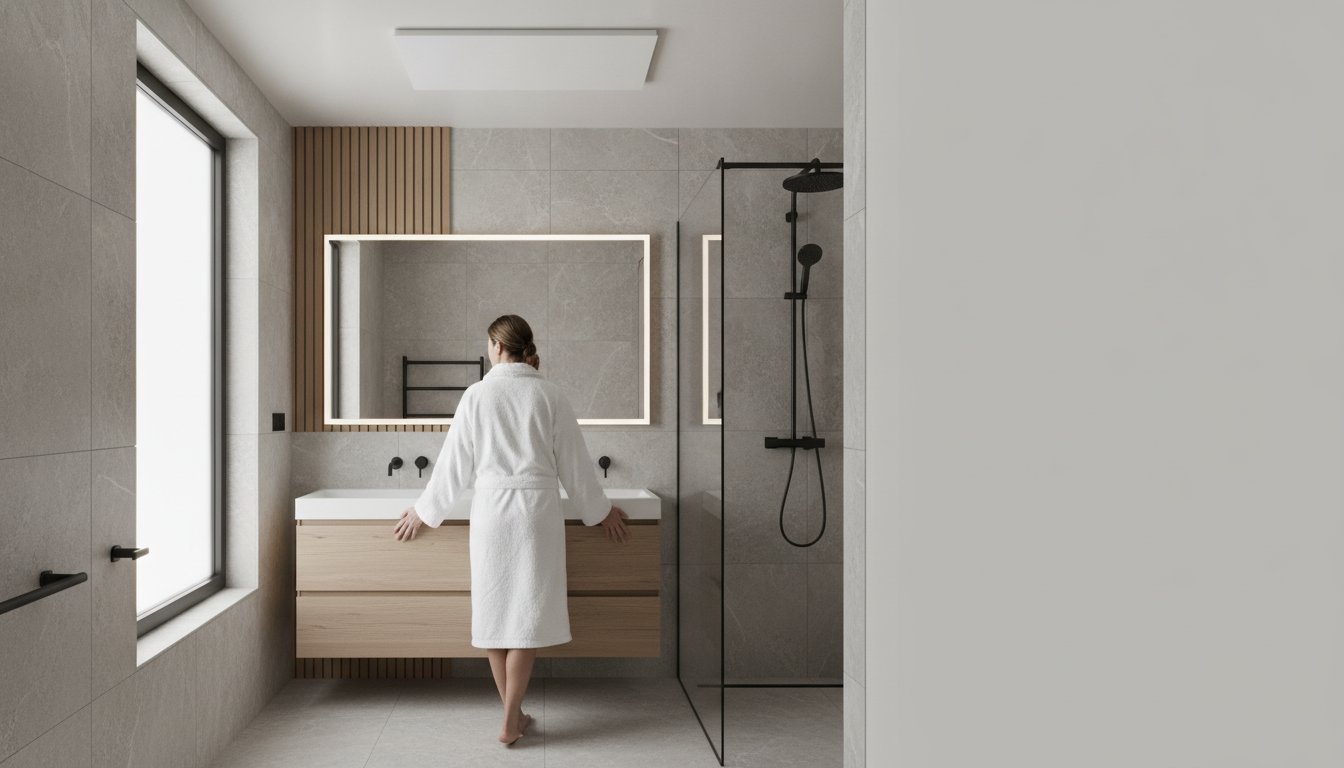
If you are looking for an infrared bathroom heater, first check what the product name means. A lamp heater, heated panel and mirror heater have different applications. A sound choice depends on the specific model’s approval, position and intended use. This guide helps assess the differences and considerations.
Start with the permitted application
A patio or industrial heater is not automatically suitable for a bathroom, even with a high IP rating. Start with the manual and model code. Have product, placement, electrical protection and exposure assessed together before ordering.
Different devices, different heat delivery
A heater with a hot element and reflector can deliver targeted warmth. A flat panel may have a different temperature response and coverage. Both also transfer heat to air and surroundings. The name heater or panel alone does not establish wavelength, response time or suitability for prolonged use. Use manufacturer product data.
Powerful radiation is not automatically desirable at short distance. High exposure can thermally affect skin and eyes. Follow prescribed distance, direction and operating duration. A product name or IP rating does not assess this exposure risk.
Targeted warmth and total comfort needs
A suitable supplementary heat source can be pleasant at a fixed use point but does not thereby heat the whole bathroom. Fast element response does not guarantee instantly warm tiles or fixed savings. Compare with existing heating for the same usage times, target temperature and conditions.
A panel does not make air dust-free and a heater does not remove shower moisture. Warmer surfaces can help limit condensation; ventilation, cleaning and leak repairs remain necessary. Neither device guarantees a mould-free bathroom or improved health.
Product choice and power calculation
Check permitted indoor and bathroom use, mounting orientation, dimensions, surface temperature, clearances and controls. Whole-room heating depends on heat loss through the building envelope and ventilation. Local radiant warmth also requires assessment of coverage and distance. A fixed 60-to-100-watt rule per cubic metre or blindly adding power is insufficient.
Choose compatible controls for the device. Timers, thermostats, dimmers and presence detection are not interchangeable functions. Not every heater may be controlled by an arbitrary dimmer or plug-in thermostat. Have the component combination and permitted electrical load checked.
Installation and electrical safety
Have a competent installer assess bathroom layout, manufacturer instructions and current local installation requirements together. An IP code describes a protection characteristic but does not generally permit a position near a bath or shower. Dutch and Belgian rules differ. Do not adopt zone distances or safe locations without assessing the actual situation.
Follow specified fixings and clearances from textiles, furniture and building materials. Consider hot surfaces and vulnerable users. Check load capacity, cable route, supply and combined load with other devices. Have fixed connections and necessary alterations professionally completed and keep the heater accessible for maintenance.
Advice for your bathroom or customer project
We supply private and business end users and work with installers and wholesalers. Send a plan, photos, dimensions, insulation data, existing heating and intended usage times. Identify the planned mounting point and available connection. We discuss suitable product types and the technical assessment required.
Include running costs and maintenance
Calculate consumption as input power in kW multiplied by actual operating hours. A 1.2 kW device continuously at full power for half an hour uses approximately 0.6 kWh. This example predicts neither savings nor annual costs. Include purchase, installation, controls, maintenance and your total electricity tariff in the comparison.
Frequently asked questions
Can I keep the existing radiator?
A combination may be possible if both heat sources are suitably controlled. If removing a radiator, have the heating installation and pipes assessed. A local heater’s power and coverage do not prove it is sufficient as the sole heat source.
Does a heater need no maintenance?
Follow cleaning, inspection and part-replacement instructions. A lamp, reflector, connection or control may need maintenance. Let the device cool and work only according to the manual. Expected lifespan is not a warranty for every part.