
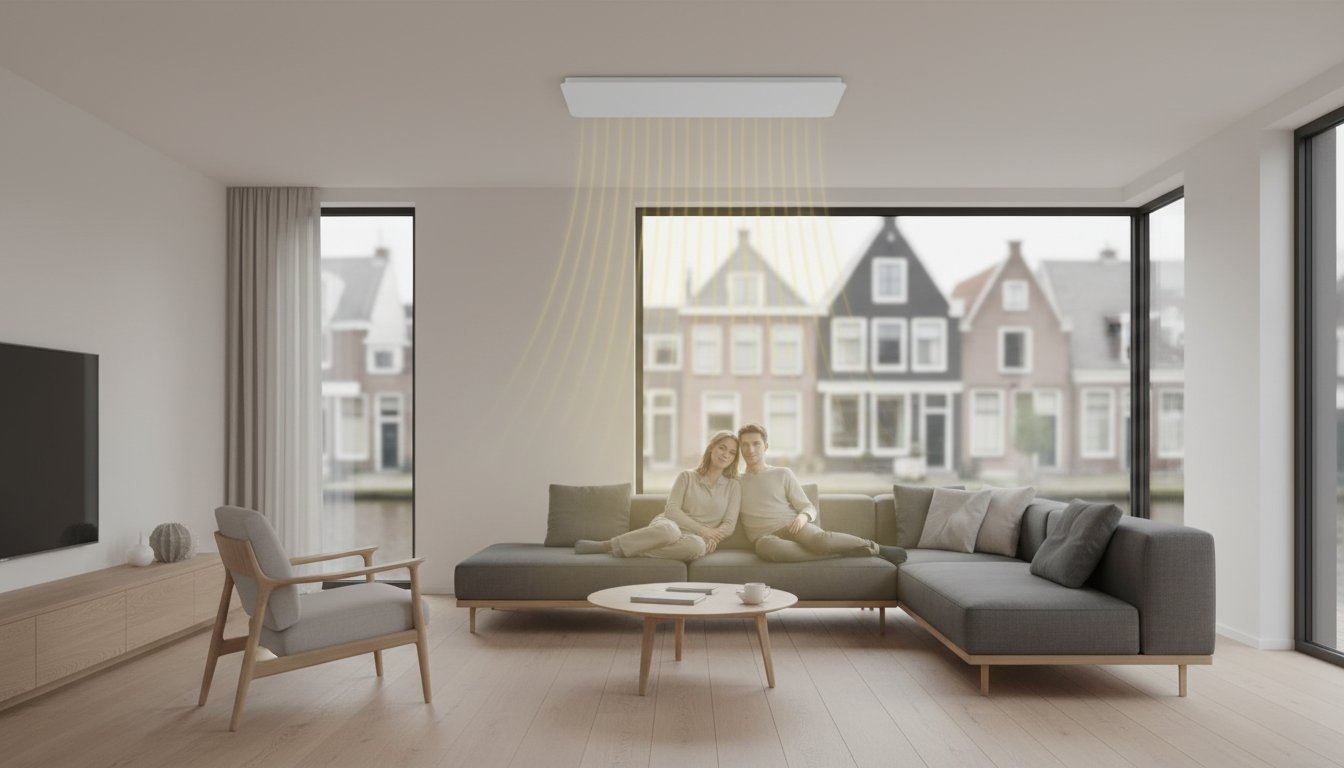
Illustration: the yellow lines have been added to represent heat transfer. Infrared radiation is invisible, and the image shows no measured coverage or heat distribution.
Buying infrared panels starts with a complete overview of the offered product and application. You want to know which model is supplied, where it may be mounted, which controls are needed and which calculation supports the proposal. This buying guide provides a practical framework for private customers, business end users, installation companies and wholesalers.
What makes a good purchase?
Compare more than wattage and appearance. Check suitability for your application, mounting data, measurement claims, complete parts list, warranty and running costs. Keep the model number and associated documentation. Later questions about expansion, controls or service can then remain specific.
First determine the heating’s role
Supplementary warmth at a seating area calls for a different assessment from primary heating for a home. Describe occupancy, usage times, desired temperature and existing installation. For primary heating, heat delivery at design conditions must match the heat loss of all relevant rooms. An energy label, construction year or general watts-per-metre rule is insufficient.
Include alternatives in the comparison. An electric resistance heater converts electricity into heat; a heat pump can also move environmental heat. A panel may be practical for targeted warmth but is not automatically the most economical primary heating. Solar panels do not automatically make a home self-sufficient in winter either.
Read efficiency and measurement data carefully
A warm panel emits radiant and convective heat. Conversion of electricity into heat differs from the portion emitted as radiation. High coating emissivity does not prove that almost all electricity drawn reaches the user as useful radiation. For any percentage, always ask about the measured quantity, test method, conditions and exact version.
IEC 60675-3 describes methods for measuring the radiation efficiency of electric room heaters. Reference to this standard alone is not a product certificate, safety approval or guarantee of lower running costs. Check that a report actually applies to the offered model. A quality mark requires a defined product range and verifiable criteria.
A technical checklist for the quote
Ask about model code, exact dimensions, weight, input power, surface temperature and permitted wall or ceiling mounting. Assess output and size together: alongside sufficient heat, space must remain for prescribed mounting clearances. Check what is supplied: fixings, connection cable, thermostat, receiver and any sensors. A fitting connection or connector does not automatically prove compatible controls.
Choose material and finish according to the specific version. Metal, glass, mirror, RAL colour or printing do not automatically have a fixed performance level. For a bathroom, model approval, position and electrical protection determine suitability; IP alone is insufficient. For a workshop or industrial zone, environmental risks and coverage must also be assessed.
Which costs are included?
Compare a complete supply and installation. Include necessary electrical adaptations, controls, labour and any accessories. Running costs require heat demand, operating hours and your total electricity tariff. A panel drawing 600 watts uses approximately 0.6 kWh in one hour continuously at full power; a fixed twenty to thirty minutes switched on per hour is not a general fact.
Mounting and controls as part of the choice
Show the desired heating zone and obstructions on a floor plan. Ceiling mounting is not always better than wall mounting and has no universal radiation angle of 120 degrees. Follow model mounting approval, fixings and clearances. Check load-bearing capacity, access and combined electrical load.
Record which functions the selected controls support: time programme, Wi-Fi, app, window detection, energy measurement or building-management connection. These features are not standard for every panel. Position the sensor according to the manual, and have fixed connections and necessary adaptations carried out by a competent installer.
Support with supply and project selection
We are happy to discuss a proposal for your home, business or customer project. Provide dimensions, insulation data, usage times and wishes for controls and finish. Installation companies and wholesalers can also contact us about collaboration and project supplies. We identify available product combinations and information still needed.
Keep agreements and documentation
Before ordering, check exact version, scope of supply, mounting, warranty terms and service procedure. Expected service life is not a warranty period. Low maintenance still means cleaning and checking according to the manual. Keep invoice, model code, manuals and installation data together.
Frequently asked questions about buying
Does a more expensive panel guarantee better performance?
No. Compare measurements, finish, components, functions and warranty for specific models. A higher price or country of origin does not by itself prove lower consumption or a service life exceeding twenty years without performance loss.
Is a panel always safe for children and pets?
Hot surfaces may pose a risk. Choose model and position with accessibility in mind and follow distance and operating instructions. Overheating protection does not automatically prevent contact burns. Have doubts about application or mounting assessed.