
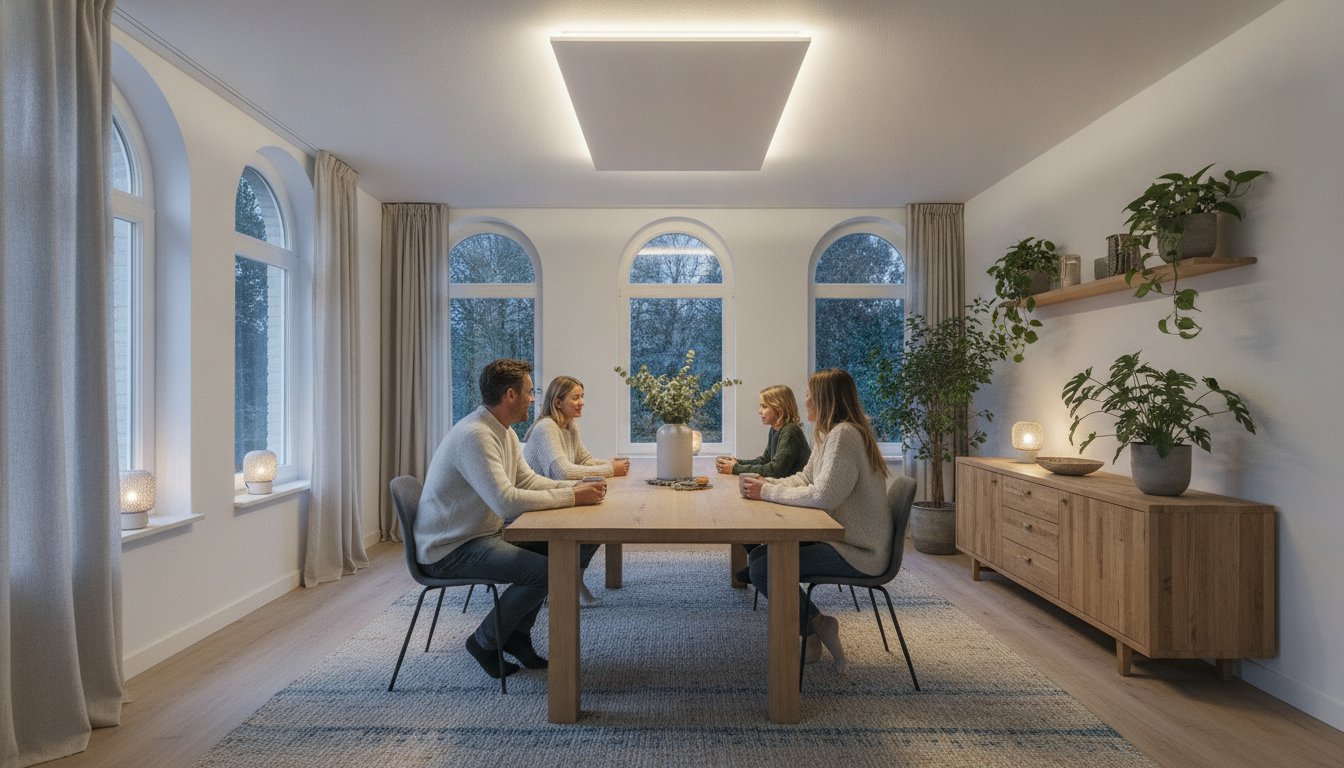
An infrared panel with lighting combines heat and light in one design. It may suit a bathroom, living room or workspace where a clean ceiling or wall is preferred. The best position for lighting is not automatically the best position for heating. Assess both functions separately before choosing a combined product.
This guide compares heating output, light quality, controls and mounting. An integrated LED edge may provide ambient light without replacing full task or room lighting. Space and cost savings also depend on what the new system replaces and how it is used.
Key points
Check heating output and light output as separate specifications. Ask whether light and heat work independently, which controls are compatible and whether LED components can be replaced. Also check structural support, wiring and approved position. An existing lighting point is not automatically suitable for the combined appliance.
What combinations are available?
Some panels have an indirect halo behind or around the heater. Other versions combine heating with a direct luminous surface or separate lights. Construction, materials and connections vary by model. A photograph of a halo says nothing about the amount of light reaching a desk or floor.
The heating section transfers heat through radiation and convection. Combining it with LEDs does not inherently make electric heating more efficient than a separate panel. The practical benefit may be design and fewer separate elements, provided both functions meet your needs.
Assessing heat and LED electronics together
Electronics must remain within the design’s temperature conditions. Do not assume universal thermal separation eliminates every heat effect. Follow specified clearances and ventilation space, using approved dimmers and supplies only. Do not attach separate LED strips to a heater without explicit approval for that combination.
The light source, driver, heater and controls may have different service lives. Ask about replaceable parts, servicing and warranty before purchase. An integrated light source may not be user-replaceable; that does not mean it is guaranteed to last as long as the heater. Origin alone does not prove these properties.
Applications: planning room by room
In a living room, indirect light may complement other lighting. Also check whether heat reaches seating and whether furniture obstructs radiation. A desk needs adequate task lighting as well as a pleasant atmosphere. A central ceiling position does not automatically distribute light and heat optimally for every layout.
In bathrooms, both heating and lighting components must suit the exact position. An IP44 label does not generally permit installation near a bath or shower. Assess product, zone, connection and electrical protection together. Ventilation remains necessary; the panel does not guarantee a dry or mould-free room.
Buying checklist: heat, light and installation
Heating output
For primary heating, assess demand using insulation, glazing, ventilation, dimensions and target temperature. A fixed wattage per cubic metre is insufficient. For supplementary heating, consider the occupied spot and existing heating. Panel quantity follows capacity and distribution; several small panels are not automatically better in every room.
Light output, colour and dimming
Compare lumens, light distribution and colour temperature. Lower Kelvin values look warmer; choose according to atmosphere and task. Consider colour rendering and glare too. CRI alone does not guarantee adequate room lighting. Check whether dimming and colour adjustment are actually supported.
Separate controls and connections
Ask whether light works without heating and vice versa. Check thermostat, light switch, required conductors and any receiver. An existing lighting point does not automatically provide suitable wiring, permanent supply, structural support or capacity. Have it assessed by a qualified installer before purchase and mounting.
Finding a suitable combination together
We advise private and business end users and also supply installers and wholesalers. Share a floor plan, ceiling height, photographs, lighting requirements and heating objective. We discuss models and mounting conditions, including whether a combined system is more practical than separate lighting and heating.
Checking and maintaining both functions
After installation, test heat and light separately and check schedules. Follow cleaning and inspection instructions and allow cooling before maintenance. Do not touch hot parts or cover the panel. Low maintenance does not guarantee that drivers, lights or controls never need replacement.
Frequently asked questions
How do I calculate total consumption?
For each function, multiply power input in kilowatts by actual operating hours and add the results. Include controls or standby where relevant. LEDs also use energy. A shared housing does not make that energy free or prove lower total costs than two suitable separate appliances.
What if light and heat need different positions?
Separate lighting and a separate heating panel may then be more suitable. Choose a combined product only where both functions work at the approved position. The aim is usable light and suitable warmth, not simply fewer visible appliances.