
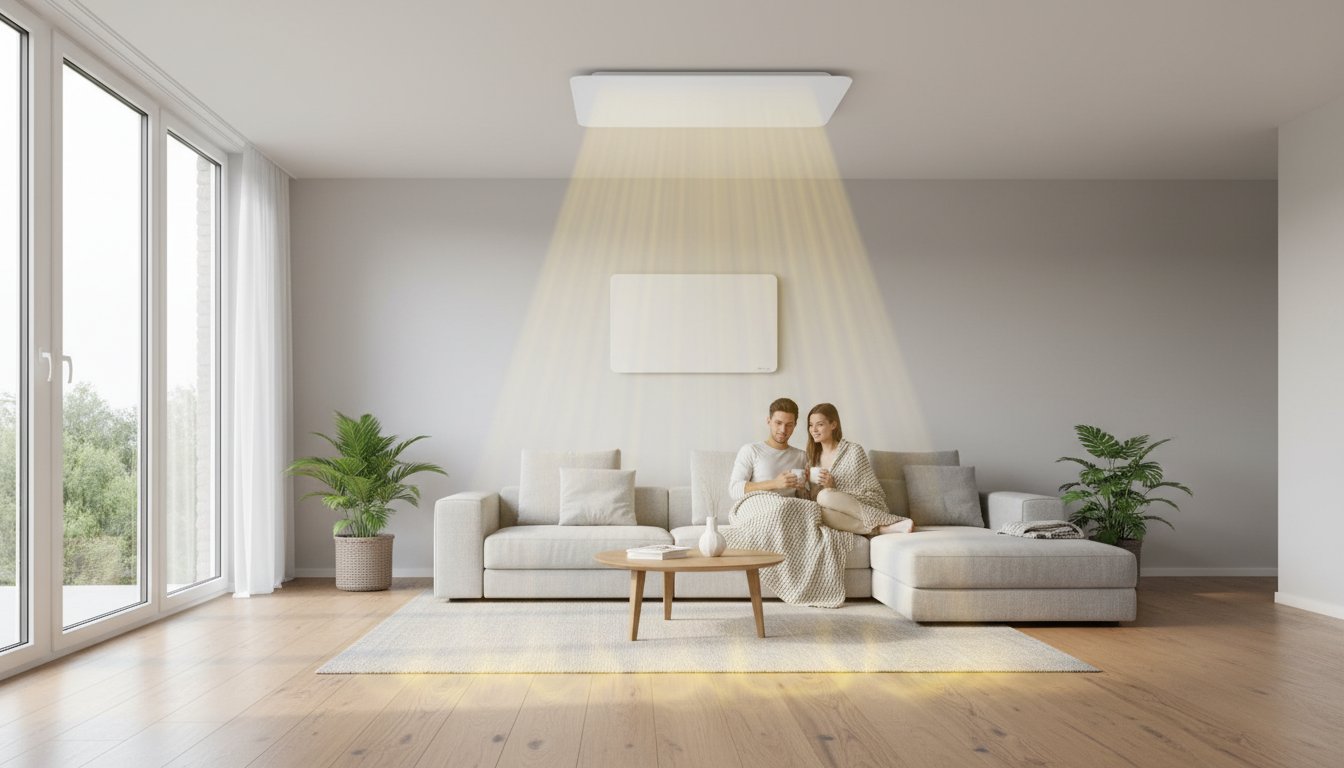
Understanding an infrared panel starts with three different questions: how does it transfer heat, how much heat does the room need and how is use controlled? They are connected but distinct. A high radiant fraction proves no fixed saving, and a hot panel does not mean the whole building is comfortable.
Key technical distinctions
Separate electrical input, radiant fraction, heat storage and running costs. Assess data by model and demand by room. Choose mounting and controls together. A generic material or temperature table does not replace the manual.
Radiation and convection in the same appliance
The electric element heats the panel. Its warm surface radiates towards people and surfaces and heats air by convection. Radiators and other warm appliances also radiate. Object and air heating are not absolutely separate. Distance, obstacles, surface temperatures, clothing and activity affect comfort; the same reduction in air temperature does not suit every user.
Reading thermal mass and measurements correctly
Walls, floors and furniture can store absorbed heat and release it later. This thermal mass already exists; infrared does not create it. Storage and cooling depend on material, starting temperature and heat loss. Heating surfaces proves neither deep wall drying, permanently dry construction nor reduced building heat loss.
IR-C identifies part of the spectrum, not an efficiency class. Emissivity describes a surface property, not the measured radiant fraction of a complete appliance. Use results with methods and conditions for the exact model. Resistance heating ultimately converts electricity to heat, but does not determine the kWh your heating aim needs.
Combining material, functions and surroundings
Metal, glass, ceramic, mirrors and printing provide different versions. Weight, warm-up, scratch resistance and mounting need model data. Industrial devices are not interchangeable with domestic panels. Desk heating is assessed as local supplementary heat, not whole-room heating. Bathrooms require water exposure, product approval and electrics to suit together; an IP code or mirror format alone is insufficient.
Designing mounting, controls and maintenance
Assess support, brackets, orientation and clearances under the manual. No universal side or front clearance or mounting height applies to every panel. Also check total simultaneous load, supply and protection. A fitted plug does not establish suitability of the complete connection.
Check whether controls switch on/off or use another approved method. Modulation, Zigbee, Wi-Fi and smart-home features are not standard. Choose compatible parts and test sensing, schedules and outages. Follow cleaning and checks; even panels without pumps or fans have connections and may contain switching components.
From technical data to a suitable proposal
We support private and business end users, installers and wholesalers with selection and supply. Share plans, photos, insulation and use. Define the room or zone and any retained heating. Assess product, controls and mounting together. Confirm warranties and responsibilities for calculations, installation and commissioning.
Checking comfort and costs after commissioning
Measure representative use and compare the same comfort demand, occupancy and outdoor temperature. kW times actual operating hours gives kWh. Include controls, installation, maintenance and retained heating in costs. Solar generation does not always coincide with demand or guarantee net-zero energy. A panel replaces neither ventilation nor moisture treatment.
Compare our infrared panels · See ceiling mounting considerations · Discuss your heating plan
Frequently asked questions about infrared panels
Is an energy label enough to choose primary heating?
No. Assess heat loss and output per room, mounting and electrical infrastructure. A label or fixed W/m³ figure is not a complete calculation. Controls and intended use also matter.
Do all panels reach the same temperature and last equally long?
No. Check temperature limits, mounting and maintenance for the exact version. Hot surfaces need safe placement; one generic height does not prevent every contact risk. Life depends on product, surroundings and use and is not a warranty period.