
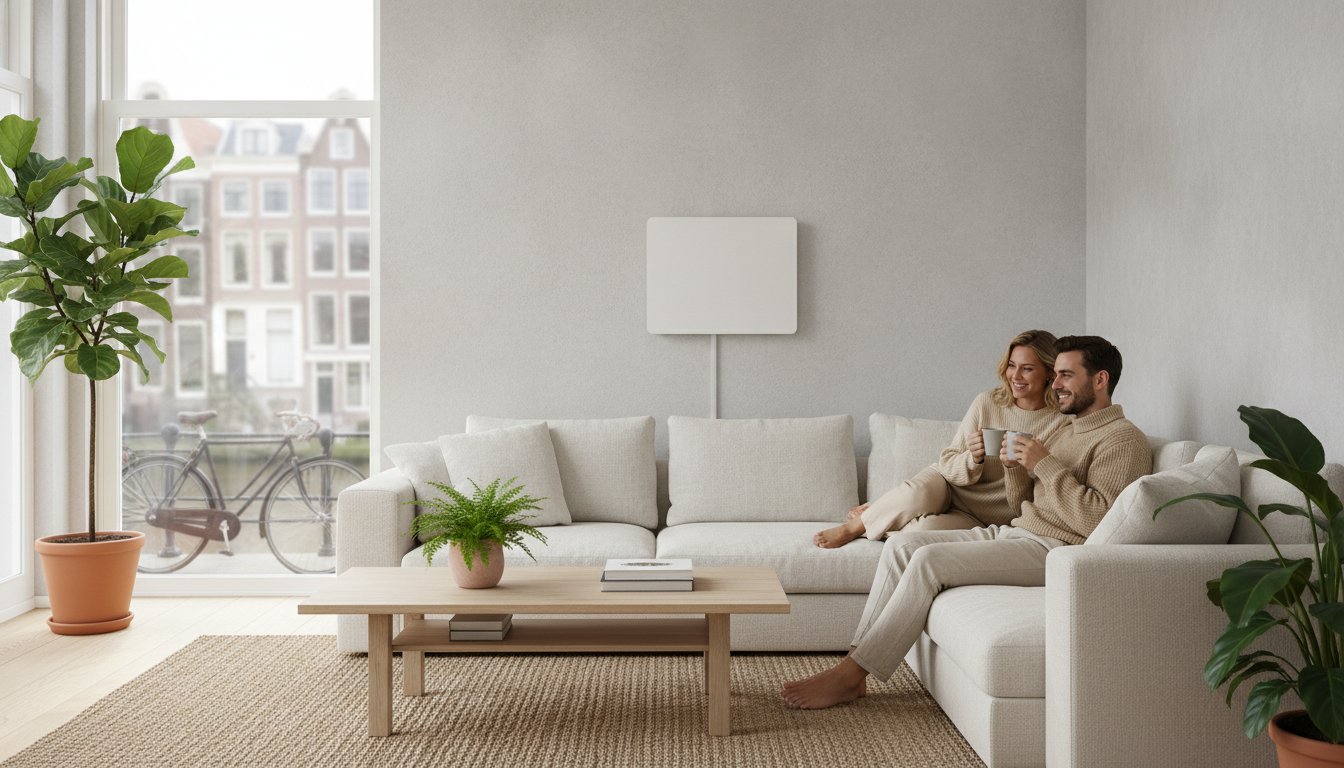
Infrared wall panels are best compared with product data alongside a sketch of the room. A size that looks good on the wall may not have the right capacity or mounting method. This guide helps turn dimensions and versions into a well-founded choice for a living room, workstation or other indoor space.
Key points
Record heat demand and available wall space separately. Check weight, orientation, connection method and clearances. Compare controls and required accessories for the model. Surface material, panel size or high price alone does not prove better efficiency or even warmth throughout the room.
How do infrared wall panels release heat?
An electric element heats the panel surface, which releases heat by radiation and convection. Distribution and temperature differ by model. Direct radiation can reach a comfort spot but is affected by distance, direction and obstacles. A suitable wall position therefore depends on where you want warmth.
The room continues losing heat through the building envelope and ventilation. Heated walls or furniture may release energy later, but this is previously supplied heat. Storage does not control humidity or guarantee the same comfort at 18 degrees as another system at 21 degrees.
Comparing infrared wall panels with your room
Decide whether the panel provides extra warmth or primary heating. For a whole room, insulation, external walls, glazing, ventilation and desired temperature matter. Have required output determined from heat demand rather than a general value per cubic metre. Also check whether the proposed panel number reaches intended spots.
Compare dimensions, weight, nominal output and permitted mounting. Use chosen-model data for surface temperature and warm-up time. Bigger does not automatically mean more even, and metal is not always faster than glass.
Measuring available wall space
Record free width and height of the intended position. Compare them with panel size and prescribed surrounding clearances. Draw furniture, doors and the connection point on the sketch. This avoids a panel fitting on paper while mounting or heat emission is obstructed in practice.
Check which thermostat and receiver are suitable and whether supplied. Controls must switch the correct load or command a suitable actuator. App control and energy measurement are different functions; ask what the chosen system actually offers.
Living room, bedroom, kitchen and workstation
In a living room, the panel may be a visible design feature or quiet wall finish. Printing does not change mounting conditions. In a bedroom, operating times and safe distance from bedding matter. A panel does not guarantee deeper sleep, absence of dust or prevention of dry eyes.
In a kitchen or at a desk, cupboards and a desktop may block radiation. Make the chosen heating spot visible on the sketch. A vertical version may only be installed that way if permitted by the manufacturer. A reception counter or treatment room also needs attention to varied users and accessible hot parts.
For bathrooms, model, zone, water exposure and electrical protection together are decisive, not IP44 alone. A heated mirror may reduce misting on its warm section but does not provide unlimited condensation-free visibility. Ventilation and addressing damp problems remain necessary.
Installation and maintenance with service access
Check wall material and load-bearing capacity before choosing fixings. Use model-specific brackets and prescribed clearance. Concealing cables must not compromise safety, access or cooling. A fixed connection is not automatically safer than a suitable plug connection; have the situation assessed.
Have total circuit load, protection and controls checked for fixed installations or uncertainty. Perform product tests and settings and keep documentation. Low-maintenance panels still require cleaning and checks; elements, connections and controls can wear or fail.
Our advice on suitable infrared wall panels
We support private and business end users, installers and wholesalers. Share photos, dimensions, insulation and operating times. We help consider the technical combination and desired finish. Request product-specific documentation, warranty and parts rather than following general origin or lifespan claims.
Making an informed wall-panel choice
Calculate consumption as kW multiplied by actual on-time. For primary heating compare a heat pump too, and for supplementary heating consider added and avoided energy together. Include purchase, installation and product-specific warranty in cost comparisons.
Frequently asked questions about wall panels
May I paint or apply stickers to the panel?
Only if the manufacturer expressly permits this for the model. Extra layers may change heat emission and safety. Prefer an approved colour or print version and retain prescribed clearances even for a decorative version.
Is brief touching safe?
Not automatically: hot surfaces can cause burns. Follow mounting and clearance requirements and prevent accidental contact by children or pets. Low thermal mass or a temperature limiter does not eliminate the risk.
Product information and further reading
For example, view the official Ecaros information on glass infrared panels to compare versions. Always use exact-item data for your infrared wall panels’ dimensions and installation.