
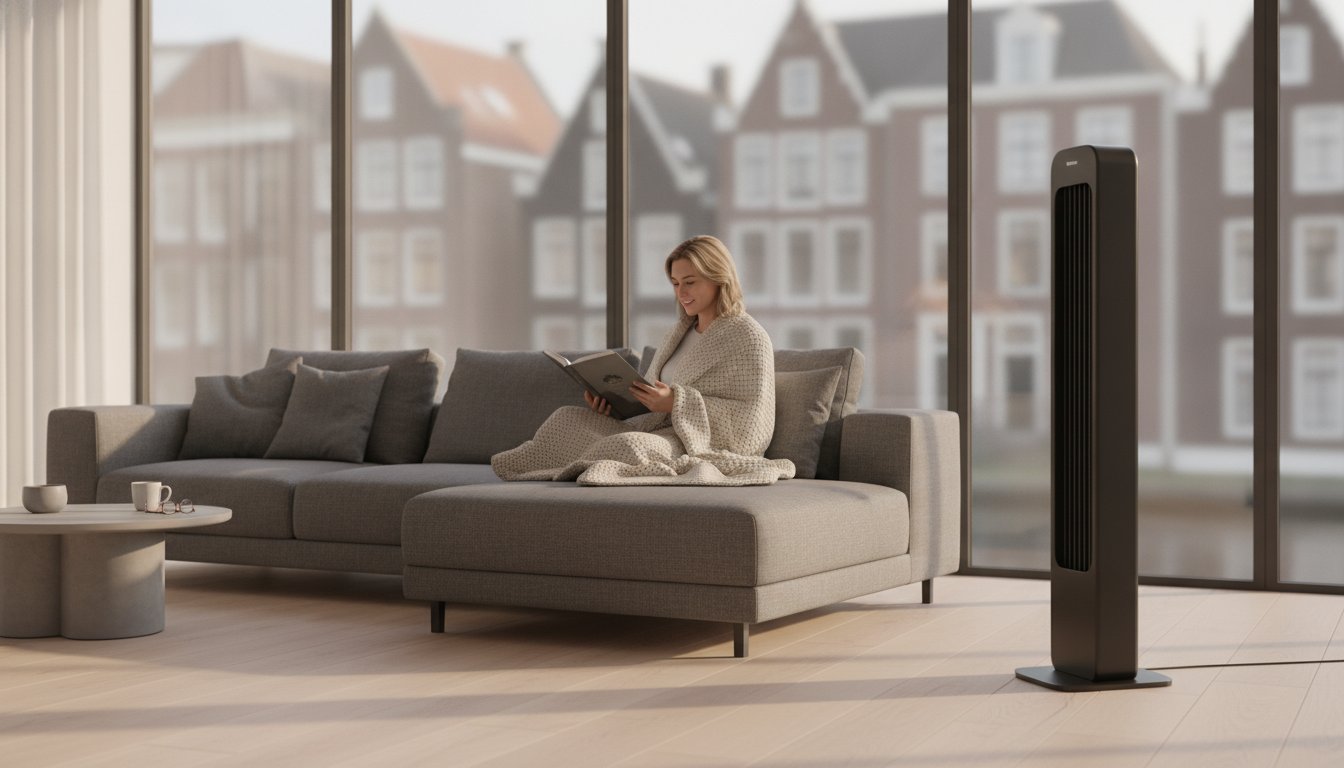
An infrared heating column can be a freestanding alternative when fixed mounting is undesirable. Its vertical shape is not a technical standard: columns differ in element, heated sides, base, controls and permitted use. First check whether the appliance is intended for indoors, outdoors or a specific workstation.
We discuss positioning, flexibility and running costs for homes and business premises. We advise private and business end users and support installers and wholesalers with product selection and projects.
Key points
A column radiates all around only if designed for it. Assess its actual heated surface and the seating or working position. Keep the floor setup stable, cables out of walkways and specified clearances free. A freestanding appliance is not automatically touch-safe or suitable for moving during operation.
What is an infrared heating column?
It is a vertical appliance using electricity to heat an element or surface. Warm parts release energy through radiation and convection. Depending on construction it radiates in one or several directions. The word column does not guarantee an even thermal island all around or that every corner of an open space is reached.
Assessing column shape and material
Round, angular or flat columns may look different and distribute heat differently. Consider dimensions including the base, weight, controls and handles. Material or European origin alone does not prove maximum emissivity, long life or low consumption. Ask for model data for the features that matter to you.
What a column can contribute technically
The source can be aimed at the occupied location without wall fixing if designed for it, which may suit changing layouts. Freestanding placement does not automatically transfer heat more efficiently than wall mounting. Distance, direction, obstacles and room temperature affect the result.
Distinguishing energy and costs
A 1000-watt appliance running continuously at full power for one hour uses approximately 1 kWh. Cost follows your tariff, not a universal€0.30 per hour. Include other heating in comparisons. A fixed three-year payback or guaranteed two-degree thermostat reduction cannot be supported without a specific calculation.
Most electric resistance appliances ultimately turn almost all electricity into heat. This does not make a column automatically more economical than a convector. Heating also removes neither moisture nor dust and does not treat allergies. Ventilation, cleaning and building quality remain important independently of heater shape.
Choosing a column or fixed panel
A column may suit rented accommodation or changing seating positions. It may avoid drilling, but uses floor space and leaves a cable in the room. A fixed panel may suit narrow passages or a permanent heating zone. Neither is always safer or more economical without assessment.
For primary heating assess the whole system: heat loss, target temperature, distribution, controls and electrical capacity. User-height placement does not prove adequate heating of a large hall or tall room. For local supplementary heat, a setup following the manual can help assess direction and distance.
Where should an infrared column stand?
Use the specified level, stable surface and fully assemble the base. Follow manual distances from curtains, furniture and other materials;20–30 centimetres is not a universal clearance. Prevent collisions, tipping and cables across walkways. Check any tip-over cut-out or wheel brakes without relying on them to justify unsafe positioning.
Moving and using it at home or work
Follow instructions for switching off, disconnecting and cooling before moving. Use intended handles and do not pull the cord. After changing position maintain clearances and access to the connection. Shared spaces also need clarity about who changes settings and checks the setup.
An integrated or external thermostat must suit the appliance. A smart plug is not automatically a suitable controller. Check load, permission to interrupt supply, sensor position and power-failure behaviour. Without controls the appliance may keep heating while switched on.
Our advice on quality and design
Send a photo or floor plan, intended hours and existing-heating information. We discuss suitable setups with end users and documentation with installers and wholesalers. Colour, customisation, supply and warranty are confirmed for the actual model. A column-shaped photo does not prove every pictured model suits the same purpose.
Choose a freestanding heat source with a clear purpose
Ask for a proposal covering setup, controls and expected use as well as appearance. You can then compare a column with fixed heating or another source.
Frequently asked questions about infrared columns
Can an indoor column be used outdoors?
Only if the manufacturer permits it. Indoor or outdoor suitability does not follow wavelength alone: protection, construction and connections also matter. Wind affects comfort and heat loss, but infrared radiation does not simply blow away. Choose a specifically suitable patio model.
Is the column touch-safe and maintenance-free?
No, do not assume so. Even brief contact with a hot surface can burn. Consider children, pets and people unable to withdraw quickly. Clean as instructed after switching off and sufficient cooling, and check cable, base and controls. There is no general guarantee of twenty-year life or fault-free use.