
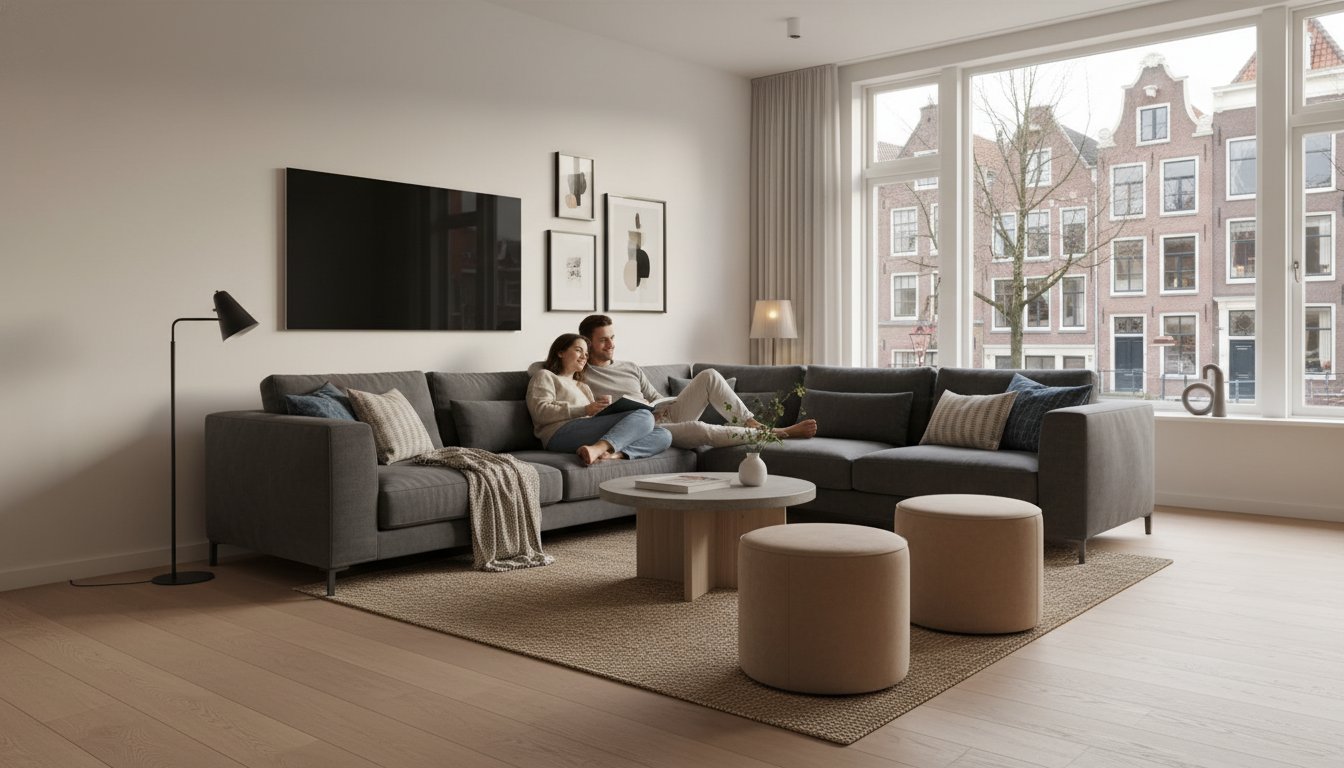
Infrared heating in the living room needs to work with the interior layout. The place where you read, eat or watch television matters, as do other users and open connections to neighbouring rooms. A good design therefore starts with the layout and desired comfort zones, followed by output, finish and controls.
Key points
Assess heat loss and distribution in the places people use. Allow sufficient clearance around approved mounting positions. Compare design options for each product and include controls and sensor measurements explicitly in the plan. Energy use and warm-up time must be assessed for the specific situation.
How does infrared heating in the living room work?
The warm panel surface transfers heat through radiation and convection. People and surfaces absorbing radiation become warmer, while the air also warms up. This gives a different local sensation of warmth from some other heat emitters, but does not automatically eliminate cold corners or heat losses. The outcome depends on the arrangement and the home.
Does infrared heating suit the way you use your living room?
Panels can provide targeted supplementary heating or form part of a primary heating plan. For primary heating, total output under the chosen design conditions must match heat demand. Feeling comfortable on the sofa does not prove that the dining area or adjoining kitchen is also heated sufficiently. Assess all occupied zones, including when several people use the room at the same time.
Potential savings depend on the heating being replaced or reduced. Two degrees lower with the same comfort is not a general product characteristic. General differences in consumption between homes do not demonstrate savings in your living room either. Heating does not treat allergies or make the room dust-free; ventilation and cleaning remain necessary.
Integrating infrared heating into the living room
Metal, glass, mirror and ceramic versions differ in appearance and specifications. Compare weight, warm-up behaviour, permitted mounting and cleaning using the documentation. A material name does not prove that a panel is faster or more economical. A mirror does not automatically remain condensation-free across its entire surface, even when heated.
A printed infrared panel or an available colour can help the heating match the interior. Check in advance which images, finishes and orientations are available for the model. Do not repaint or cover a panel yourself without permission. Even a decorative panel needs the clearances required for heating.
Combining heating and lighting requires an approved lighting solution and suitable connections. A single housing does not automatically mean one switching function or one suitable connection point. Check whether light and heat can be used independently. Assess light distribution separately against your needs for reading, dining or ambience.
Compare possible wall and ceiling positions with furniture, curtains and the people using the room. A sofa directly in front of a panel can block heat and breach the required clearance; putting a panel behind the sofa is not a general comfort solution. Ceiling mounting can keep walls free, but is not universally better. Use only a mounting method permitted for the version concerned.
Determining the required output and consumption
Determine output using heat loss, ventilation, desired temperature and use. Construction year and room floor area alone are insufficient. With an L-shaped room or double-height space, assess individual use locations and distances. A fixed extra allowance or higher output does not automatically improve distribution or reduce consumption.
A thermostat must measure representative conditions and be compatible with the panels. Different zones in one open living room affect each other; two settings do not demonstrate that those exact two air temperatures will result. Match schedules to household use. Check any app functions for each model and distinguish measured consumption from estimates.
To calculate costs, multiply actual power draw in kilowatts by operating hours, then by your own tariff. Also compare investment, installation and maintenance. A heat pump can deliver more heat per kWh of electricity than direct resistance heating. Solar panels do not automatically make the result energy-neutral, because generation and heat demand occur at different times.
We help you prepare your living room heating plan
Have load-bearing capacity, fixings, electrical load and protection assessed for the plan. A hard-wired or plug connection is chosen according to the product and installation, not just its appearance. Keep hot surfaces out of unintended reach and do not cover the panel. After mounting, check controls and comfort at all agreed use locations.
We supply private and business end users, installation companies and wholesalers. Share photos, a floor plan, insulation details and your preferred layout. We will be happy to assess suitable versions and controls. Available options, availability and warranty conditions must be checked for each product.
A plan that adapts with the interior
Consider the heating when you later change furniture, curtains or lighting. Keep the mounting and control information. Follow the instructions for cleaning and checking the panel, cable, brackets and controls. Low-maintenance does not mean that components never need attention or replacement.
Frequently asked questions about infrared heating
How soon will I feel warmth, and when will the room be warm?
These are two different questions. Panel warm-up and the immediate sensation vary by model and distance. Heating the whole living room also depends on starting temperature, thermal mass and heat loss. A fixed time does not apply to every room; assess operation after installation and adjust the programme accordingly.