
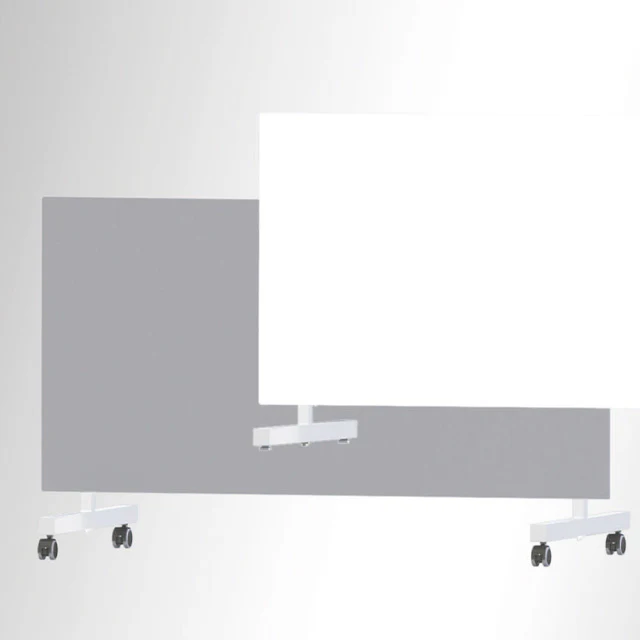
Product image: example of a panel on a wheeled stand. Check whether the panel and stand are approved together for your application.
A freestanding infrared panel can provide extra warmth at a workplace or seating area without fixed wall mounting. Choose an appliance the manufacturer approves for freestanding use with the associated supports or wheeled base. Portability does not automatically make a panel suitable for every room or surface.
Key points
Assess heat demand and available space. Stability, clearance, safe cable routing and suitable controls matter as much as output. Check exact model dimensions including feet or wheeled base so the complete arrangement fits with required clearance. Compare total energy use with existing heating; choosing radiant warmth alone does not produce savings.
How does a freestanding infrared panel work?
The heated surface emits radiant warmth to people and surfaces it can reach. Convection also occurs and air warms up. A desk, sofa or cupboard can shield radiation. Direct the panel towards the intended occupied position and maintain distances stated in the manual.
Freestanding and fixed mounting are different versions. Use only a support approved for the exact panel. Material, finish, warming behaviour and heat distribution vary by model; equal wattage does not mean equal comfort at every distance.
Energy use and controls
Electricity consumption depends on input power and operating duration. At an actual continuous input of 1 kW, one hour uses 1 kWh. Multiply measured consumption by your tariff for running costs. A thermostat can limit operating duration, but heat demand also determines the result.
Local heating may be useful when other heating genuinely needs to work less. If it continues unchanged, panel consumption is additional. Insulation, ventilation, draughts, usage times and comfort requirements remain important. Primary heating requires assessment of heat loss and all occupied rooms.
Check whether a built-in thermostat, external thermostat or plug-in control is approved for the model. A smart plug does not automatically measure room temperature. Check switching load, sensor position and behaviour after power failure. After moving rooms, sensor position and programme must also suit the new situation.
Stability, cables and safe moving
Place the appliance on a level, suitable surface with its complete foot assembly according to the manual. After assembly, check all fixings are secure. Use any wheel brakes as prescribed. Not every model has tip-over protection, a temperature sensor or brakes, and these do not replace stable positioning or unobstructed heat release.
Before moving, switch off, unplug and let the appliance cool according to instructions. Move it using the intended parts; do not pull the cord. Check thresholds, loose rugs and damage. A wooden floor or carpet is suitable only if the manufacturer permits it for that version and clearances.
Connect the heater directly to a suitable wall socket and have uncertainty about available capacity assessed. Route the cord away from walking routes, wheel paths and hot surfaces. Prevent pinching beneath doors or furniture and avoid a taut cable to the socket. Maintain prescribed clearance from curtains, furniture and other materials. Do not cover the panel or use it as a drying rack.
For damp, dusty or professionally used spaces, have suitability of the exact appliance, exposure and complete connection assessed. An IP code or CE marking is not general permission for bathroom use. Check supporting documentation; additional certification applies only within its stated scope.
Applications at home and work
At a desk or sofa, a freestanding panel may be a practical supplement if radiation reaches the user and the arrangement does not block a passage. Also check accessibility to children and pets: surfaces can become hot. Bedroom, overnight or unattended use is appropriate only where the manufacturer permits it.
In an office, reception area or workshop, cable management, passages and layout changes belong in the plan. A portable residential panel does not automatically suit a high hall, wet workshop or combustible dust. Have business applications assessed for actual conditions. Any tax benefits need separate assessment against current official requirements.
Advice on version and positioning
We help private and business end users compare permitted versions, dimensions, supports and controls. Installers and wholesalers can coordinate with us on information needed for projects or supply. Send a photo or floor plan, intended occupied position and usage times for focused advice. Colour, printing, glass or metal depend on the selected range.
Make a practical usage plan
Determine beforehand where the appliance stands during and after use. Record how it cools, moves and is stored without damaging its cord or loosening its feet. Clean and check according to the manual. Damaged cables, loose supports or faults need assessment before the appliance is used again.
Frequently asked questions about freestanding panels
What distance provides pleasant comfort?
There is no universal ideal distance. Start with model safety distances and assess seating position, shielding and warmth within those limits. Choose another arrangement if it feels too hot; do not obstruct heat release.
Can the panel be the only heating?
That depends on heat loss, desired temperature, output and permitted use. A pleasant sensation close to the panel does not prove the whole room is heated sufficiently. Have this assessed when replacing existing primary heating.