
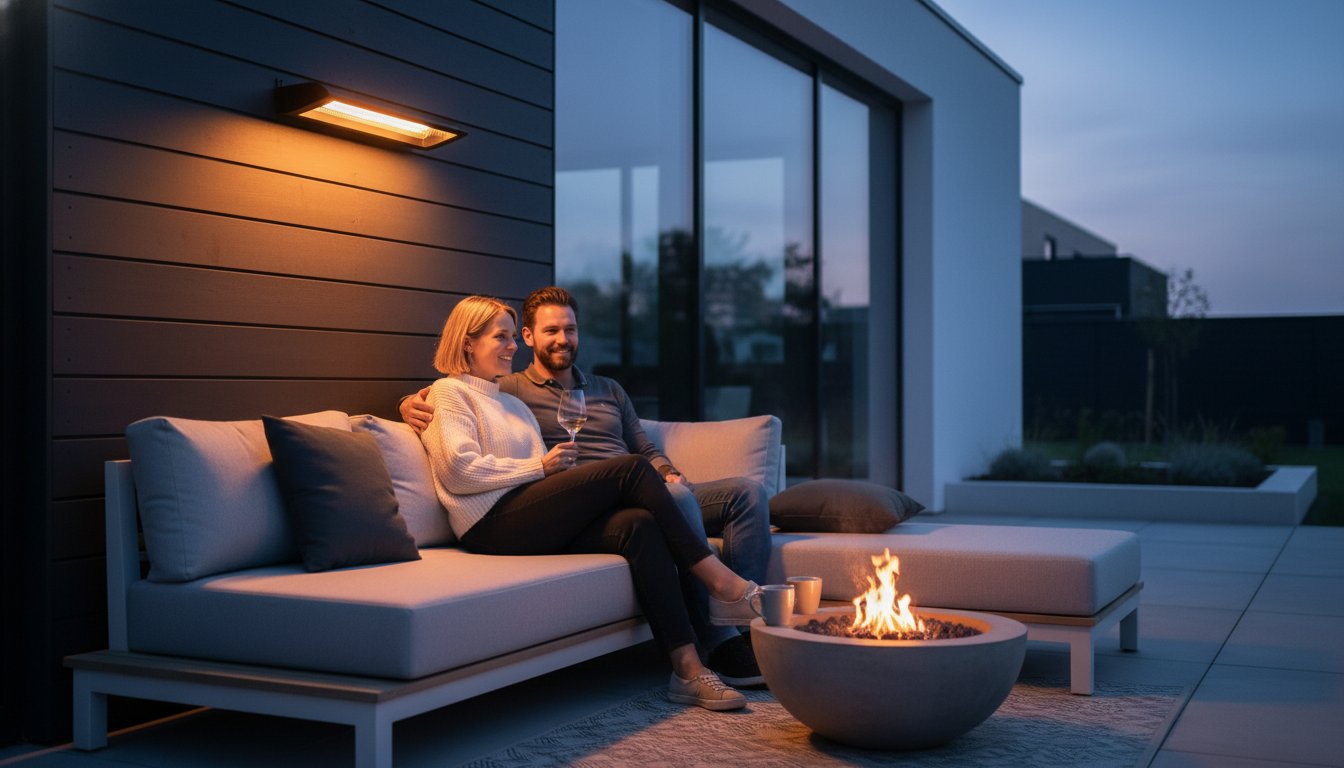
Outdoor infrared heating targets the places where people sit or stand, rather than bringing all the outdoor air up to temperature. A useful plan starts with the terrace: open sides, wind, seating layout, mounting positions and hours of use. Only then choose a heater and controls that the manufacturer permits for those conditions.
This guide helps private terrace users, hospitality businesses, other commercial end users, installation companies and wholesalers prepare their plans. The same principles apply to every project: assess comfort, the electrical supply and installation together. Outdoor heating uses additional energy and does not automatically become climate-neutral through an electrical connection or solar panels.
Key points
Heat only the zones being used and switch them off when empty. Check the permitted exposure to weather and observe every model-specific clearance. An IP rating is not complete approval for outdoor use. Wind, cold surfaces and the distance from users affect comfort; no heater can guarantee heat without losses in every outdoor setting.
How does outdoor infrared heating work?
The hot element and, where fitted, a reflector direct radiation towards the occupied zone. People and surfaces reached by it absorb energy. The heater also releases heat into the air. Radiation can make warmth perceptible locally without heating all the outdoor air, but wind can still cool people and objects. Shelter can therefore matter for comfort, without making every heater suitable.
An electric heater has no local gas combustion, but gas heaters can also provide radiant heat. Do not compare them on the incorrect assumption that gas only heats air. Output, operating hours, energy source, tariffs and an equivalent level of comfort all matter when comparing costs and environmental impact. Check any local rules on use for your location separately.
Coverage and intensity of a patio heater
Short, medium and long wave describe parts of the infrared spectrum. The performance of a complete heater cannot be determined from that name alone. The element, reflector, output, distance and mounting angle work together. Ask for the heat distribution for the intended arrangement and check whether all seats are reached without creating an excessively intense spot close to the element.
Also consider visible glow and how long people will stay. Less visible light does not prove equivalent coverage, and a dark housing does not prove suitability for an open terrace. Ask which conditions the manufacturer permits for a low-glare or dark version. A sensation of warmth is not evidence of deep tissue heating or a medical effect.
Output and costs
There is no universal standard of 250, 300 or 350 watts per square metre that guarantees comfort. Layout and exposure require an assessment for the specific model. Calculate consumption by multiplying electrical input in kilowatts by the actual hours switched on. With output control, use the actual average rather than automatically using the maximum value. Multiply the result by your own tariff.
Which infrared heating suits your terrace?
A wall- or ceiling-mounted model can keep the floor clear. Check that the mounting surface has sufficient load-bearing capacity and that all clearances from wood, fabric, glass, cables and other materials are achievable. Adjustability does not mean every angle is permitted. Use only the supplied or explicitly approved fittings and allow access for maintenance in the design.
Recessed installation requires a version designed for that purpose, with the specified clearance and heat dissipation. Placing a surface-mounted heater in a homemade recess is not equivalent. For a covered terrace, also have the structure and the canopy manufacturer’s instructions assessed. An existing opening or lighting connection does not prove that the installation is suitable.
A freestanding heater needs a stable surface, an approved base or stand and a safe cable route. Consider children, pets, guests, wind and the risk of tipping. Check whether protection is fitted and exactly what it does, without relying on it as a replacement for proper positioning and supervision. Store the heater as instructed.
Hospitality and shared terraces
Use clearly defined zones and controls that staff understand. Establish when each zone is switched on and who switches it off at the end of the shift. Reassess the arrangement when tables, parasols or screens are moved. Avoiding heating an empty zone is a practical management measure; increased turnover or guaranteed savings do not automatically follow from installation.
Technical requirements for outdoor use
Assess IP protection together with permitted rain exposure, mounting orientation, connections, corrosion and ambient temperature. A higher IP rating does not mean you may immerse the appliance or clean it with a water jet. Follow the exact product conditions. If there is any doubt about an open terrace, coastal location or damp connection, the supplier or installer must confirm the application.
Have the electrical supply checked for simultaneous load, starting behaviour, cable length, connection and protective devices. Whether a separate circuit is needed follows from that design. A general wattage limit alone is insufficient. Use a dimmer, receiver or timer only if it is permitted for the specific heater; do not connect an ordinary lighting dimmer indiscriminately.
Checks after installation
Test the warmth at every occupied seated and standing position and assess the person closest to the heater as well. Check that users are not exposed to an uncomfortable direct view of the element. Test operation and switching off, and document maintenance and cleaning. A CE marking is not an independent quality certification; check any additional certificates for the exact model and their scope.
Suitable advice for your terrace and garden
Send us photos or a drawing with dimensions, open sides, mounting height and seating layout. Tell us whether it is a private terrace, a hospitality setting or another commercial project and specify the intended hours of use. We discuss the available product information with you and, if desired, with the installation company or wholesaler. This ties the selection to the actual application.
From terrace layout to a suitable proposal
Ask for a proposal describing mounting, controls, expected coverage and installation requirements. Keep uncertainties such as strong wind or a changing layout visible. A realistic selection may also mean that better shelter or another mounting position is needed first. This helps prevent a purchase that suits the terrace only on paper.
Frequently asked questions
Can I use an indoor panel under a canopy?
Only if the manufacturer permits that specific application and the positioning and connection requirements are followed. Appearing dry is not the same as being a suitable environment; condensation, wind and temperature changes remain possible. A suitable output does not make a heater without outdoor approval suitable after all.
What about lamp replacement and maintenance?
Service life and replaceability vary by model and use. Check which part may be replaced and by whom, and use the specified parts. Before cleaning according to the manual, first have the heater safely switched off and allowed to cool. Also check fixings, cables and signs of corrosion or damage; low maintenance does not mean maintenance-free.