
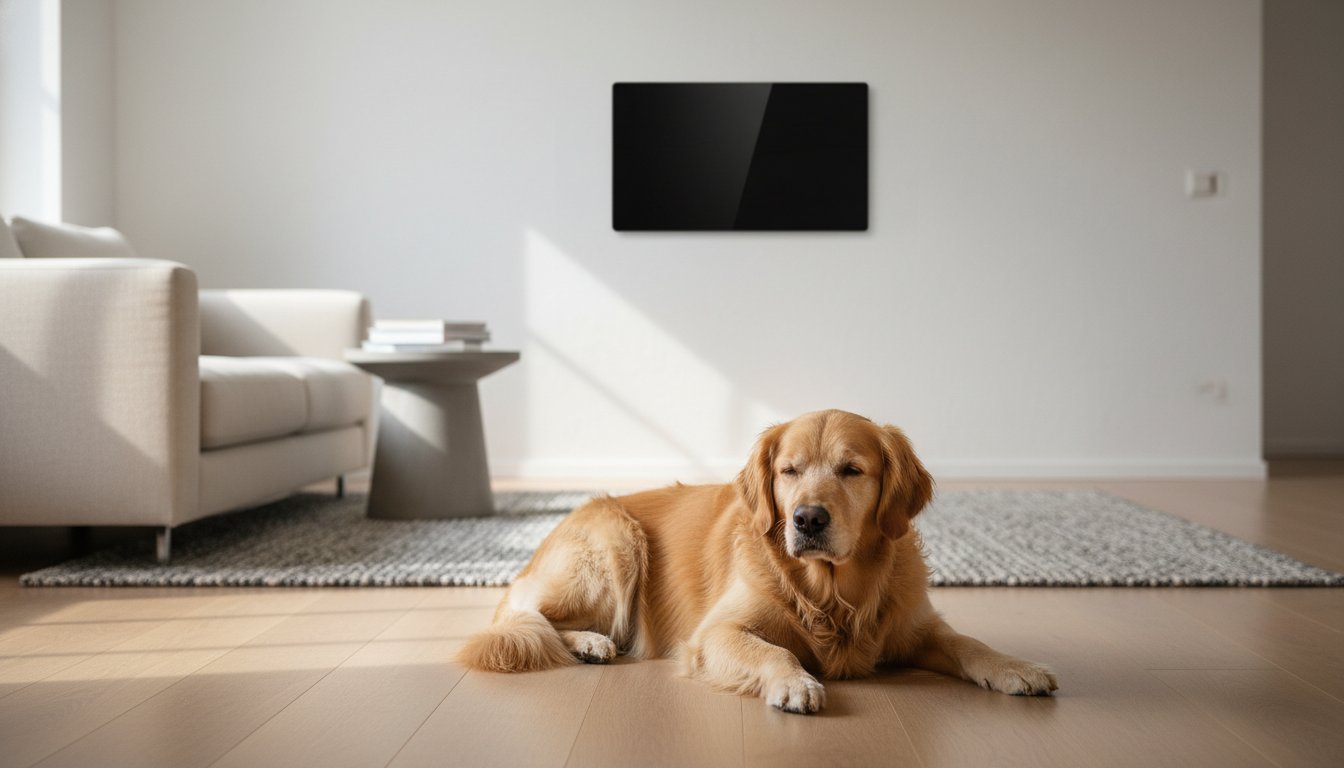
Would you like to use infrared heating in a home with pets? Then we assess the chosen product, mounting location and your animal’s enclosure together. A heating panel can provide thermal comfort, but is not automatically suitable for every species or every animal enclosure.
We advise on the technical possibilities. For your animal’s heat requirements, a medical condition or the climate in a specialised enclosure, seek advice from a vet or an expert for the species concerned. Our space heating is not a treatment for symptoms and we make no health promise for it.
Key points
- Assess suitability for the animal, the enclosure and the permitted use of the specific product.
- Hot surfaces can cause burns. Prevent contact and do not rely on a startle response.
- Take cables, climbing, jumping, collisions and limited freedom of movement into account.
- A thermostat or app does not replace supervision and a suitable arrangement.
- Follow the manufacturer’s conditions and seek veterinary advice about the animal’s needs.
Assessing the animal and its enclosure
A dog roaming freely around the living room, a climbing cat and a bird in a cage require different considerations. Do not just look at where your animal usually lies. Also take behaviour, accessible furniture and changes to the room layout into account.
We cannot generally guarantee that infrared heating is safe for all pets. Suitability depends on the specific appliance, the circumstances and the animal’s needs. A space heating product is not necessarily intended as a targeted heat source for a cage, terrarium, nest or other enclosure.
Hot surfaces and contact
A panel can become hot and even brief contact can cause burns. Do not assume that fur, low thermal mass or an animal’s startle response provides sufficient protection. Prevent your animal from leaning against the panel, lying on it or touching it with its nose, paws or tail.
Ceiling mounting can help limit accessibility with a suitable model. It does not guarantee that every risk disappears. A climbing cat or a bird can also reach places that appear out of reach to people.
Being able to move freely is not enough
Do not rely on the idea that an animal will always choose a cooler spot in time by itself. Avoid an arrangement in which the animal is exposed to excessive heat for prolonged periods or unintentionally. Old age, illness or limited mobility may be reasons to seek additional advice.
For a cage or other confined enclosure, heat requirements and the distribution of climatic conditions must be assessed specifically. Keeping only part of it in the shade does not prove that the arrangement is suitable. Seek advice from a species expert or vet for this, and check whether the heating product is intended for this application.
Thermal comfort without health claims
Infrared heating emits radiant heat to people, animals and surfaces. Convection also occurs and the air warms up too. The sensation of warmth is not evidence of a therapeutic effect or deep tissue heating.
We do not offer our space heating as a treatment for osteoarthritis, pain, circulation problems or recovery after exercise. Nor do we promise detoxification, protection of eyes or skin, or an improvement in the animal’s health. Discuss symptoms and any additional warmth with a vet.
Air quality and cleaning
An infrared panel does not purify the air or rid a room of dust or pet hair. Convection, ventilation and movement remain present. Continue cleaning and keep ventilation facilities unobstructed. Heating does not replace ventilation of a home or animal enclosure.
Humidity is not independently regulated by a panel. The climatic conditions required depend in part on the species and the enclosure. Therefore, do not use space heating on the basis of a general promise that it preserves the natural moisture balance.
Choosing a suitable heating solution
Compare specific products for the same application. Wall panels, ceiling panels, convectors and underfloor heating differ in mounting, accessibility, controls and heat output. The name of a technology alone does not determine what best suits your animal and home.
Consider factors including surface temperature, permitted distance, stability, fixings and protection of connections. A fixed panel can also develop a fault and requires checks in accordance with the manual. A portable appliance is not suitable for every animal or location; prevent tipping and unintended contact.
For a living room, you can use our information about infrared heating in the living room as technical guidance. That information does not replace an assessment of the situation with your pet.
Positioning and everyday use
Mounting location and clearance
Follow the manual for the chosen version. Mounting height and distances from animals, furniture, textiles and other materials differ by product. We therefore do not give a universal height that keeps every animal out of reach.
Assess your animal’s route through the room. Think of a cat jumping from a cupboard, a dog lying against furniture and a bird that can fly freely. Keep beds, baskets, blankets and toys outside the specified clearance. Do not cover the appliance or use it as a resting place or drying rack.
Cables and electrical connection
Prevent cables from being pinched, pulled loose or accessed by an animal that may chew them. Have cable routing and any protection assessed without obstructing the product’s cooling, mounting or operating instructions. A cable duct does not automatically make a cable inaccessible or resistant to every animal.
Have a competent installer assess the electrical connection and available load capacity. Stop use in the event of damaged cables, scorch marks, an unusual burning smell or a suspected fault. Switch the appliance off using its intended controls if it is safe to do so, and have it checked before using it again.
Controls and supervision
Choose suitable controls and position the sensor in accordance with the manual. The measured air temperature does not tell you everything about the heat an animal receives in a specific location. An app, thermostat or overheat protection therefore does not guarantee protection against an animal overheating.
We do not make a general commitment to use overnight or when animals are home alone. Check the manufacturer’s conditions of use and assess the arrangement and required supervision. If in doubt, seek advice about the species and situation concerned.
Professional animal accommodation
Stables, kennels, grooming salons and other animal accommodation may impose additional requirements due to moisture, dust, cleaning agents or conditions of use. An IP rating alone does not prove that a panel is suitable for such an environment. Describe the conditions and have the selected equipment and installation assessed against them.
Technical advice from us
We help private and business end users, installation companies and other business partners with product selection and technical data. For a proposal, please provide the dimensions and layout of the room, insulation details, possible mounting locations and intended use. State which animals stay there and whether their freedom of movement is limited.
We assess the heating products and provide relevant documentation. The animal’s specific welfare and medical needs are a matter for a vet or species expert. Coordinate that advice before choosing a targeted heating arrangement.
Browse our range and ask about the conditions for the specific version.
Discuss your situation with us
A proposal makes clear which products and controls are selected and which installation assessment is required. Consumption and any savings depend on heat loss, operating time and the heating system you compare with; we do not make a fixed savings or health promise.
Request a quote for your home or business project. Mention the presence of animals so that we can take this into account during technical preparation.
Frequently asked questions about infrared heating and pets
Is every infrared panel suitable for a home with animals?
No. Assess the product, mounting and accessibility for the animal. A space heating version is not automatically a suitable heat source for every animal enclosure.
Can my animal burn itself on the panel?
Yes. Hot surfaces can cause injury even with brief contact. Prevent access and contact, and do not rely on a startle response or the presence of fur.
Can an animal overheat under a panel?
Take excessive heat into account and do not rely on an infallible instinct. The arrangement, exposure and animal’s needs must be appropriate. Have the situation assessed specifically in the event of limited mobility or a confined enclosure.
Is it suitable for birds or animals in a cage?
You cannot assume this in general. Seek species-specific advice and check whether the manufacturer permits the application. Keeping part of a cage in the shade is not in itself evidence of suitability.
Does it help with osteoarthritis, skin complaints or other conditions?
Our space heating is intended for thermal comfort. We make no medical promise. Discuss symptoms and any need for additional warmth with a vet.
What mounting height is safe?
There is no universal height. Follow the product conditions and assess jumping, climbing, flying and the room layout. Ceiling mounting does not eliminate all risks either.
Can the system remain on when the animal is alone?
Check the manufacturer’s conditions and assess the arrangement and supervision for your situation. A thermostat or app does not provide a general guarantee for unattended or overnight use.