
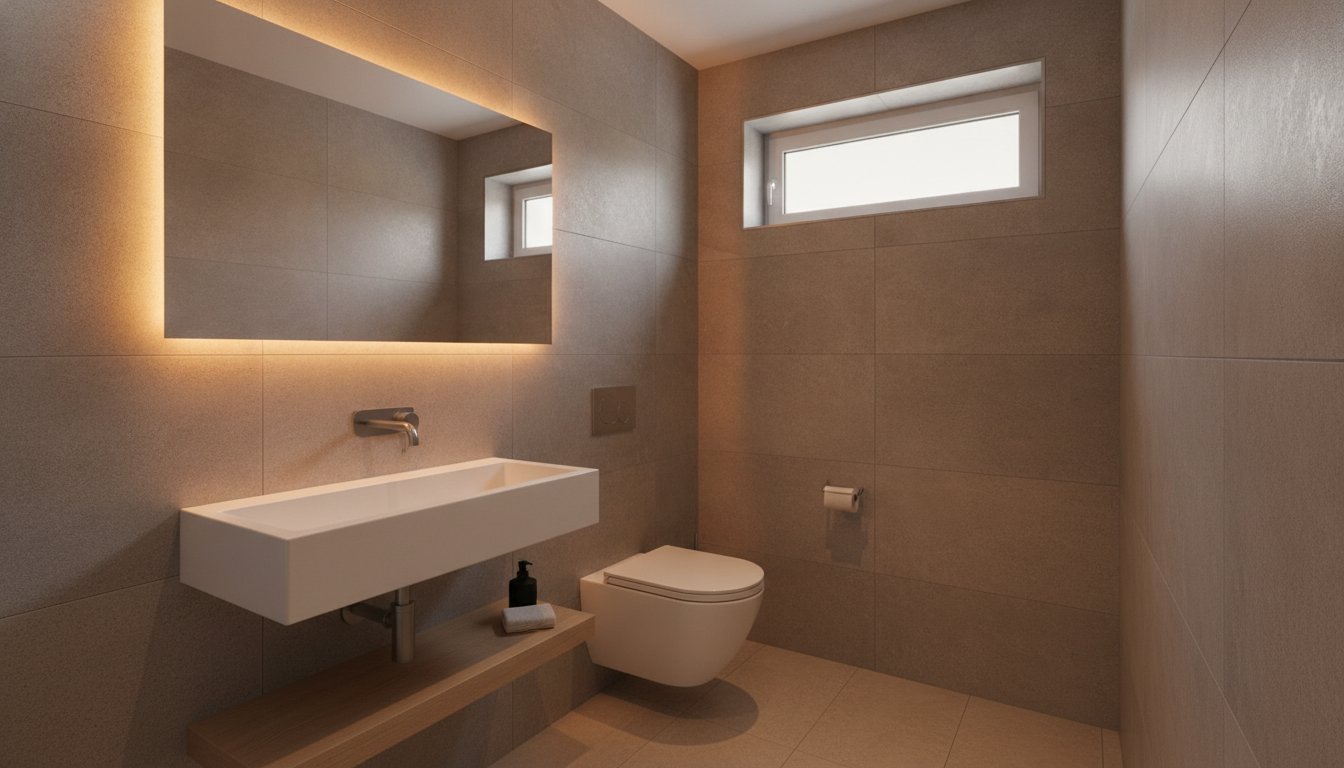
An infrared panel in a toilet room is above all a positioning question: can warmth reach the occupied spot without the appliance getting in the way? Consider the open door, seated position, hand basin and cupboards. An attractive size alone is not enough for a comfortable installation.
Here we explain how to integrate a panel into the layout and match its controls. We help private and business end users and support installers and wholesalers with a single toilet room or a washroom renovation project.
Key points
Check wall, ceiling and mirror positions against the manual and occupied location. Ask not only how many watts are needed but when warmth must be available. Maintain ventilation and do not treat heating selection as a moisture remedy. Document mounting, operation and maintenance for the user.
When does infrared heating suit a toilet room?
A panel may help where radiator space is limited or extra warmth is wanted at the seated position. It needs no heating-water pipe but does require a suitable electrical connection. Compare it with existing heating: replacing a working radiator is not automatically the most economical choice. Insulation or improved controls may help too.
Allowing for warm-up time
The panel surface must warm before delivering its intended heat. Response time varies by appliance and situation. Switching on only at entry may therefore be too late for a brief visit. A schedule or background setting may be more practical but also uses energy outside occupancy. Check performance during real use.
Technical properties in a small room
The warm surface releases energy by radiation and convection. A user and tiles may absorb direct radiation; doors or cupboards may block its path. The panel does not prevent losses through extraction, glass or external walls. Stored heat in ceramics and walls does not mean the room stays at constant temperature after switching off.
Consider consumption, moisture and hygiene separately
Calculate electricity using power draw and actual operating hours. A small room does not guarantee extremely low consumption. Moisture does not disappear because a wall becomes warmer: ventilation and fixing causes remain necessary. The panel also does not eliminate dust movement or cleaning. Its purpose is thermal comfort, not medical or hygiene treatment.
Types of infrared panel for a toilet room
A metal or glass panel may suit the design, but weight, fixings and clearances remain model-dependent. Printed versions need a manufacturer-approved finish. Do not paint or cover a panel yourself without approval. Ask which colours, sizes and prints are actually available rather than assuming every RAL colour.
Mirror panel above the hand basin
A mirror may combine functions in one wall position, but the required mirror height is not automatically the best heating position. Check clearances, reflection, hot surfaces and connection. Heating may reduce misting on the heated area depending on temperature and moisture; a permanently clear mirror is not certain.
Light and heat at the ceiling
An approved combination needs both suitable lighting distribution and heating direction. Check independent operation so heating need not run with summer lighting. Match dimming and thermostat to the specific components. A lighting point may need assessment or modification for heating load.
Planning installation and required capacity
Sketch dimensions, doorway, external walls, glass, ventilation and connections. Have heat loss determined for complete heating. Standard figures of 200–400 watts or 30–40 watts per cubic metre cannot replace an actual calculation. Also discuss simultaneous use and other circuit appliances with the installer.
The manual determines wall or ceiling use, clearances and fixing method. Have substrate and load capacity checked. Near water, assess actual exposure and product permission together with the electrical installation. Have the required protection determined for the entire combination.
Our advice on a suitable toilet-room panel
Share the sketch and photos with us, together with your preference for wall, ceiling or mirror heating. We discuss options with end users and support business partners with product information. Finish, availability, warranty and replaceable parts are confirmed by model.
Assess the complete setup before buying
A compact panel may fit well when position, controls and demand match. Ask for a proposal stating these assumptions clearly so you can coordinate them with the installer.
Frequently asked questions about infrared heating in toilet rooms
Can I use a motion sensor?
Only if appliance and sensor arrangement are suitable. Check load capacity, run-on time and whether a seated, still user remains detected. Consider panel warm-up time. A sensor may limit forgotten operation but is not automatically the most economical or comfortable control.
What should I keep checking after installation?
Follow the manual for cleaning, visual cable and fixing checks and control maintenance. Prevent accidental access to hot surfaces and do not cover them. Reassess when the layout changes. Low maintenance does not make wear or faults impossible, and lifespan is not a warranty period.