
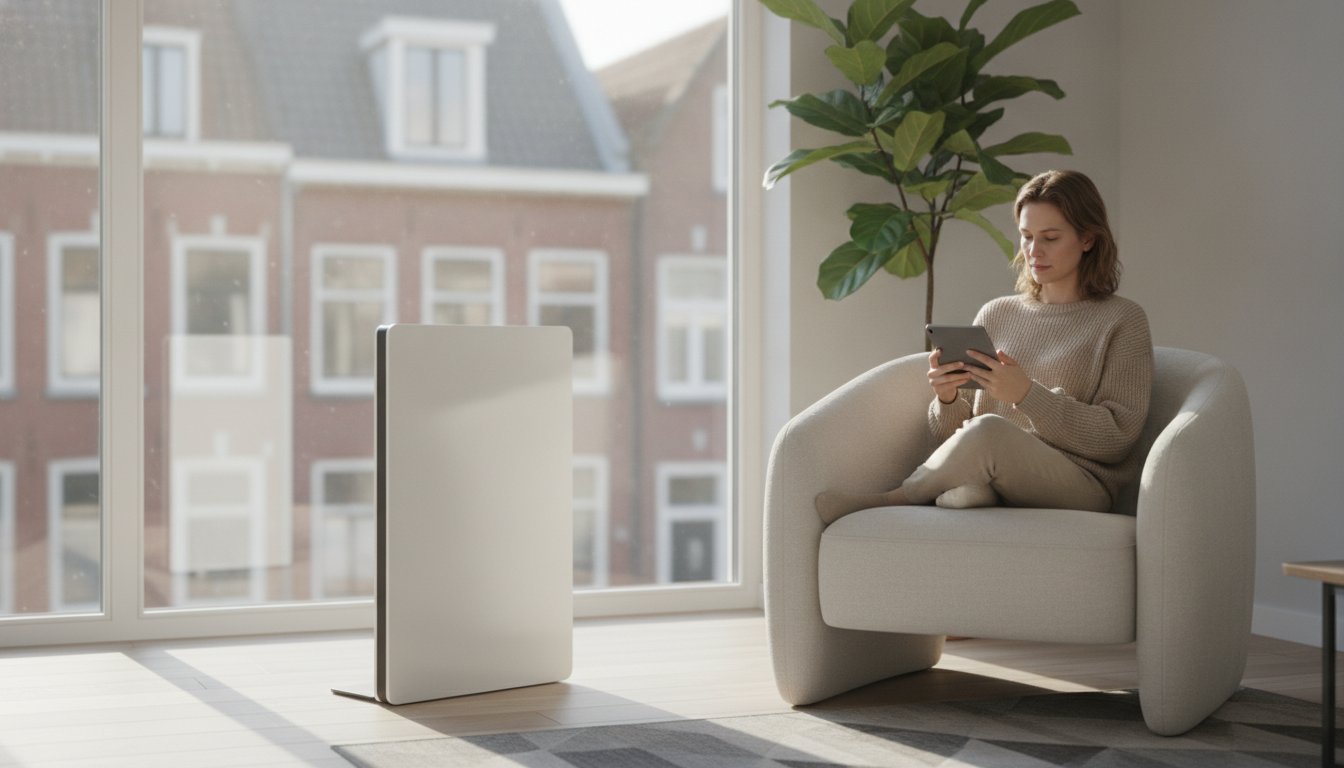
Freestanding infrared heating can be useful when you want a heat source without permanent wall or ceiling mounting. The key buying question is not only appearance but which panel, feet and controls are approved as a freestanding appliance. A separate support does not make every wall panel suitable for floor use.
This guide helps compare freestanding and fixed mounting. We supply private and business end users as well as installers and wholesalers seeking a suitable solution for their customer or project.
Key points
Ask about approved feet or wheels, weight and the space occupied by the complete appliance. Consider cable routing and clearances. Decide whether you want one comfort spot or regular movement. Assess consumption using actual operating time and controls compatible with the specific appliance.
What is freestanding infrared heating and how does it work?
An electric panel stands on a designed base. Its heated surface releases radiant and convective heat. People and objects may receive some radiation, and the air warms too. This can provide local comfort but does not eliminate heat loss or cold air movement.
The freestanding category includes different appliances. A flat panel without visible glow is not the same as a glowing-element heater or convector. Check intended indoor or outdoor use and permitted operating duration. Appearance does not prove mild, harmless or immediate heat.
Technical properties of the complete appliance
Check power, dimensions, weight and instructions for both panel and base. Metal or glass alone does not determine warm-up time: mass, construction and controls also matter. An insulated back may still become warm. Ask about fitted protections; tip-over or overheat protection cannot be assumed for every model without documentation.
Choosing feet and wheels
A low base may suit one fixed location, while wheels may aid movement. The manufacturer determines permitted combinations. Check floor contact, fixings, wheel brakes and suitability for your floor. A particular base material does not universally guarantee stability. Also consider thresholds, rug edges and lifting weight.
Estimating electricity without savings guarantees
A 500-watt panel running continuously at full power for four hours uses approximately 2 kWh. Actual daily on-time may differ. Multiply consumption by your tariff and include main heating in comparisons. A thermostat reduces on-time only when settings and conditions allow.
Freestanding or fixed: weighing the options
A freestanding model may suit temporary workstations or moving home, balanced against floor space, visible cable and possible movement. A fixed panel needs appropriate fixings but keeps the floor clear. Choose by use and available positions, not a blanket promise about property value or official sustainability calculations.
Primary heating needs assessment of demand, distribution and electrical capacity as a whole. Size alone does not establish whether a freestanding model is sufficient. Ask for heat-loss calculation and permitted-use assessment before removing existing heating.
Using freestanding heating at home
Near a sofa or desk, direct radiation must reach the intended zone. Furniture, clothes or paper must not cover the appliance. Follow manual distance and direction; one to two metres is not a universal ideal seating distance. Keep cables outside walkways and allow room to stand or move a chair.
Movement requires checks after every new setup. Switch off, disconnect and cool as instructed. Do not place it in a bathroom or near water without assessment. Intended use, exposure, position and connection must all suit; a protection rating alone is insufficient.
What should you check before buying?
Ask for documentation, approved accessories, warranty and repair or replacement information. Origin and price alone do not prove better performance. Check integrated controls and permission for an external sensor. A smart plug may interrupt settings or provide poor temperature measurement; compatibility must be confirmed.
Determine output from intended use. Fixed 40–60 watts per square metre or standard 300 watts for a desk and 700 for a seating area do not fit every situation. Apps do not automatically show measured energy either: ask whether the system measures it or merely converts operating time.
Choose with a complete usage plan
Send us photos, dimensions and intended use. We help private and business customers compare options and coordinate versions and documentation with installers and wholesalers. A proposal can clarify which base, controls and mounting conditions belong together.
Frequently asked questions about freestanding infrared heating
Is a freestanding panel safe around children or pets?
The setup must suit its users. Hot surfaces can burn even on brief contact. Prevent accidental access, tipping and covering. Tip-over or overheat protection does not replace suitable positioning and supervision required by the manufacturer.
Do I only need a socket?
Check supply, connection, existing load and permitted accessories. Not every freestanding version is identical. Follow extension-lead and power-strip requirements rather than treating an available socket as a complete suitability check. Have the connection assessed if uncertain and check cable, base and controls as instructed.