
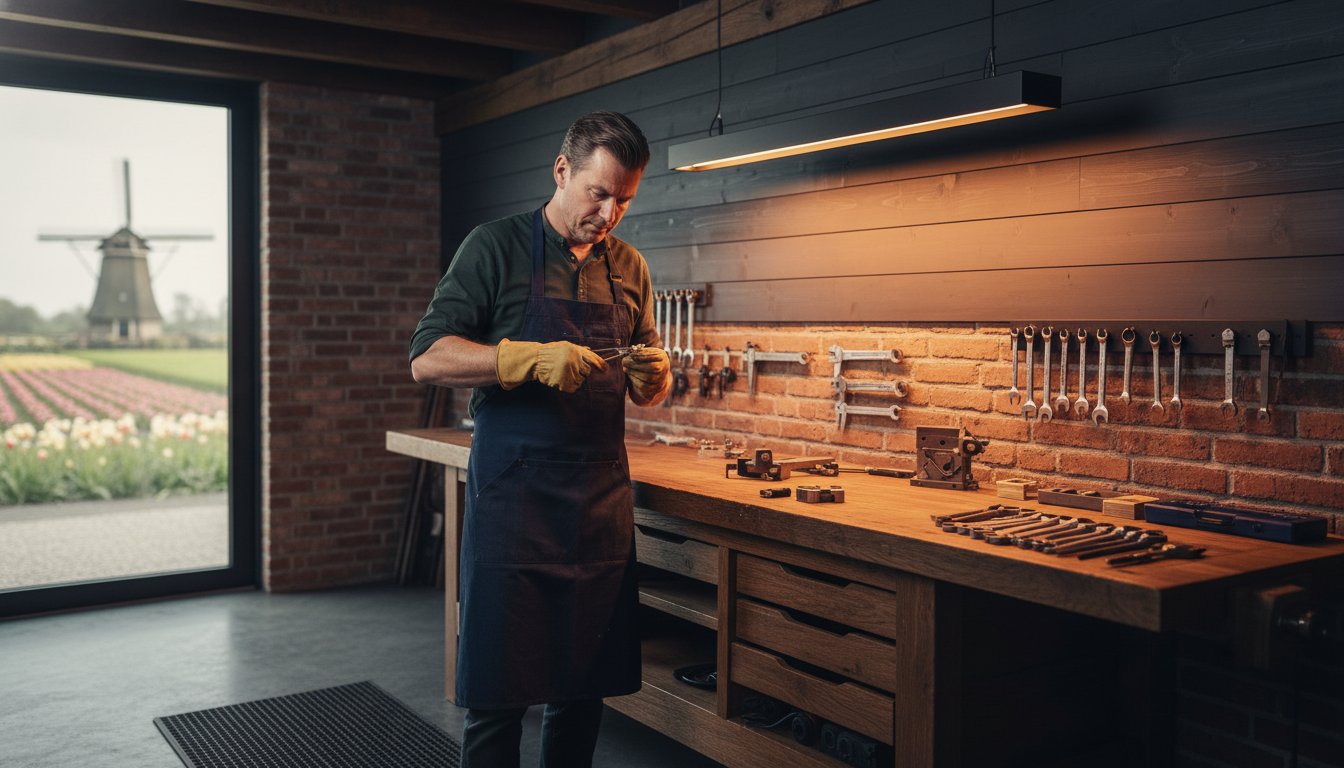
Choose infrared heating for a shed according to its use: storage, hobbies or a workshop used every day. That distinction determines what you need from heating. Infrared can provide local thermal comfort, but does not automatically make a draughty or damp shed suitable for every use. Start with the work involved, time spent there and the building’s condition.
Key points
Distinguish comfort at a workstation, heating the whole space and protecting stored goods. Assess dust, moisture, flammable materials and electrical capacity beforehand. An ordinary domestic panel is not automatically suitable for a demanding workshop.
When is infrared heating suitable for a shed?
For brief use of a workbench, targeted heat can be a different approach from continuously keeping the entire shed at temperature. The coverage area must be unobstructed and the selected appliance must suit the distance and use. The air and structure still lose heat, so an open door also affects infrared heating.
Where possible, improve unwanted gaps and roof and wall insulation before installing more power. Maintain ventilation required for the work. Heating does not remove moisture, vapours or dust and does not replace suitable extraction. Persistent condensation or rust requires the cause to be addressed separately.
Operation and perceived warmth in an outbuilding
An electric radiant heater converts electricity into heat and releases it through radiation and convection. How strongly warmth is felt at the workstation depends on the model, distance, direction and any obstacles. Material names or the terms short-wave and long-wave alone do not guarantee comfort or safety.
Radiation does not heat every tool and machine equally well. Surface, finish and line of sight matter; metal does not automatically remain above the dew point. A temporarily warm workstation therefore does not generally protect all stored equipment against corrosion or frost.
Which appliance suits your shed or workshop?
A flat panel may suit an appropriate, more enclosed space. Higher or more open workstations may require a heater specifically designed for them. See our information on industrial workstation heating. Compare the application, heat distribution and permitted mounting height. A dark radiant heater emits little or no visible glow, but can still become very hot.
If lighting is integrated into the appliance, assess the lighting requirement separately. A portable appliance is only appropriate with the approved arrangement and protection against tipping over. A fixed installation may keep walkways clear, but requires suitable fixings and clearances from stored goods, shelving and workpieces.
Assessing output and electrical installation
For whole-space heating, assess heat loss at the desired temperature. For local workstation heating, also assess coverage, distance and time spent there. A general watts-per-cubic-metre value or a standard allowance for rapid warm-up is not a reliable design for every shed.
Have the simultaneous load of heating, machinery and tools checked. A circuit’s theoretical capacity does not mean all of it is available for heating. Cables, protection and connections must suit the installation and environment. An ordinary room thermostat usually measures air at its sensor, not automatically the temperature of tools or every pipe.
Dust and flammable materials need extra attention
A workshop is not automatically suitable for every panel simply because it has no fan. Dust can accumulate and hot surfaces remain a risk. Where flammable vapours or dust are present, first assess which equipment is permitted. Do not use an ordinary appliance until suitability for the specific environment has been established.
Our advice for your shed or workshop
We support private and business end users, installation companies and wholesalers. Send photos, dimensions, insulation details and a description of the work and materials. Also mention frequently opened doors and existing electrical provision. This lets us discuss an appropriate heating objective before selecting an appliance.
Record mounting and management arrangements
A quotation should clearly identify appliances, controls, fixings and connection work. Maintain clearances even after rearranging the space. Clean and inspect the cooled appliance according to the manual. Low-maintenance does not mean inspections, cleaning or repairing damaged cables are unnecessary.
Frequently asked questions
Does a frost setting protect every pipe?
Not automatically. A sensor may be in a warmer location than a pipe beside an external wall. Power failure and insufficient output are also possible. Assess pipe positions and the protection they need separately; a general setting of five degrees does not guarantee protection at every cold spot.
What do occasional working hours cost?
Kilowatts multiplied by actual operating hours gives consumption. For example, two hours of continuous heating at 2 kW uses 4 kWh. Multiply this by your tariff. Solar panels help only insofar as generation matches consumption or suitable storage; summer output does not guarantee an inexpensive winter evening.