
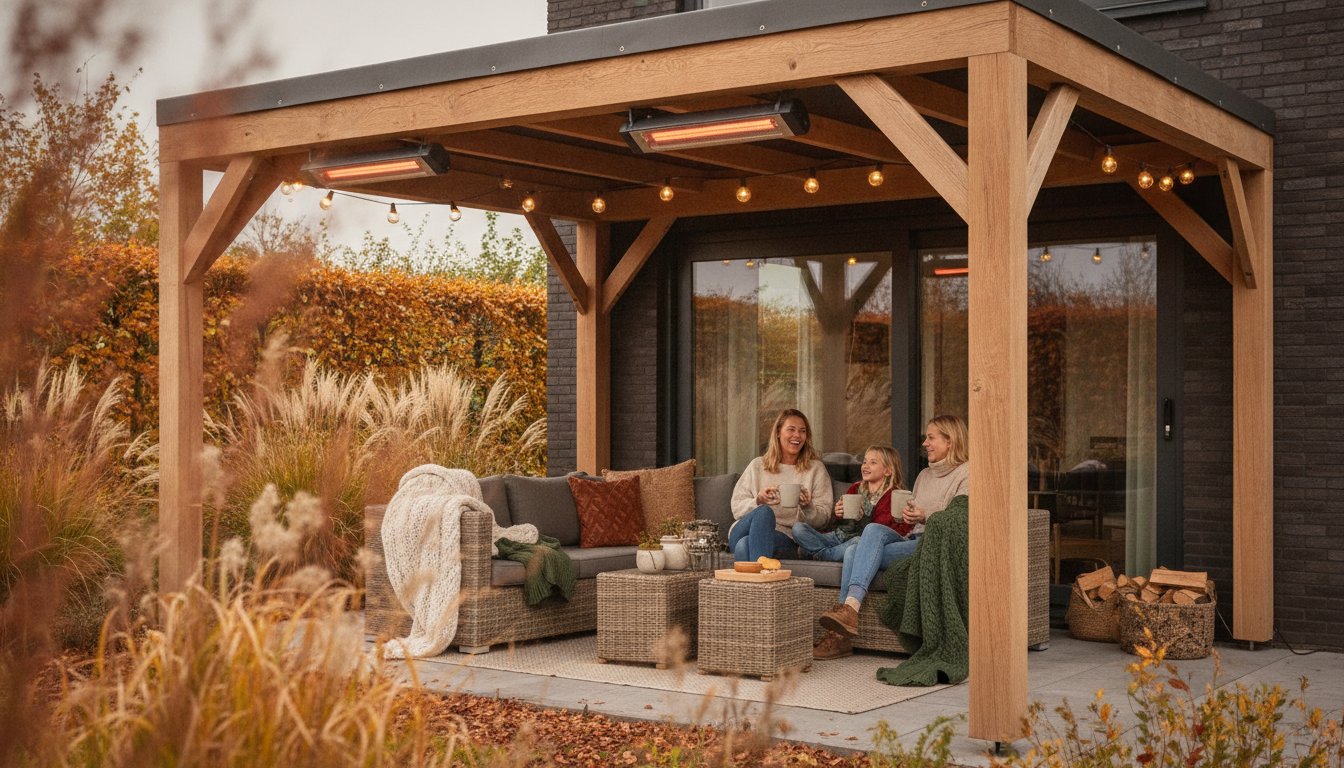
Infrared heating under a canopy needs a plan suited to roof, open sides and seating. A sheltered garden room and an open pergola have different requirements. Start with the intended heated zone and safe mounting options rather than maximum wattage.
Key points
Map shelter, material clearances and moving parts. Use the selected model’s coverage and mounting instructions. Wind can reduce comfort even with radiant heating. Match electrical supply and controls to the whole plan and retain maintenance access.
Start with the canopy
Record open sides, prevailing wind and whether sliding walls or shading move. Mark seating and whether tables change position. The heated zone need not equal the entire floor area.
A heater can radiate directly towards people and surfaces while also emitting convective heat. Shelter can limit cooling. A roof alone does not turn an open space into an indoor room; heating does not guarantee comfort 365 days a year.
Wavelength: useful distinction, not a complete selection tool
Short-, medium- and long-wave terms describe infrared spectrum regions. They do not alone establish heat received at a given distance. Output, reflector, temperature and dimensions also matter. Skin penetration depth is not a general measure of heating quality.
Lamp heaters may emit visible light; dark radiant heaters little or none. Compare light and warm-up behaviour per version. Long-wave heaters also radiate and are not merely air heaters. Manufacturer information establishes the intended open or sheltered application.
Wind does not transport radiation like warm air but can cool people and surfaces more strongly. No wavelength makes comfort entirely immune to wind. Assess the heater against exposure and intended months of use.
Choose model, coverage and exposure suitability
Measure mounting points and distances to seating. Consult coverage diagrams and permitted height and angle. General watts per m² or one ideal height are insufficient. More output does not automatically compensate for blocked exposure or unsuitable positioning.
Check manufacturer approval for mounting under the actual rain and moisture exposure. An IP code describes specific tested protection, not every weather situation. Connections and cable entries must also suit conditions. Water protection does not automatically prove corrosion resistance.
Mounting and controls around moving structures
Account for fabric, shading, sliding panels and where people stand or walk. Maintain model-specific clearances in every position of moving parts. Generic 30–50 cm gaps or a 45-degree angle do not replace this. Check beams and fixing strength.
Have electrical capacity, starting currents and protection assessed. A dedicated circuit alone does not guarantee safety. Choose compatible dimmers, timers and receivers. An outdoor air thermostat does not automatically measure radiant comfort, and motion sensors may miss seated people.
Retain access for cleaning, inspection and possible part replacement. Switch off and cool as instructed before maintenance. Low maintenance does not mean unlimited operation without service or repairs.
Our advice for your canopy
We support private and business end users, installers and wholesalers. Send photographs, dimensions, roof material, open sides and shading details. State supply and control preferences. We advise on a suitable combination without promising fixed savings or year-round comfort.
A complete proposal for outdoor comfort
Compare heater, brackets, controls, installation and maintenance together. Colours and special mounting vary by version. Origin alone proves neither service life nor payback. Check warranty and parts for the selected model.
Canopy heating questions
What does a 3000-watt heater cost per hour?
One continuous hour at full output uses 3 kWh. Multiply by your tariff. Dimming or intermittent use can change actual energy, depending on setting and duration. Compare other heating at the same comfort.
Is one heater enough for the whole canopy?
It depends on seating, coverage and conditions. Several independently controlled zones may suit the space but are not always necessary or more efficient. Use a model-specific layout matching actual furnishings even when canopy dimensions are known.