
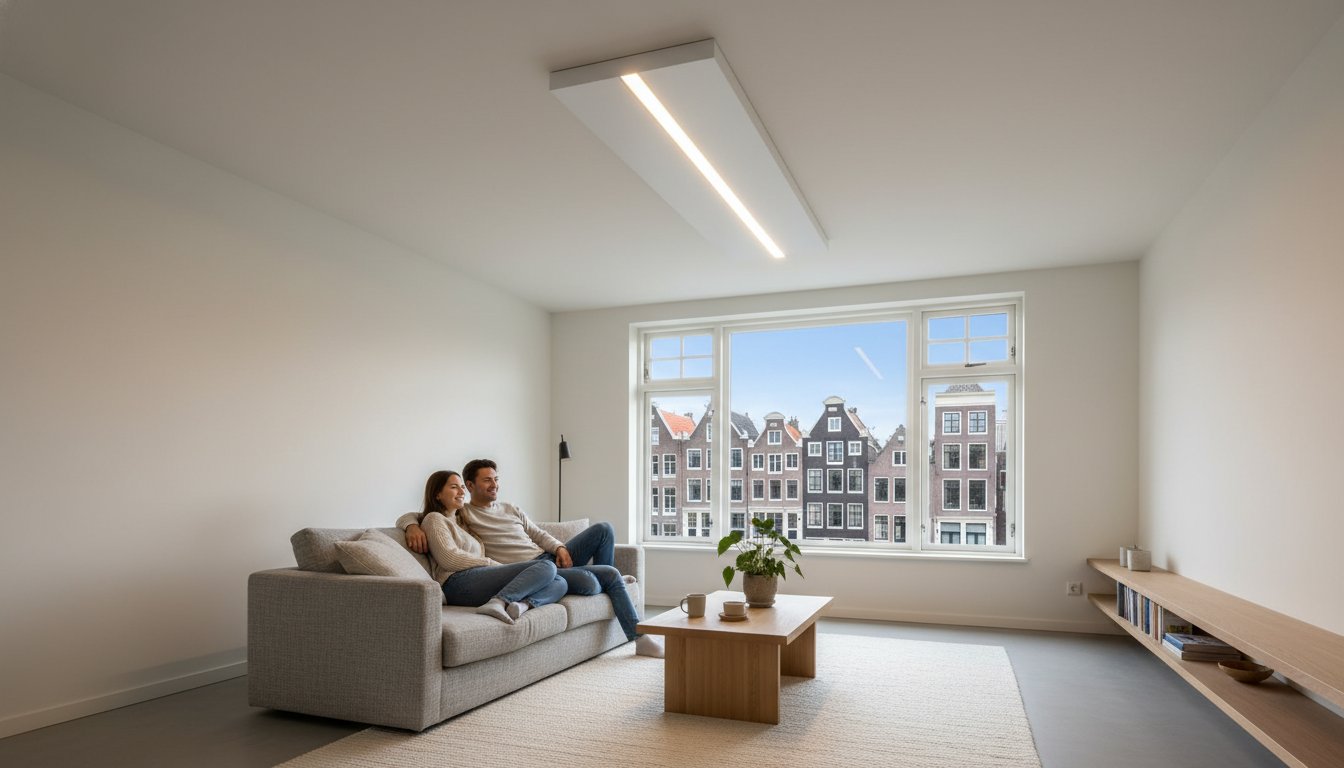
Infrared heating with lighting combines two functions in one design. This can create a calmer ceiling appearance, but the best position for heat is not automatically the best for light. A good choice therefore needs two assessments: a heating plan and a lighting plan that work together.
Key points
Check heating output and light output separately. Ask about independent operation, dimming, connections and replaceable parts. Combine only components approved for one another, and match mounting to weight, substrate and electrical load.
What is infrared heating with lighting?
A heating panel can be combined with an integrated light unit or a purpose-designed lighting frame. The version determines whether it is one appliance or a combination of components. The panel releases radiant and convective heat; the lighting supplies light. Adding LEDs does not automatically make the heating function more economical.
The combination can keep walls free and reduce separate objects. Additional task lighting may still be needed, for example at a desk or mirror. The desired heat coverage may also require several panels. Do not make an uncluttered appearance your only selection criterion.
Thermal management and product construction
LED modules and drivers must remain within their permitted temperatures. How manufacturers achieve this differs by product. Do not assume general thermal separation or an air-cooled construction. Use only the matching lighting frame, prescribed clearances and permitted recessed or surface mounting method.
Before buying, ask how maintenance and replacement are performed. A driver, remote control or LED module may have a different warranty and service life from the heating element. Stated operating hours do not promise the entire appliance will last equally long without faults. Maintain service access according to the manual.
Light quality is more than brightness
Compare light output in lumens, colour temperature, colour rendering and light distribution. More lumens alone do not prevent glare or shadows. Illuminance in lux also matters for light reaching a work surface. Have this assessed for the room, height and tasks rather than using one fixed lumen-per-square-metre figure.
A coordinated heating and lighting plan
For heating, determine heat loss, desired temperature and usage duration. For lighting, activities, work surfaces and sight lines matter. Mark both on a floor plan. If ideal positions do not coincide, a separate lamp or different heating panel may be better than a forced combination.
Follow mounting height, fixings and clearances for the exact version. There is no universal optimum height of 2.5 to 3 metres, and a fixed wattage allowance does not replace coverage assessment. A lowered or suspended system may be mounted only with approved components and a suitable supporting structure.
Controls, dimming and smart functions
Ask whether heat and light operate independently so summer lighting does not unintentionally activate heating. Check the wiring diagram, receiver and number of connections needed. One housing does not automatically mean one standard connection or one control system for both functions.
Dimming and supported dimmers or apps depend on the model. Do not connect an arbitrary wall dimmer to the heating element or light unit. Also check Wi-Fi, wireless protocol and offline operation before expecting integration with an existing system. Occupancy functions must suit people sitting still.
Safety and damp spaces
In a bathroom, have zones, permitted use, IP protection and connection assessed together. An IP code alone does not permit mounting above a bath or shower. The heating surface can cause burns; keep it clear and follow prescribed distances, including for children and vulnerable users.
Our advice on your combination
We support private and business end users, installation companies and wholesalers. Send a floor plan, ceiling photos, insulation details and a description of the desired lighting. We can then discuss whether a combination suits and what extra components or work are needed.
Record the complete solution
Request a quotation itemising the heating panel, light unit, control components, mounting and connection. Check warranty and replaceability per component. Limited maintenance requirements do not guarantee freedom from faults: follow cleaning and checks in the manual and let the appliance cool before maintenance.
Frequently asked questions
How do I add heating and lighting consumption?
For each function, calculate kilowatts multiplied by actual operating hours and add the results. For example, 600 watts of heating for one hour is 0.6 kWh, and a separate 20-watt lighting function for three hours is 0.06 kWh. Together this is 0.66 kWh. These are examples, not specifications of a particular model.