
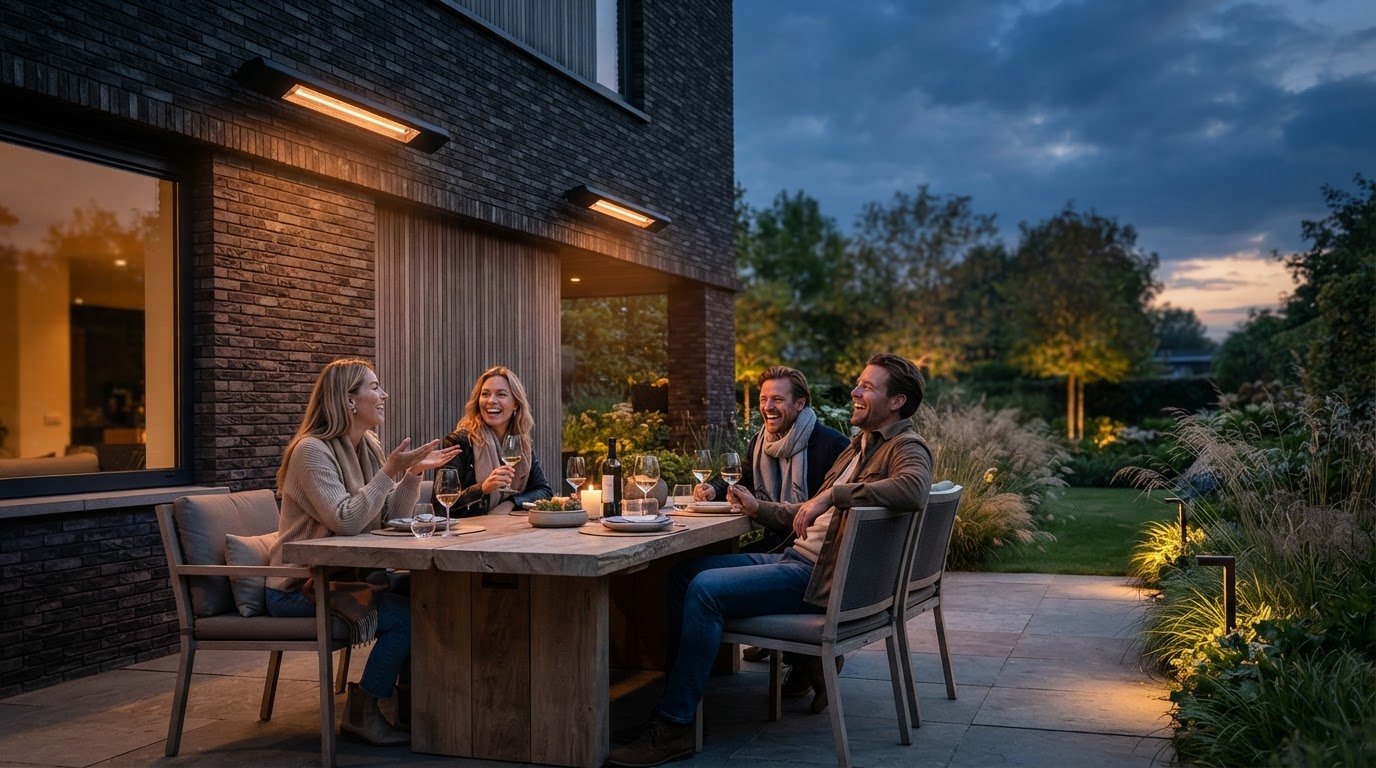
Infrared patio heating can provide targeted warmth around seating, beneath a canopy or on a hospitality terrace. Results depend on the heater, positioning, shelter and weather. Start with the places where people sit rather than the total patio area alone.
This guide helps you compare heater types, heat distribution, controls and installation requirements. We do not promise comfort in every weather condition or a fixed saving. Outdoor heating uses energy; brief, targeted operation and adequate shelter help limit unnecessary consumption.
Key points
Choose a heater explicitly suitable for your outdoor arrangement. Consider radiant coverage, visible light, output and mounting instructions together. Also check electrical capacity and any compatible controls. An IP code or wattage alone is not enough to establish suitability.
How does infrared patio heating work?
An electric heating element emits radiant heat as part of its heat output. People and surfaces within its coverage absorb some of that radiation. The reflector and heater position influence where it reaches. Obstacles, distance and the angle to seating can reduce its effect. Gas heaters can also emit radiant heat; the distinction is not simply radiation versus air heating.
Radiation is not blown away like warm air, but wind still cools people and surfaces. A heater therefore does not make an open patio independent of wind or outdoor temperature. Electric appliances need no gas cylinder or combustion at the point of use; that does not automatically make them the cheapest or climate-neutral choice. Compare energy use and operating time for the same situation.
Short-wave, medium-wave and long-wave
Patio heaters differ in element temperature, radiation spectrum, reflector and visible light. Some glowing-element models are designed for targeted outdoor warmth. Dark radiant heaters may look more discreet and provide comfort with suitable shelter. An element does not emit only one wavelength; names such as carbon, quartz or heatstrip do not fully describe performance.
Assess the technical data for the proposed mounting and conditions. A dark radiant heater does not rely on a necessary warm-air envelope: it also emits radiation. Suitability for your open patio or veranda follows from the product’s intended use and required intensity, not a universal rule about three enclosed sides.
Selection criteria: seating, output and shelter
Map seating, walkways, wind direction, canopy and obstructions. Ask about usable radiant coverage at the specified height and angle. A ten-square-metre patio does not automatically require a fixed wattage: the seating area’s shape and heat distribution matter too. Several heaters may serve separate zones if the layout and electrical installation support them.
For salty, damp or dusty locations, also check material suitability and maintenance requirements. A metal housing is not automatically corrosion-resistant in every environment. Request model-specific advice, especially in hospitality settings where guests, staff, parasols and movable furniture affect coverage and safe clearances.
Mounting, electricity and controls
Follow the manual’s minimum clearances to people, ceilings, walls and combustible materials. Do not assume a universal height or angle. Use only approved brackets, stands or recessed frames for that model. Mounting under fabric or a timber roof requires specific assessment; a heater must not be covered.
The IP code describes a degree of protection but does not alone permit exposed installation. Check orientation, connections and outdoor-use instructions too. Have an installer assess supply, combined load, residual-current protection, wiring and any starting current. A different circuit breaker or soft starter is not a standard solution: both appliance and installation must support it.
Use only a dimmer or controller approved for the element and output concerned. Timers and zone controls can prevent unnecessary heating of empty seating. App control, presence detection and building-management integration depend on the model. Check operation without internet and, in hospitality, assign responsibility for switching off after closing.
Advice for your patio project
We supply private customers, business end users, installation companies and wholesalers. For a suitable proposal, send photographs, seating dimensions, shelter details and information about the electrical supply. We consider suitable models and controls. The installation plan then requires checks of the actual mounting and electrical provisions.
A usable patio starts with realistic expectations
Decide when you want to sit outdoors and how much warmth you expect there. Improve shelter where possible before simply adding power. Limit heating to occupied zones and switch off afterwards. Clean and inspect the appliance according to the manual when cooled and safely disconnected. Have damaged heaters or connections assessed before reuse.
Frequently asked questions
How do I calculate consumption?
Multiply actual power in kilowatts by operating hours. An appliance drawing 2 kW continuously for one hour uses approximately 2 kWh. Multiply by your electricity tariff for energy costs. Dimming or intermittent operation changes the result; use suitable metering for an accurate assessment of installation consumption.
Can an indoor panel be used on a patio?
Only if the manufacturer permits the outdoor arrangement and performance suits the intended use. A panel designed for an insulated indoor room is not automatically suitable for an open patio. Assess the appliance, connection, safe clearances and radiant coverage together.
Is a separate circuit needed?
That depends on the heaters, other connected loads and installation. Have it assessed beforehand and do not change protective devices yourself to prevent tripping. Plug-in models must also meet the conditions for the socket and outdoor use.