
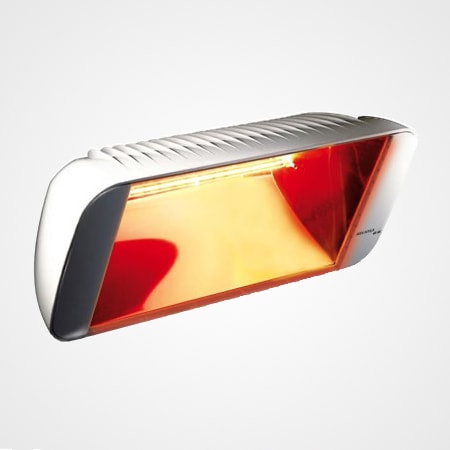
An infrared radiant heater can provide targeted warmth on a terrace, at a workstation or in another occupied zone. The appliance must suit the environment and intended exposure. Do not look only at watts: beam shape, distance, visible glow, mounting and controls help determine whether the heat is pleasant and useful.
This guide helps you assess a heater and prepare its application. We advise private and business end users and support installation companies and wholesalers with product selection and supply. The exact model’s manual remains decisive for permitted placement, connections and use.
Key points
First determine where people need warmth and how long they stay. Then compare radiation distribution and permitted distances. Check suitability for moisture, wind, dust and any flammable substances. Savings, lifespan and instant comfort are not fixed characteristics shared by every appliance and situation.
How does an infrared radiant heater work?
An electric element heats up and emits radiation. A reflector can direct that heat towards a particular zone. People and surfaces reached by radiation absorb some energy. The appliance also releases heat to the air. Furniture, screens and other obstacles can block direct radiation; assess sight lines from the mounting position.
Almost all electricity absorbed by a resistance appliance eventually becomes heat. This differs from the radiant fraction or comfort at a certain distance. Nor does it mean heat without losses: wind can cool people and surfaces and ventilation continues to carry heat away. A heater can be useful locally without bringing the whole room to the same temperature.
Understanding short, medium and long waves
IR-A, IR-B and IR-C describe wavelength ranges. A real appliance has a radiation spectrum; the trade name alone does not describe its complete heat distribution. Element temperature, reflector, output and distance work together. Request model data and placement information rather than choosing solely by short- or long-wave labels.
A glowing element can quickly produce a clear sensation of warmth, but also visible light and high local intensity. A dark radiant heater produces little or no visible glow and may have a different warm-up time and heat distribution. Neither is automatically suitable for every interior, terrace or industrial environment. Also check whether the selected intensity is comfortable for users seated for long periods.
Applications by occupied zone
Terrace and canopy
Map tables, seating and walkways. Assess wind, open sides, mounting substrate and shading or canopy materials. Only use a model the manufacturer permits for the specific outdoor situation. A canopy does not automatically make an indoor appliance suitable outdoors, and an IP code is not a complete assessment of wind, corrosion and safety.
Workstation, hall and warehouse
A targeted heating zone may be useful at a packing table or fixed workstation. Include movement space, working posture, changing occupancy and the remaining indoor temperature. Assess flammable stock, dust, vapours and process materials separately. An ordinary heater is not automatically suitable where explosive hazards or combustible dust occur; have an expert assess this.
Home and bathroom
In a living space, gentler heat distribution may be more pleasant than an intense beam close to seating. In a bathroom, model, electrical connection, moisture and placement conditions must be assessed together. A high IP rating alone does not permit every position near a bath or shower. Heating does not replace ventilation or addressing moisture problems.
Choosing a radiant heater or infrared panel
Compare the objective: rapid local warmth, comfort during a long stay or heating an entire room. Then compare warm-up time, model-based coverage, visible glow and permitted distances for the same use. Use exact model data for coverage, heat distribution and surface temperatures.
A combination of background and targeted supplementary heating may be suitable but is not automatically the most economical. Calculate joint consumption and prevent unnecessary simultaneous operation. Neither technology makes a room dust-free or provides medical treatment. The choice concerns comfort, use and the complete energy plan.
Comparing infrared heaters before buying
Request suitable mounting information and an indication of heat distribution for the chosen position. A whole indoor space requires a heat-loss calculation; a targeted zone requires assessment of distance, beam, occupancy and environmental conditions. General watts per square metre do not replace that assessment.
Have the installer assess load, switch-on behaviour, switching equipment, wiring and protection together. A dimmer, thermostat or receiver must suit the exact heater type and output. Soft start or a different fuse is not a general DIY solution. Only use extension leads or power strips to the extent permitted by the manual and installation conditions.
Clearances, certification and exposure
Maintain model-specific minimum distances from people, ceiling, walls and combustible materials. Do not substitute a general mounting height for the manual. CE marking is not an independent quality label and does not prove savings. Avoid an uncomfortable direct view of the element and follow all instructions for exposure, shielding and accessibility.
Controls and handover
Choose controls suited to the duration of occupancy and the appliance. A timer, power control or presence sensor may be useful, but not every heater is compatible. After installation, test the actual seated or working position, heat distribution, switching off and behaviour during failures. For shared use, explain clearly who may change settings.
A proposal for your heating zone
Send us photos or a dimensioned floor plan, mounting height, open sides and occupied spots. State operating hours and conditions such as moisture, dust or flammable materials. We can then discuss a suitable version and controls for home use, a business project or supply to an installer or wholesaler.
Frequently asked questions
How do I calculate running costs?
Multiply input power in kilowatts by actual on-time and your electricity tariff. With power control, use actual average power. Compare the same comfort and operating times, and include purchase and installation separately. Without these details, general savings against gas or a heat pump are unsubstantiated.
How long does the element last?
This varies with element type, switching frequency, environment and maintenance. Use information for the chosen model; an expectation is not a warranty term. Also check whether replacement is possible and who must perform it. Clean and inspect according to the manual after safely switching off and allowing the appliance to cool.