
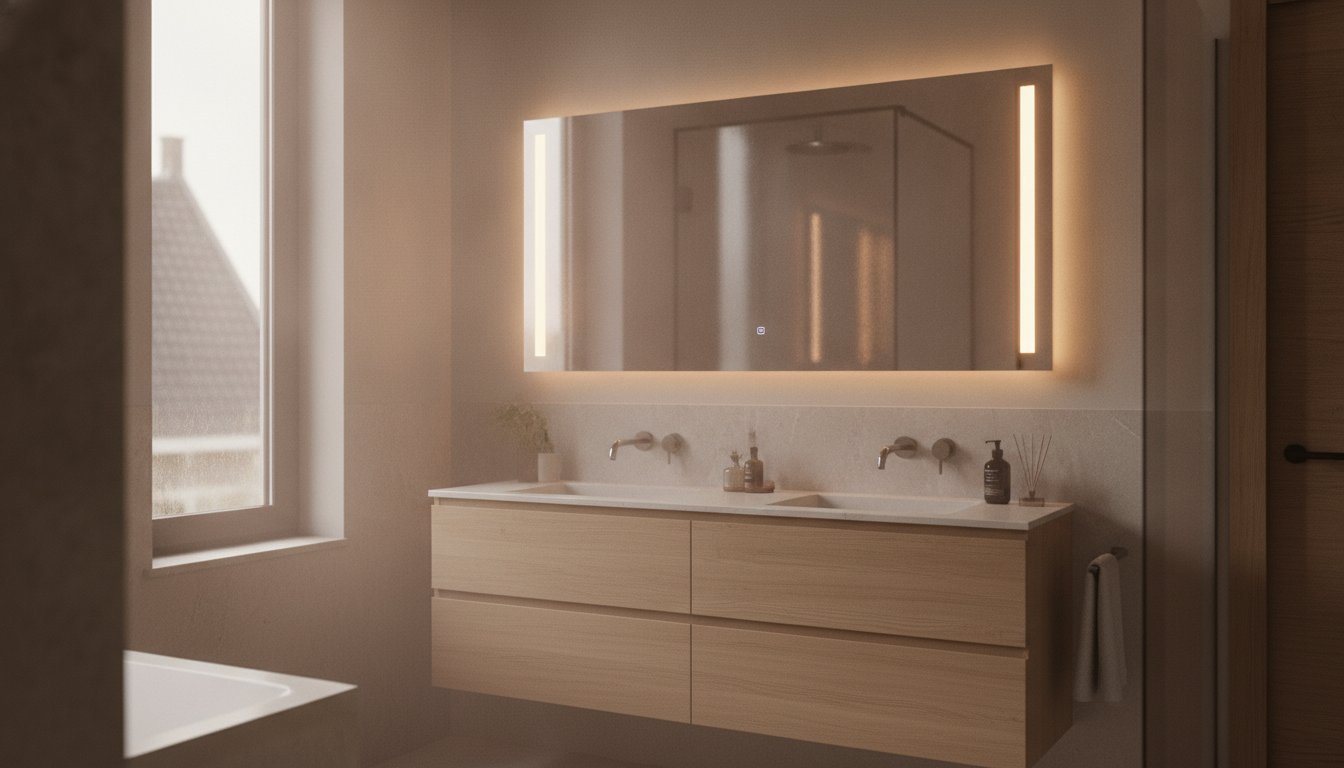
An infrared bathroom mirror must fit in two ways: it should work well as a mirror and be a suitable heat source in that position. Ideal viewing height does not automatically indicate where heating works best. Assess mirror use, available wall space and heat demand as one design question.
We help private and business end users with that assessment and support installers and wholesalers with suitable products and available documentation. This guide focuses on technically integrating a heating mirror in the bathroom.
Key points
Confirm that the product is intended for space heating, not just demisting. Have heat loss, mounting position and electrical connection assessed. Check lighting and controls separately. Less mirror condensation does not mean moisture is removed from the bathroom.
What does an infrared mirror do in the bathroom?
A heating element warms the mirror panel, which releases energy through radiation and convection. Users may receive radiant heat while other surfaces and air also warm up. The ratio of heat-transfer forms depends on the model. The product therefore does not heat people exclusively or prevent ventilation losses.
Difference from separate demisting film
Film behind a mirror may be intended to heat a limited area and reduce misting. This does not prove sufficient room-heating output. A mirror designed for space heating has a different product function. Compare heated area, nominal output, controls and conditions and do not assume one category always lasts longer than the other.
Technical specifications and required output
Heating the whole bathroom requires a heat-loss calculation considering insulation, glazing, ventilation and desired temperature. Volume and floor area alone do not determine output. A standard link between panel output and bathroom size is not a reliable selection aid for every home. For supplementary warmth, also assess where someone stands and how long the bathroom is used.
Size and viewing height of your infrared bathroom mirror
Check approval for horizontal and vertical mounting; this varies by product. Rotation does not automatically change radiation reach in depth. Check whether all users can see themselves and warmth reaches the desired spot without obstacles. For large sizes, also ask about weight, brackets and substrate.
Safety and installation of the infrared mirror
Have a qualified installer assess the exact position and bathroom electrical installation. Product application, water exposure, protection, connection and operation must align. Do not treat a general zone table or IP rating as complete permission for a mounting position. The product manual and current requirements for the actual project are decisive.
Required earthing follows from protection class and product diagram. Glass type and safety characteristics must also be documented, not assumed from “mirror panel”. Use prescribed fixings for weight and substrate and retain necessary clearance. The back and connections may become warm.
Existing lighting point and rented property
A lighting point behind the mirror is not automatically suitable for the heating load or desired separate controls. Have the complete connection checked. In rented property, agree permitted mounting and electrical alterations with the landlord beforehand. Consider reinstatement on departure and have a fixed connection properly finished rather than simply removing the mirror.
Condensation and moisture: what a heating mirror can do
Heating the glass can reduce condensation on the heated surface if sufficiently above the local dew point. Warm-up time, moisture load and heated zone affect results. Edge areas may respond differently. An always-clear mirror or corrosion prevention throughout its life is not a general guarantee.
The mirror does not remove water vapour or guarantee drying walls from within. Ventilation and addressing leaks or other moisture sources remain necessary. Assess mould by its cause. Heating does not eliminate cleaning or provide general medical or air-purifying effects.
Coordinating functions and controls
Check the functions actually present: space heating, demisting, lighting and possibly dimming. Not every LED mirror has an independent heating function. Ask whether light and heat work separately and which connection, driver and thermostat are required. An extra ceiling panel is not a standard requirement; total heat demand determines whether supplementation is needed.
Programme heating according to routine and measured warm-up time. A presence sensor may start too late for brief bathroom use. Check what happens after power or internet failure and whether manual operation remains available. An app only shows measured electricity if the system actually measures it.
Costs and maintenance remain product-specific
A 600-watt mirror heating continuously at full power for one hour uses about 0.6 kWh. Multiply actual on-time and output by your tariff for a cost estimate and include lighting separately if specified separately. Follow maintenance instructions for glass, cable, fixings and controls. Warranty and expected lifespan are different conditions.
Our proposal for your mirror and bathroom
Send photos, a floor plan and wishes for mirror use, lighting and warmth. We discuss options with private and business customers and coordinate available products and documentation with installers and wholesalers. This establishes whether one mirror fits or another combination suits better.
Frequently asked questions
Should the mirror keep heating all day?
Not automatically. Match the programme to the function: space heating, brief comfort and demisting may need different times. Keep necessary bathroom background temperature and moisture management in mind. The best setting follows from use, heat loss and product conditions, not general advice always to heat only during occupancy.
Can I use the mirror in any bathroom?
No. The model must suit the specific mounting and complete installation. Consider water, hot surfaces, users and maintenance access. Correct installation reduces risks but does not automatically make touching safe. Follow clearances and operating instructions and have uncertainties assessed before installation.
Documentation and further reading
Separate demisting film is a different product from a heating mirror. The official Termofol manual for film behind a mirror (English, PDF)Open PDF in a new tab illustrates such a film application. Always use the exact mirror version’s manual to install your infrared bathroom mirror.