
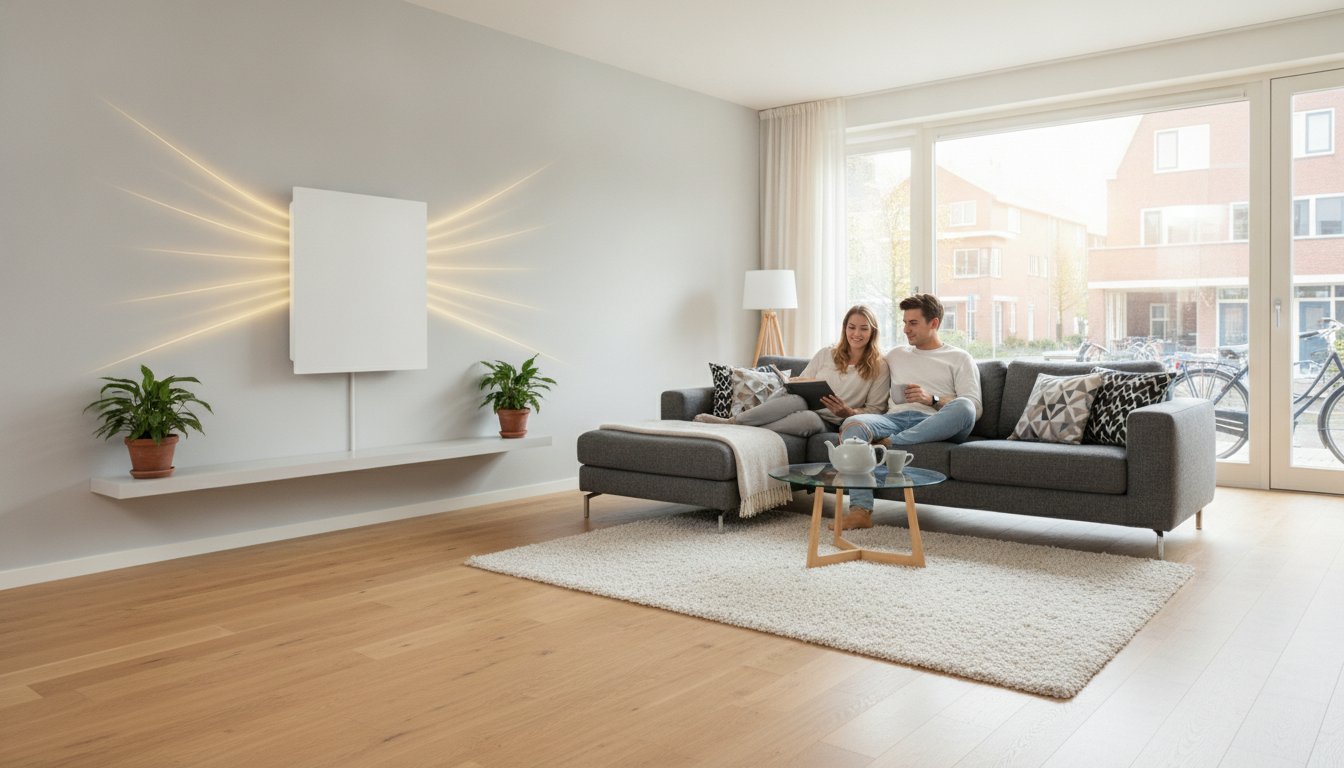
Illustration: the yellow lines clarify the heating principle. Infrared radiation itself is not visible.
Infrared radiators are electric heaters in various forms. Sometimes they are flat panels; sometimes they resemble traditional radiators. Start with model data and intended use. Read how to assess heat emission, capacity, installation and controls for a home, workstation or customer project.
Look beyond the product name
Ask which heating element, heat emission and controls the specific version has. Compare input power, dimensions, weight and permitted mounting. A robust housing or the word radiator does not prove wider coverage, lower consumption or longer lifespan.
How do infrared radiators release heat?
A warm appliance can radiate heat to people and surfaces and warm air by convection. The ratio varies by version. An ordinary radiator also radiates heat. An infrared radiator therefore does not eliminate air movement, and a flat panel is not automatically technically equivalent to every other appliance bearing that name.
Comparing performance on the same basis
With electric resistance heating, almost all input electricity eventually becomes heat. This is not the same as radiant fraction or running costs. A heat pump can transfer ambient heat and must be assessed as a different technology. Compare installation, controls, maintenance and energy for the same heat demand and comfort.
Radiant heat can contribute to comfort but does not guarantee dust-free air, balanced humidity or treatment of allergies and asthma. Ventilation and cleaning remain necessary. Warmer surfaces may reduce condensation; persistent moisture problems also require investigation of the cause. Fixed savings or a lower thermostat setting cannot be promised for every room.
Infrared radiators in homes and businesses
A seating area, workstation, bathroom and industrial hall do not need the same version. Assess coverage and obstacles for local heat. In a bathroom, model approval, mounting position and electrical protection must all align; an IP code alone is insufficient. Industrial environments also require attention to dust, vapours, accessibility and any special requirements.
Metal, glass, mirrors, printing or RAL colours are model-specific options, not universal product properties. Check whether wall or ceiling mounting is permitted. A mirror that helps reduce condensation is not necessarily sized to heat the whole room.
Choosing capacity from room requirements
Have heat loss, insulation, windows, external surfaces, ventilation and desired temperature considered. Fixed watts per square or cubic metre do not provide a full calculation. More output does not automatically mean lower consumption. Appliance numbers follow from required heat emission and possible mounting positions, not a standard two or three radiators per living room.
Combining with existing central heating or a heat pump may be possible. Coordinate controls and occupied zones to limit unnecessary simultaneous heating. Your own solar electricity may cover part of consumption, but generation and heat demand do not automatically coincide. Use your own current tariffs when comparing costs.
Installation, controls and maintenance
Check substrate, load-bearing capacity, fixings and clearances according to the manual. Ceiling mounting is not always the best choice. Have a qualified installer assess supply, protection and combined electrical load. A fitted plug or wireless thermostat does not make every connection or location suitable.
Choose a compatible thermostat, receiver and sensor position. Functions such as wifi, window detection or energy measurement vary by combination. Follow cleaning and inspection instructions and keep connections accessible where required. Low-maintenance does not exclude faults, wear or component replacement.
A proposal based on your information
We supply private and business end users, installation companies and wholesalers. Share dimensions, photos or a floor plan, insulation and operating times. State existing heating and mounting and control preferences. We discuss suitable combinations for your building or customer project and identify technical information still required.
Frequently asked questions
Can the outside become hot?
Yes. Surface temperatures vary by version and may pose a contact risk. Choose an approved mounting position with children, pets and other vulnerable users in mind. A temperature limiter does not automatically make touching safe. Do not cover the appliance unless expressly permitted.
Does every appliance last more than twenty years?
This cannot generally be promised. Lifespan depends on product, environment and use and is not the same as warranty. Check conditions for heating element, finish, controls and accessories separately.