
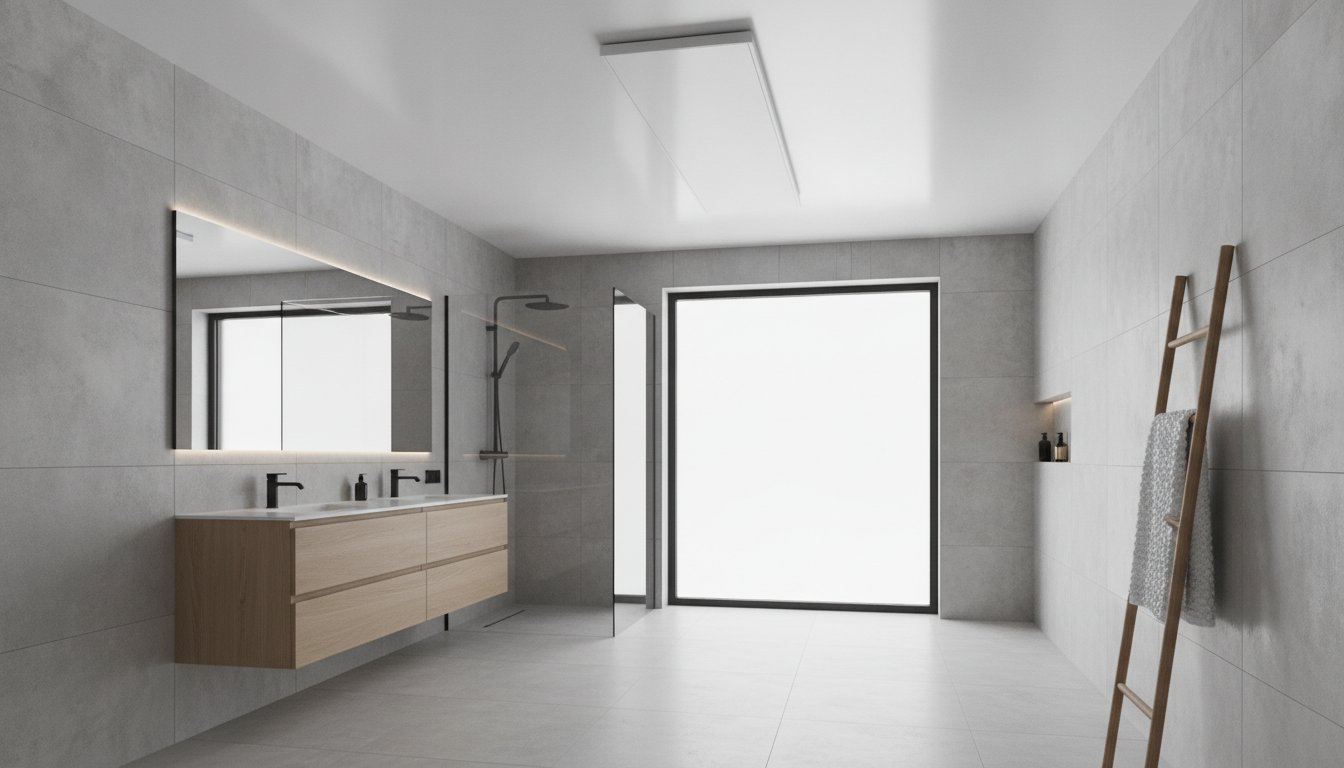
Bathroom ceiling heating with an infrared panel can leave wall space free. Choosing takes more than a suitable size: the appliance must suit its position, the structure must support it and heat must reach the intended occupied area. This guide helps residents and professional partners assess these points beforehand.
The key checks before you start
Check bathroom layout, product approval, ceiling construction, heat loss, electrical connection and controls. An IP code does not generally permit mounting above a shower. A ceiling panel also does not guarantee a warm floor, condensation-free mirror or disappearance of moisture problems.
When is bathroom ceiling heating suitable?
Where wall space is limited, the ceiling may be useful if the manufacturer permits that orientation. Assess coverage and any obstruction from cupboards or shower screens from the basin, changing area or other occupied zone. Wall mounting or another heat source may fit better if ceiling height or layout is unfavourable.
A warm panel emits radiant and convective heat. Some radiation may reach the floor or other surfaces, but warming depends on distance, obstruction, material and operating duration. Panel response time is not the same as the time needed to bring the whole bathroom to temperature.
Safety in a damp room
Have a qualified installer assess current requirements and exact bathroom geometry. Product approval, mounting position, IP protection, supply and electrical safeguards must align. Do not copy mounting above a bath or shower from a general image. The Netherlands and Belgium have their own requirements; an old standard reference is not complete installation advice.
Temperature and accessibility can matter even at the ceiling. Maintain prescribed distances from materials and obstacles. Rear insulation does not automatically permit mounting on wood, plasterboard or a suspended ceiling. Check the exact version’s manual and have substrate and fixings assessed.
From ceiling construction to a connected system
Check panel weight, load-bearing capacity and the specified mounting kit. A ceiling board does not automatically support a panel’s load. Laying into a modular ceiling is possible only with an approved combination. Have cable routing, connections and access prepared; do not conceal necessary connection points where inaccessible.
Match thermostat, receiver and sensor to the chosen panel. Wireless controls may reduce signal wiring, but heater and receiver still need suitable power. Wifi, apps and energy measurement depend on the model. Use a schedule accounting for actual bathroom warm-up time.
Comparing with radiators and underfloor heating
Compare at the same desired temperature and operating times. A ceiling panel is not an underfloor-heating system, and a water-fed radiator is not automatically slow or inefficient. Warm-up time, costs and suitability depend on the complete installation. Whether the existing radiator can be removed follows from heat loss, available heat emission and electrical capacity.
Determine output from actual heat demand and intended application. General watts per cubic or square metre do not replace a calculation for your bathroom. Consumption is input power in kW multiplied by actual on-time. Compare running costs with your own total energy tariff.
Our advice on bathroom ceiling heating
Some panels combine heating and LED lighting. For the exact version, check light output, colour temperatures, dimming and separate controls. A glass or mirror panel is not automatically suitable for the ceiling. The chosen finish, mounting and bathroom position must be permitted together.
We supply private and business end users, installation companies and wholesalers. Send a floor plan or photos, ceiling height, structural details, insulation and desired operating times. State existing heating and electrical connections. We discuss product options and technical assessments still needed for your room or customer project.
Use, maintenance and indoor climate
A heating panel does not replace ventilation, cleaning or addressing moisture problems. Warmer surfaces may reduce condensation but do not prevent mould or a misted mirror under every condition. Follow the chosen product’s manual for cleaning, checks and warranty. Keep maintenance access even with ceiling mounting.
Frequently asked questions
Can the panel go above a shower?
An IP code or height alone cannot answer this generally. Have the exact position and chosen model assessed beforehand. Order only once mounting approval and electrical installation conditions are clear.
Can I operate light and heat separately?
Only if the chosen combination supports it. Check the manuals for panel, lighting, receiver and remote control. Functions of another model or earlier version do not guarantee your product’s functions.