
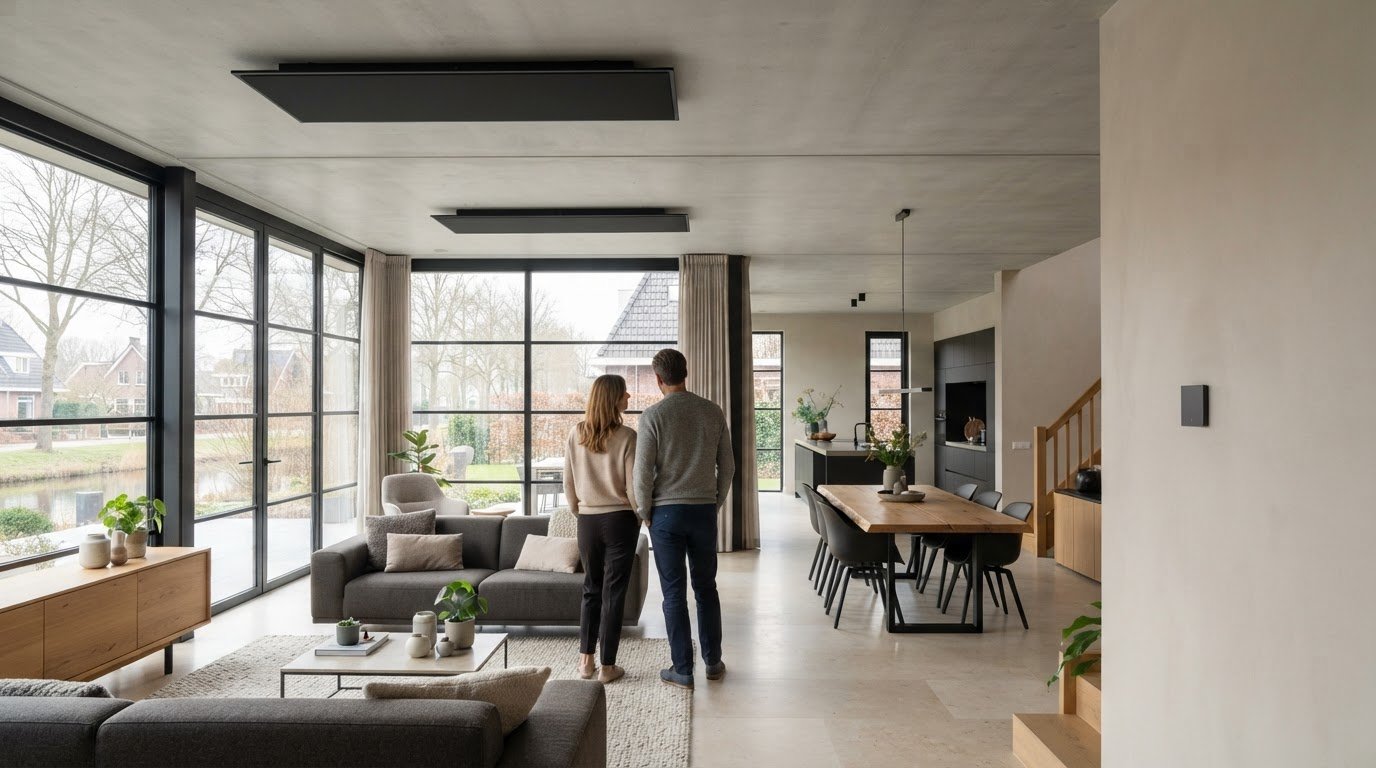
Black infrared panels can stand out against a light wall or blend with a dark ceiling and black interior details. Choose the colour for its appearance, but assess heating output and consumption using the actual model data. A visibly black colour does not prove that a panel heats better than a white version.
We discuss finish, heat output, positioning and controls for homes and business premises. Installers and wholesalers can also contact us for suitable product selection and project information.
Key points
Black is a design choice, not a general efficiency advantage. Compare models by power, dimensions, weight, permitted mounting and controls. Consider gloss and material for the interior, and assess bathroom use and fastening according to the product manual.
What are black infrared panels and why choose them?
These are electric heating panels with a black finish. Their warm surface releases heat through infrared radiation and convection. This warms people and surfaces and ultimately the air too. A panel does not eliminate air movement or heat loss. Nor does it solve ventilation problems or provide medical treatment.
The role of black in an interior
A matt panel may look discreet on a dark ceiling, while glossy glass may reflect light and its surroundings. How conspicuous it looks depends on lighting, size and positioning. Also consider the colour of the frame, brackets, connection and cable: these details help determine how well the whole installation fits the design.
Heat output: assess the model, not just the colour
Emissivity describes how a surface emits thermal radiation compared with an ideal black body. That ideal concept is not the same as a product painted black. Properties at thermal infrared wavelengths do not follow simply from the colour visible to the eye. White coatings can also have high thermal emissivity. A general claim that black is warmer or more economical than white is therefore not justified.
Comparing consumption and comfort
A 600-watt panel running continuously at full power for one hour uses approximately 0.6 kWh, regardless of its visible colour. Required operating time depends on heat loss, settings, positioning and usage. Assess radiant fraction and temperature distribution using data for the specific model and measurement method. We do not promise savings or a fixed air-temperature reduction based on colour.
Materials and finishes: matt metal and glossy glass
Metal and glass may differ in appearance, weight and cleaning requirements. Warm-up and cooling behaviour also depend on mass, construction and controls; material alone does not determine a fixed result. Check product data for dimensions, surface temperature, weight and coating. Availability of matt, gloss or a particular RAL colour varies by brand and model.
Bathrooms, glass and mirror versions
Black glass does not establish bathroom suitability. Check the exact model, permitted position and electrical installation. An IP rating alone is not sufficient for every bathroom zone. Dark glass is not automatically a usable mirror either. For a mirror version, check reflection, lighting and heated area. Heating does not replace ventilation and moisture control.
Installation and positioning
Wall and ceiling positions may both suit a panel approved for that mounting. Furniture can obstruct direct radiation; distance and orientation determine which places receive it well. Ceiling mounting is not always more efficient and does not give a 360-degree radiation angle. Follow the model’s mounting height and clearances. Heat may also develop at the back.
For primary heating, have heat loss and the target temperature assessed. A fixed wattage-per-square-metre rule is insufficient. Choose fixings suited to weight and substrate, with particular care for ceiling mounting. Timber or plasterboard is not automatically suitable because the back is insulated. Have fixed electrical connections and total load assessed by a competent installer.
Controls and combination with floor heating
Choose a compatible thermostat and match schedules to occupied hours. Combining with electric underfloor heating may be desirable, but is not standard practice or automatically more economical. Assess floor construction, temperature limitation and control of both systems separately. A black finish does not change these technical requirements.
Our advice on black infrared panels
Send us photos, a floor plan, dimensions and your preference for a matt or glossy appearance. We help private and business end users assess design and heat demand together. With installers and wholesalers, we discuss product documentation, fixings, controls and available versions for their project. We confirm stock, customisation and warranty per product.
Choose for both appearance and suitability
A suitable black panel can be an attractive addition to your interior. Ask us for a proposal with the right configuration and controls, without attributing an efficiency advantage to colour.
Frequently asked questions about black infrared panels
Are black panels warmer than white ones?
You cannot infer this from colour. Compare actual models, operating temperature and heat output under the same conditions. The physical concept of a black body is not evidence of a black product’s performance.
How do I clean the surface?
Switch off and allow cooling according to the manual. Use only cloths and products permitted for the coating or glass. Avoid abrasive or aggressive products and do not spray liquid into connections. Low maintenance does not mean maintenance-free: also check cable, fixings and controls.
Can I paint the panel black myself?
Not without the manufacturer’s express permission and instructions. A different coating may affect heat output, surface behaviour and warranty. Choose a factory finish or ask us which colour options are available for that model.