
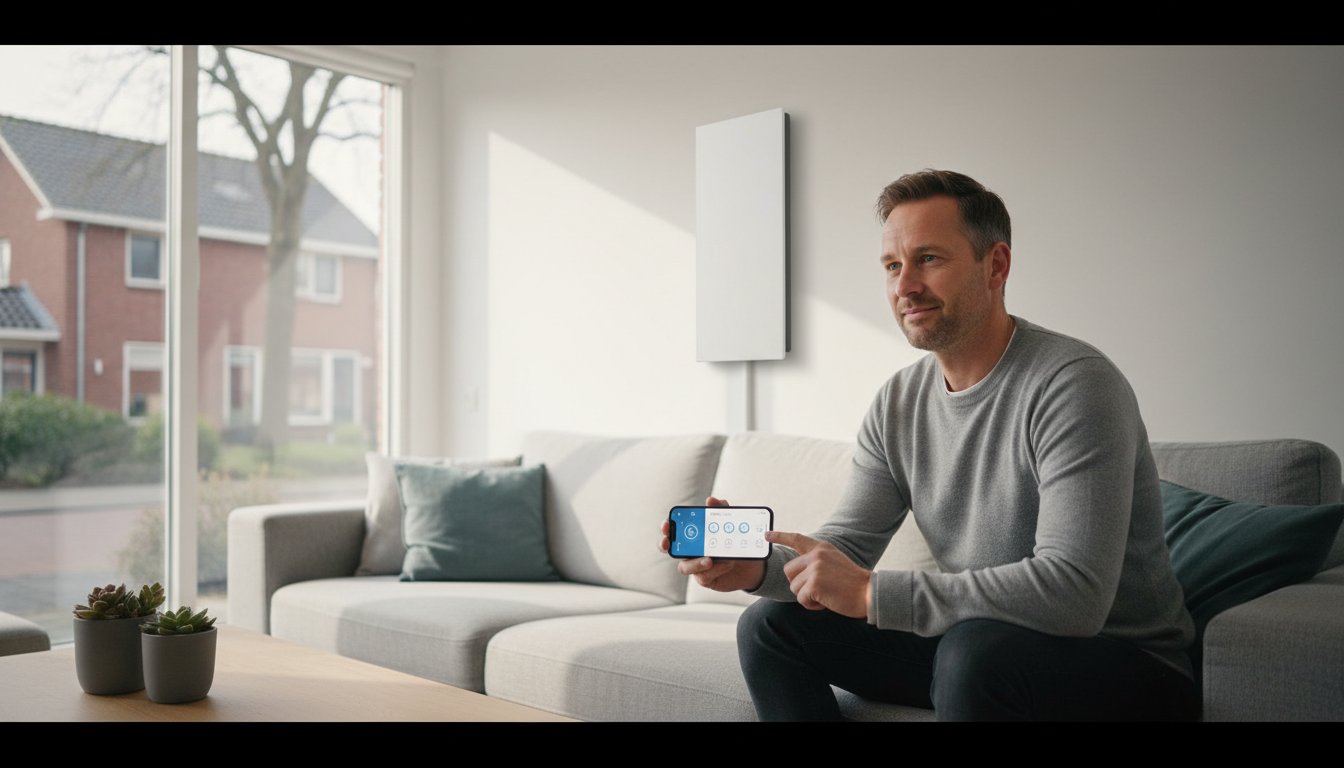
Infrared panels with thermostats combine a heat source with a way of sensing and controlling it. A complete kit can be convenient if every component suits the panel, room and electrical load. This guide compares the practical differences between built-in, external and connected controls.
Key choices
Ask exactly what the kit includes, where temperature is measured and which functions work locally. Check zone count and permitted load. An app, small temperature step or the word smart does not prove savings or compatibility.
Distinguishing sensing, control and switching
The sensor measures temperature; the controller compares it with the target and operates an output or receiver. Together they determine heat demand. Actual behaviour depends on model and settings. Not every controller modulates output: switching on and off may be normal operation.
A thermostat cannot correct an undersized or badly placed panel. First establish heat demand and layout. An infrared panel warms exposed people and surfaces but also produces convection. Ventilation, heat loss and comfort outside its field remain relevant.
Built-in, external, plug-in or connected
Built-in controls reduce separate parts, but check sensor position and access to controls. An external room sensor offers placement options; it is not automatically more accurate in every layout. Follow sensing and mounting instructions for both and assess results where people use the room.
Compare our thermostats and controls by function, connection method and compatibility with your panel.
A plug-in controller must suit the appliance, load and socket. Wireless communication does not replace power wiring to the panel. App control may need a gateway, network or account; check what works locally during failures and whether settings survive power loss.
Check the exact model combination and permitted receiver or zone count. Devices sharing a protocol name are not automatically compatible. For several panels, add connected loads and have receivers, contacts and electrical protection assessed. A generic wattage limit cannot replace product instructions.
Matching controls to each room
Living rooms, guest rooms and offices have different usage patterns. Create zones where separate control makes sense and avoid using one sensor to represent several closed rooms. Discuss simple operation, temporary overrides and permissions for shared spaces. A schedule only suits use when occupancy matches it.
In bedrooms, also assess switching sounds and operation in the dark. In bathrooms, panel, sensor, receiver and location must suit the conditions together. An IP code does not approve every shower location. Mirrors are not condensation-free in every condition, and a boost mode cannot replace necessary preheating.
Handover and careful commissioning
Follow mounting and electrical instructions for the complete combination. Position the sensor as instructed in a representative place, avoiding interfering heat or draughts where specified. Test demand, switch-off, communication and failure behaviour per zone. Check that the user understands the display and temporary controls.
Change hysteresis, control method or calibration only where supported by the manual. A differing display first calls for assessing sensor location and measurement conditions. An arbitrary offset may hide a fault. Record final settings and avoid changing several parameters at once when assessing behaviour.
Our support with a complete kit
We advise private and business end users, installers and wholesalers. Discuss room count, existing panels, outputs, model numbers and required controls. For existing electronics, we seek a demonstrably compatible combination rather than an arbitrary universal switch replacing prescribed controls.
Use and management still matter
Review schedules when occupancy changes and follow cleaning, battery and inspection instructions. Smart controls do not make a system maintenance-free or automatically climate-neutral. Compare actual consumption and comfort before and after changes; no universal savings percentage or guaranteed payback applies.
Request a quote for panels and controls
Frequently asked questions
Can one thermostat control different rooms?
Some systems manage multiple zones, but need suitable components and separate measurements. One sensor and shared heat demand cannot provide independent room temperatures. Check the proposed zoning against the exact system’s capabilities.