
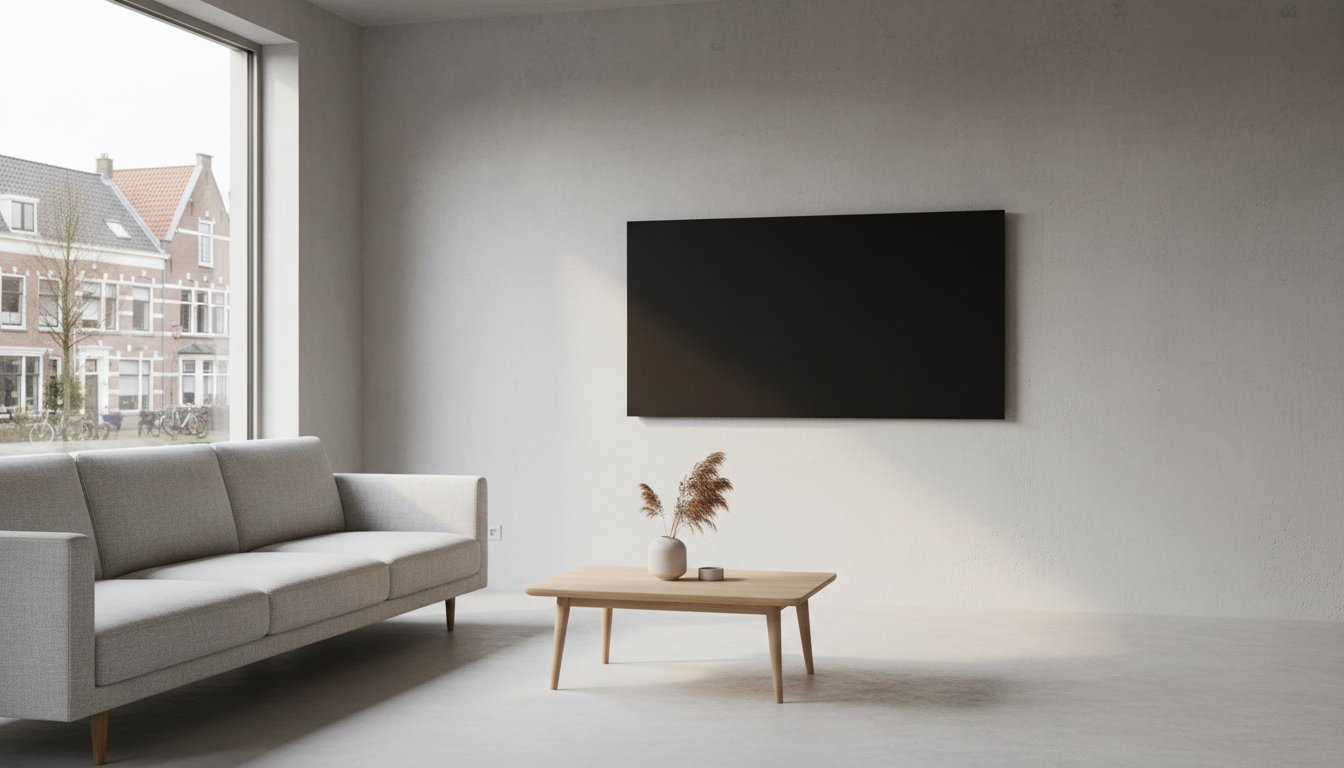
A black infrared panel can blend into a dark interior or contrast with a light wall. Choose based on appearance and model data. Colour alone does not prove higher efficiency, lower consumption or faster warm-up than a white panel. We help compare power, material, installation and controls together.
Key considerations
Compare specific versions under the same usage conditions. Base power on heat loss and check permitted installation. General guarantees about warm-up time, resistance to breakage or stains, service life or savings are not justified without model data.
Colour, emissivity and heat output
Visible colour and emissivity in the thermal infrared are different properties. Both black and white coatings can have high infrared emissivity. Product comparisons require data for the exact construction and finish. A warm panel also transfers heat by convection; it does not make a room dust-free and ventilation remains necessary.
Black glass or black metal
Glass and metal differ in appearance, finish and sometimes weight or heat storage. The complete construction determines how a model warms and cools; there is no fixed time for each material. Compare weight, fixings, surface temperature and cleaning. Safety glass is not unbreakable, and a matt coating is not automatically resistant to scratches or fingerprints.
Assessing power and placement
A building year or fixed wattage per m² is insufficient for a final choice. Insulation, glazing, ventilation, desired temperature and use determine heat loss. Also assess radiant coverage and obstacles. Multiple panels may improve distribution but are not necessary in every room. Ceiling installation is not automatically more efficient than wall installation.
Installation, controls and maintenance
Follow the manual for location, wall or ceiling load, fixings and clearances. Have electrical work assessed where specialist knowledge is needed. A bathroom or lightweight plasterboard structure requires a separate suitability check; colour or low weight does not establish safe installation.
Choose a compatible thermostat and coordinate schedule and sensor position with the room. A modulating controller or smart-home connection is not available or necessary for every panel. Clean only as instructed for the model, switching off safely and allowing it to cool as prescribed. Do not paint, cover or modify the surface without permission.
Advice for homes, businesses and installation partners
We help private and business end users and also supply installers, dealers and wholesalers. Share dimensions, insulation, intended installation and preference for glass or metal. We compare suitable models and controls. Non-standard dimensions, RAL colours and other options depend on the manufacturer and version.
Assess the complete heating plan
Compare purchase, installation, controls and consumption over the same usage period. Combining an electric panel with solar panels does not automatically make a home carbon-neutral: consumption, generation, timing and other energy supplies matter. Warranty and expected life vary by model. Check the terms and consider controls, connections and possible replacement.
Frequently asked questions
Does a black panel get hotter or use less energy?
This does not follow from visible colour. Compare temperature, heat output, power input and controls of the specific models under comparable conditions.
Can the panel go on plasterboard or in a bathroom?
Only when the model, structure, fixings and location are suitable. A general choice of toggle fixings or an IP44 rating alone is insufficient. Have the specific situation assessed and follow the manufacturer’s instructions.