
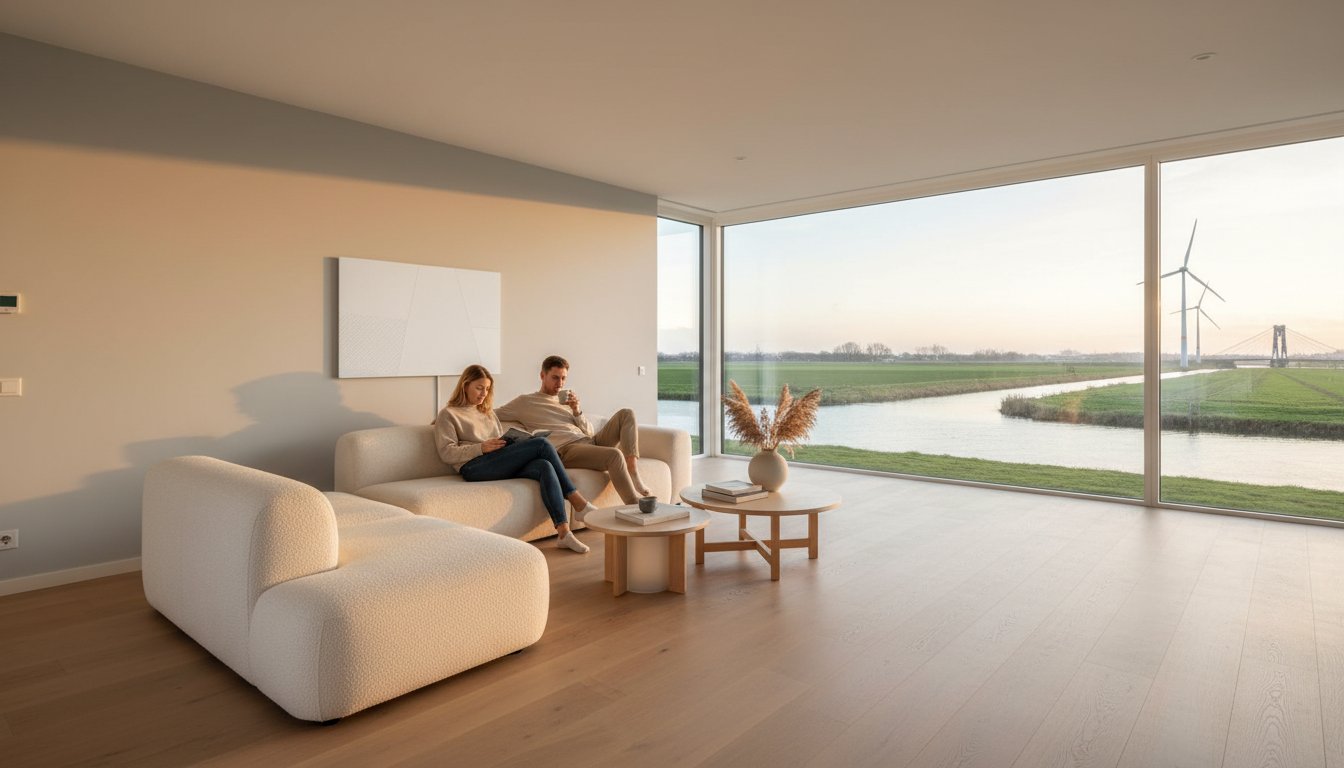
An infrared panel in the living room can provide local warmth or form part of a complete heating plan. Start by asking whether you need local supplementary heating or want to heat the entire room. That difference determines the required assessment, positioning and controls. We compare options for your home or customer project according to heat loss, use and comfort wishes.
Key considerations
Calculate heat demand and assess where you sit or work. Compare total running costs with existing heating and possible alternatives. Good insulation and suitable controls help but do not give a general percentage saving. Ventilation, cleaning and protection from hot surfaces remain necessary.
Supplementary or primary heating?
Targeted heat at a sofa or dining table may suit supplementing an existing system. Check that the rest of the space stays sufficiently warm. Primary heating requires a calculation also including cold conditions, ventilation losses and adjoining rooms. An energy label or construction year alone does not prove a chosen panel is sufficient.
Heat transfer, efficiency and consumption
An electric panel emits heat through radiation and convection. Electrical conversion efficiency differs from the radiant heat fraction or savings on your energy bill. In a resistance appliance, the electricity drawn ultimately becomes almost entirely heat. A heat pump uses a different principle and must be compared for the same heat demand using performance under the relevant conditions.
Calculate consumption as power in kW multiplied by actual operating hours. A 600 W panel heating continuously for three hours uses 1.8 kWh. Multiply that by your electricity tariff and include other heat sources in the comparison. Thermostat control can limit operating time; a panel does not guarantee lower total costs.
A version suited to the interior
Compare metal, glass, mirror and image panels by appearance, exact size, weight and mounting. Consider output and model dimensions together: the panel must deliver the desired warmth and fit the available position with all prescribed clearances. RAL colours, your own image and integrated lighting depend on the model. For lighting, check whether heating and light can be controlled separately. Colour or a luxury finish does not by itself prove higher efficiency.
Assessing output and positioning
Have heat loss calculated for the actual space. Fixed values per m² or m³ are at most indicative. Map seating, dining table, windows, doors and obstructions. Wall and ceiling mounting each have possibilities and limitations; the best position follows from the room and permitted mounting for the model. Not every living room needs multiple panels.
Use a compatible thermostat and position its sensor according to instructions, away from unwanted sun, draught or direct radiation influences. Match the programme to use and the existing heating system. Wi-Fi or modulating control is not available or necessary for every panel.
Advice and supply for your project
We advise private and business end users and also supply installation companies and wholesalers. Share a floor plan, insulation information, existing heating and the positions where you want warmth. We compare suitable panels and controls and discuss available documentation for your version.
The overall energy plan matters
An electric panel does not automatically replace all gas use in the home. Other rooms, domestic hot water and cooking must also be considered. Solar panels do not make consumption free or carbon-neutral at every moment. Compare demand, generation, usage times and energy tariffs before assessing a complete switch.
Frequently asked questions
How many panels are needed for 30 m²?
Floor area alone is insufficient for a reliable quantity or wattage. Heat demand, ceiling height, glazing and desired distribution must first be assessed.
Are panels safe for children and pets?
Panels can become hot and cause burns. Choose a permitted mounting position where contact can be prevented, maintain clearances and do not cover the appliance. Low mass or a temperature limiter does not rule out contact risk. Follow the model manual.
How do I assess installation and product quality?
Compare product data, permitted mounting, controls, warranty and maintenance instructions. A high price or general quality claim alone does not prove lower consumption. Check supporting structure and electrical capacity and use a professional where needed. Clean and inspect according to the manufacturer; expected service life and warranty are different things.