
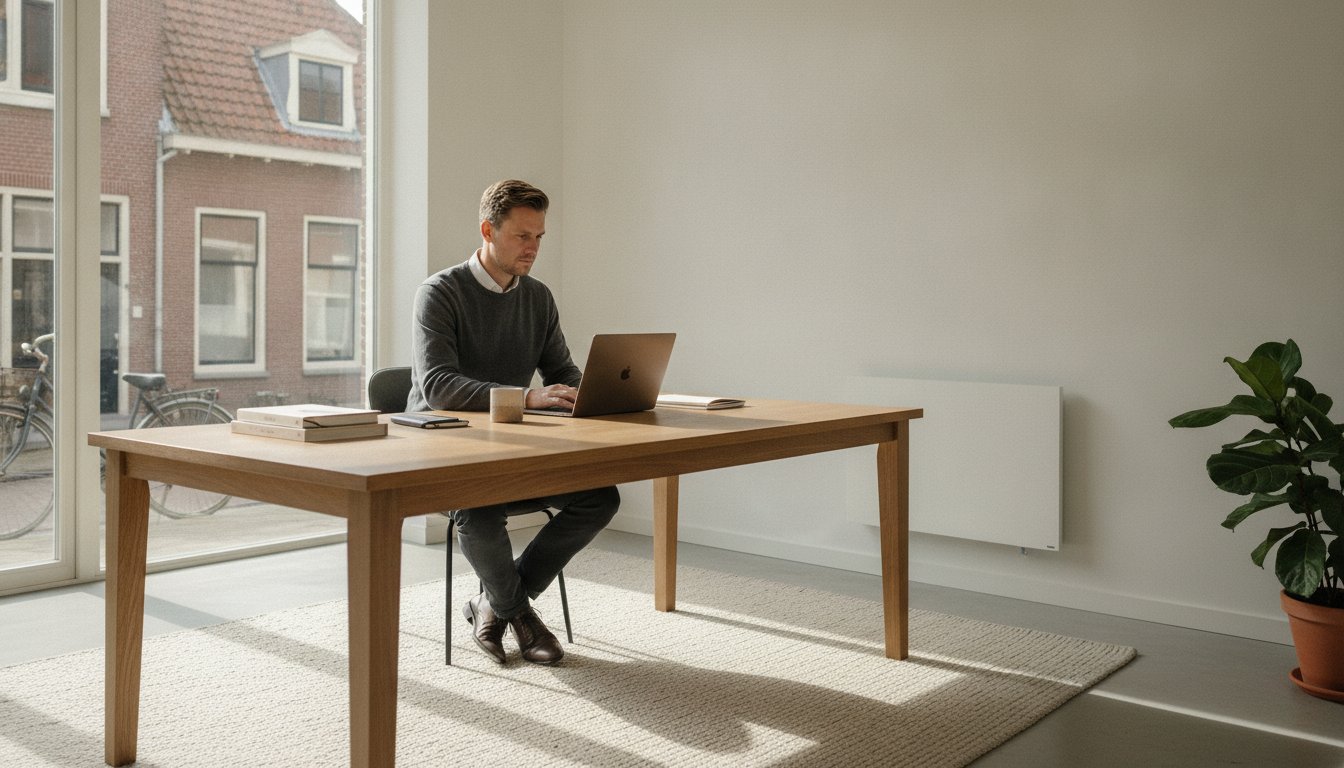
An infrared panel in a home office may add warmth where you sit still. This can be useful at a desk, but a suitable plan involves more than mounting a heater above your chair. Consider demand, coverage, clearances and whether you need personal supplementary warmth or full room heating.
This guide helps choose a practical home-office arrangement. It does not promise increased productivity, concentration or medical benefits. Comfort also depends on the workspace, clothing, air movement and personal preference. Compare all heating energy together before expecting savings.
Key points
Identify where extra warmth is needed. Check furniture and monitor obstructions and choose a model approved for the intended position. Match output and controls to the room. Maintain ventilation and movement space and assess electrical load.
Heating one workstation or the whole room?
For personal supplementary warmth, assess the desk and chair alongside existing background heating. Primary heating must cover the room’s heat loss. These goals need different assessments. A small desk panel that comfortably warms legs is not automatically sufficient for the whole room.
If reducing other heating, consider occupants and moisture or frost protection. A fixed fifteen-degree background setting is not suitable for every building. Solar generation does not always coincide with work hours either; assess actual production, demand and costs rather than assuming energy-neutral working.
Distinguishing warmth from indoor-air claims
A panel transfers heat through radiation and convection. It may have no fan, but that does not eliminate air movement. Relative humidity depends on temperature, ventilation and moisture production. A panel does not guarantee dust-free air, less dry eyes or better cognition and does not treat allergies.
Fanless designs avoid fan noise, but relays or expansion may still be audible. Compare specifications if noise matters during calls. Ventilate, clean and investigate recurring damp. A warm wall does not prove mould cannot return.
Choosing a desk, wall or ceiling model
A dedicated desk panel may allow under-desk mounting, but do not substitute a general wall panel. Check clearances to legs, materials and cables, preserving movement. Freestanding models need approved feet, stability and clear walkways. Higher output at short distance is not automatically more comfortable.
Wall or ceiling mounting can free space. Choose by model approval, occupied position and layout. Monitors or cupboards can obstruct radiation, but ceiling mounting does not guarantee unobstructed distribution. Select materials, colours or prints from available versions. With LEDs, both light and heat must suit the workspace.
Assessing capacity, placement and controls
For primary heating, assess insulation, windows, exposed walls, ventilation, dimensions and target temperature. A fixed 20-to-45-watt-per-cubic-metre formula is insufficient. Slight oversizing does not prove lower consumption. For local warmth, assess coverage at the occupied chair too.
Match fixings to weight, structure and instructions. Universal brackets or supplied plugs do not automatically suit your ceiling. Check sockets and circuit load. Have fixed wiring and changes done by a qualified installer. Hot surfaces can burn even on brief contact.
Use compatible thermostats or timers. Match work hours and test room warm-up. Presence sensors must recognise seated, still occupants. Check shutdown after work and manual control for changed schedules.
Advice for home workers and business projects
We support private and business end users, installers and wholesalers. Share a floor plan, desk and chair photograph, dimensions and existing heating details. Explain where extra warmth is needed and how long the workstation is used. We can then compare models, controls and positions concretely.
Check the workstation during normal use
Assess comfort through a normal workday, changing one setting at a time. Compare energy in similar weather, including other heating. Low maintenance is not maintenance-free: follow care and inspection instructions. Cool and safely disconnect where required, checking mounting, cable and controls for damage.
Frequently asked questions
Can it heat the whole office?
Only if the installation is suitable and adequately sized. Comfort near one panel does not prove room temperature will hold in cold weather. Assess primary heating separately for loss, capacity, distribution and controls.