
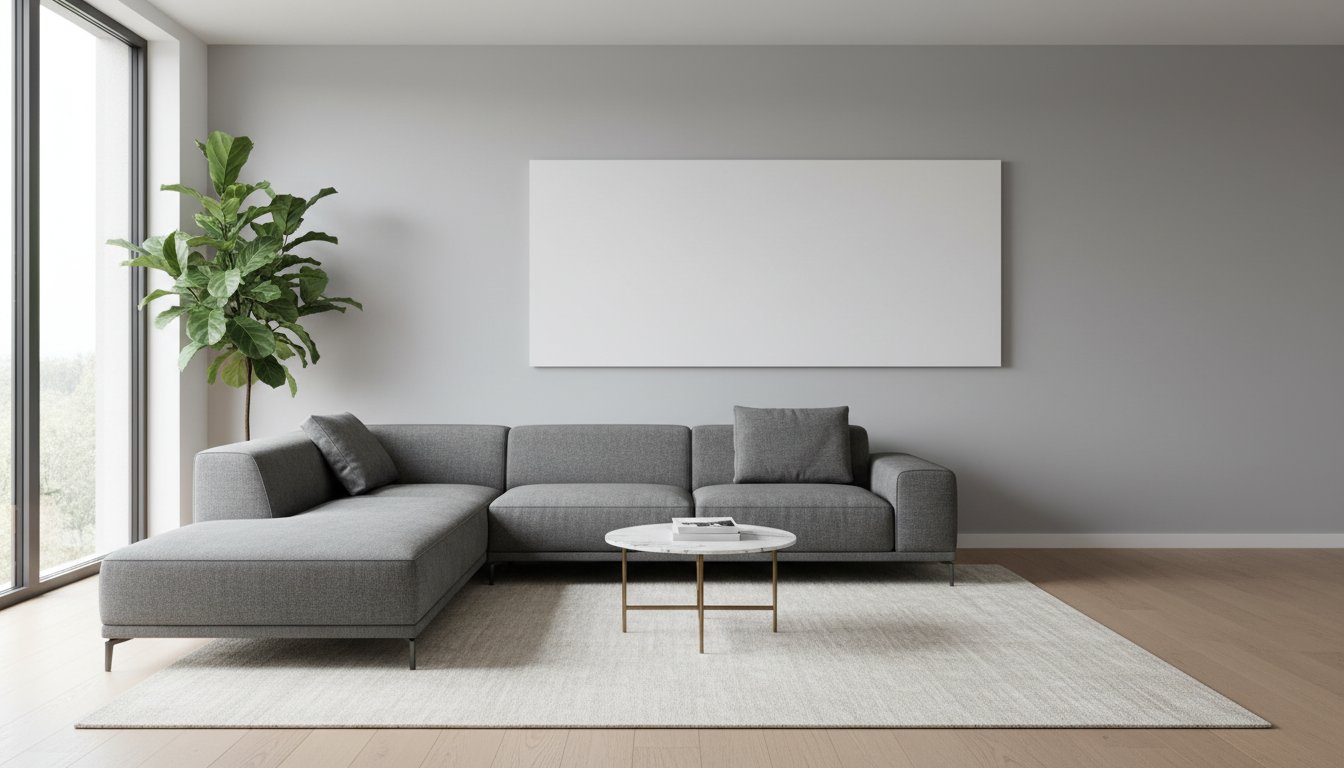
A wall-mounted infrared panel can be a fixed heat source or targeted supplement. Its position on the wall determines which users and surfaces radiation reaches. Start not merely with a free piece of wall, but with the desired warmth and room layout. Then check whether the selected version may be mounted there.
This guide helps private and business end users, installation companies and wholesalers prepare a wall-mounted arrangement. We consider coverage, finish, fixings, electrical supply and controls together. Wall mounting is not better or worse than ceiling mounting in every room; the application and model requirements decide.
Key points
Determine primary or supplementary heating and calculate the required capacity. Draw furniture and occupied positions on the plan and maintain prescribed clearances. Have load-bearing capacity and electrical load assessed. A slim design, glass panel or metal finish does not prove a fixed warm-up time, lower bill or safe contact.
How a wall panel works
The panel surface is electrically heated and emits radiant and convective warmth. Ordinary radiators emit radiant heat too. A wall panel can reach particular seating or work positions if the radiation path is clear. Furniture, curtains or a door can block that direct warmth. Higher wattage does not automatically make an obstructed position suitable.
Walls and furniture can absorb heat and release it later, but losses through the building envelope and ventilation remain. A panel therefore does not prevent every cold zone or air movement. Assess comfort where you actually spend time, considering air temperature, surfaces, distance and operating duration. Heating panels are not medical treatment and do not make a room dust-free.
Integrating wall heating into the interior
A wall model can suit the available space and leave the floor free. Compare overall dimensions, including fixings and required clearance, not just plate thickness. Do not hide the panel behind furniture. Good integration preserves permitted heat transfer and maintenance access.
For energy costs, compare the same heat demand and actual use. Targeted supplementary heating may differ from heating a whole room. Resistance panels convert almost all electricity into heat, but a heat pump can deliver more heat per unit of electricity by moving environmental heat. Higher emissivity or European origin is not an independent savings guarantee.
Metal, glass, mirror and image panels
Choose the finish alongside model data for weight, output, exact dimensions, temperature and fixings. Assess output and size together so the panel fits the wall with prescribed clearance. Metal does not prove impact resistance, and glass does not prove longer heat release for every version. The complete construction matters. Use measurements and certificates only for the model and conditions they concern.
A mirror can offer a second function, and an image panel can suit the interior if that version is offered. Have image, crop, scope of supply and any customisation terms confirmed. Do not paint the panel yourself or add a frame, fabric or film without approval for the exact product.
For a bathroom, assess model, mounting position, IP protection and electrical connection together. A mirror or glass surface is not automatically suitable for damp conditions, and an IP code does not permit every position. A heated mirror does not guarantee a condensation-free bathroom or replace ventilation or repairs to moisture problems.
Preparing wall mounting step by step
1. Describe heat demand and use
For primary heating, have heat loss calculated using insulation, glazing, external surfaces, ventilation and desired temperature. Only m², m³ or a label does not provide a complete result. For targeted warmth, record distance, operating duration and sitting or working posture. Then distribute capacity over suitable positions without presenting arbitrary excess capacity as a saving.
2. Check mounting position and fixings
Use the model’s permitted orientation and prescribed clearances. There is no universal mounting height of 1.20 to 1.60 metres for every panel. Check load-bearing capacity and suitable fixings for the wall type. Avoid positions where users unintentionally touch a hot surface or furniture could later easily block necessary clearance.
3. Plan supply and controls
Have simultaneous load, cable routes and protection assessed, and fixed work carried out competently. Choose a compatible thermostat and receiver with suitable switching capacity. Position the sensor representatively, away from direct radiation, sun and draughts. Wi-Fi or Zigbee is usable only if the specific components support it; wireless control does not replace the panel’s power supply.
4. Test and document
After mounting, test panel, controls and comfort in actual occupied positions. Check programmes and recovery after power failure, and retain manuals and settings. An automatic presence sensor does not guarantee instant comfort and must also account for seated, still users. Adjust settings only within product instructions.
Discussing your wall arrangement with us
Share a floor plan, photos, dimensions, use and existing heating. We discuss product information and options with you and, where relevant, the installation company or wholesaler. Have delivery, fixings, controls and installation responsibility clearly specified. For subsidy or building questions, have current conditions checked separately; the product gives no automatic exemption or benefit.
Maintaining a suitable solution
Follow the manual for cleaning and inspection after the appliance is safely switched off and cooled. Check fixings, cables and controls, and have damage assessed. Low maintenance is not maintenance-free; expected service life is not a warranty period. Ask about service and replaceable components instead of relying on a general twenty- or thirty-year promise.
Frequently asked questions
Is brief contact safe?
Do not assume so. Even brief contact can cause burns, and a startle reaction is not protection. Maintain prescribed distances and prevent accidental contact by children, pets and other vulnerable users. A metal or glass surface is not automatically impact-resistant or safe to touch.
How do I determine consumption?
An actual input of 600 watts for one hour is 0.6 kilowatt-hours. For a month, use actual operating hours or suitable measurement and your own tariff. A fixed fifteen or twenty minutes per hour is not a general expectation. Weather, heat loss, use and controls change the outcome.