
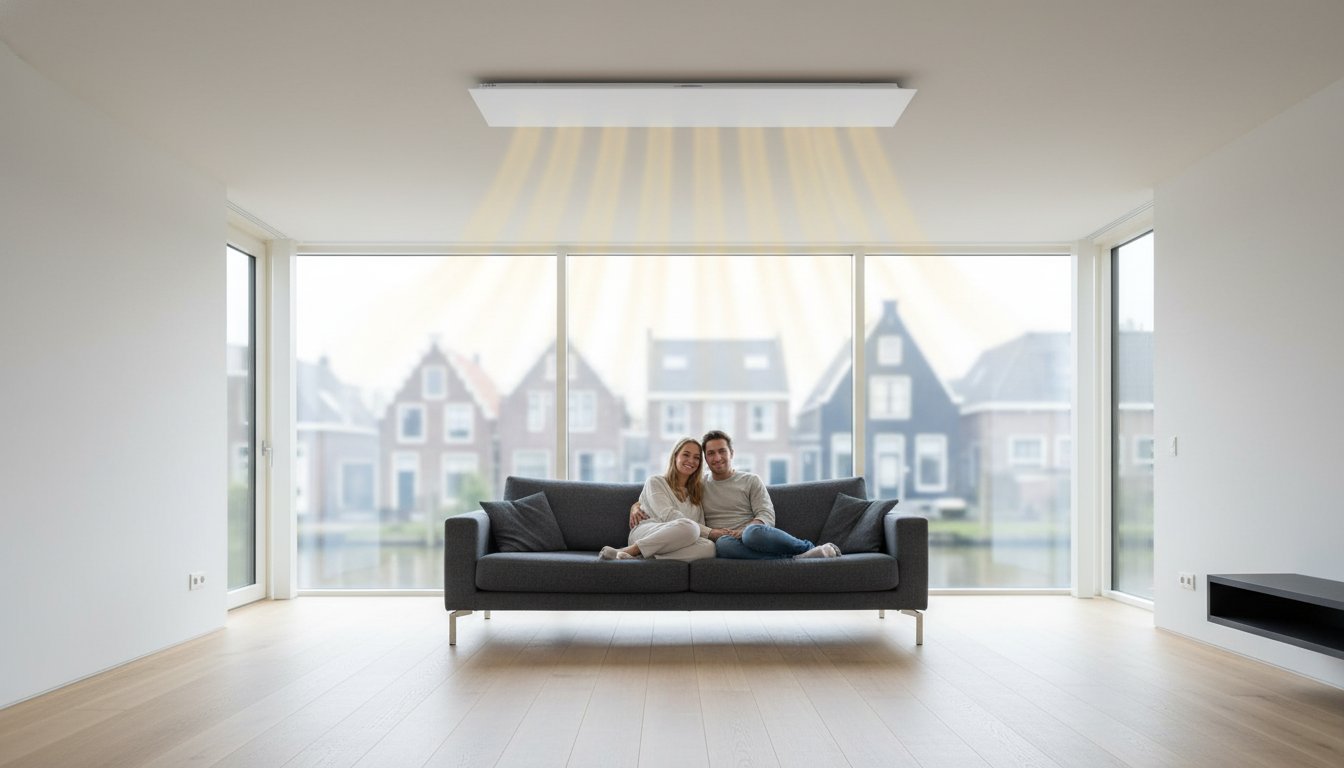
Illustration: yellow lines are drawn to represent heat transfer. Infrared radiation is invisible and this is not measured heat distribution.
Infrared panel heating is an electric heating option for various applications. A sound choice considers demand, heat transfer, positioning and controls. This guide helps compare product data and quotations for a home, workspace or customer project.
Key considerations
Calculate demand and assess occupied spots. Compare total running costs with existing heating and alternatives. Good insulation and controls help without guaranteeing a savings percentage. Ventilation, cleaning and hot-surface protection remain necessary.
How does an infrared panel emit heat?
Infrared lies beyond visible light in the electromagnetic spectrum. Warm panels radiate towards reachable people and surfaces. Convection at the surface also warms air. This removes neither airflow, dust nor moisture. Ventilation and cleaning remain part of indoor conditions.
IR-A, IR-B and IR-C describe wavelength ranges. Labels do not establish suitability for every interior or safety in all conditions. Output, surface temperature, exposure, distance and exact permitted application remain decisive.
Which product data should you compare?
Check input, exact dimensions, weight, mounting and supplied or required controls. Compare output and size together: it must meet demand and fit with prescribed clearance. Compare manufacturer documentation, warranty and maintenance too. Material, price or general quality claims do not prove better radiant share or lower energy. Ask method, conditions and exact version for measured claims.
Compare systems for equal heat demand
Panels emit radiation and convection. Electrical conversion efficiency differs from radiant share or bill savings. Resistance converts nearly all electricity to heat. Heat pumps transfer ambient heat and can deliver more per electrical kWh. Compare performance and total costs for equal demand and building conditions.
Calculate kWh as kW multiplied by actual hours. A 600 W panel heating continuously three hours uses 1.8 kWh. Multiply by your tariff and include other sources. Thermostats can reduce operating time; panels do not guarantee lower total costs.
A positioning and control plan
Start with loss calculation and occupied zones. Then assess positions, obstacles and support. Have load and protection checked and controls coordinated with existing heating. Standard heights or fixed watts per m² do not suit every room.
Use compatible thermostats and place sensors as instructed, avoiding sun, draught and direct radiation. Match schedules to use and existing systems. Wi-Fi or modulation is neither available nor necessary for every panel.
Different applications need different versions
Homes, bathrooms, industrial workplaces and terraces need different appliances and mounting. Bathroom choice needs model approval, location and electrics, not IP alone. Halls or terraces need separate coverage, height, airflow and usage assessment. Do not repurpose residential panels without evidence.
From product selection to a supported proposal
We advise private and business users and supply installers and wholesalers. Share plan, insulation, existing heating and desired warm spots. We compare suitable panels and controls and discuss documents for your version.
A panel does not automatically replace all home gas use. Include other rooms, hot water and cooking. Solar does not make electricity free or carbon-neutral at every moment. Compare demand, generation, schedules and tariffs before assessing a full transition.
Frequently asked questions
Can infrared provide primary heating?
Assess the complete building at equal comfort. Include losses, electrical capacity, running costs and alternatives. A favourable rating alone does not prove sufficient panels.
How many panels are needed for 30 m²?
Area alone cannot establish reliable numbers or watts. First assess demand, ceiling height, glazing and distribution.
Are panels safe for children and pets?
Panels can become hot and burn. Choose permitted positions avoiding contact, retain clearances and do not cover. Low mass or temperature limiters do not remove contact risks. Follow the model manual.
How do I assess installation and quality?
Compare data, mounting, controls, warranty and maintenance. Price or general claims do not prove low consumption. Check structure and electrical capacity and seek a professional when needed. Clean and inspect as instructed; lifespan and warranty differ.
Sources and principles
- Living room heating
- Bathroom heating
- View our range
- Milieu Centraal: heating with infrared panels
- ICNIRP: visible and infrared radiation guidelines (2013, PDF)Open PDF in a new tab
- Australian government: electric heating and heat pumps
- Welltherm: glass panel installation and operating manual (PDF)Open PDF in a new tab