
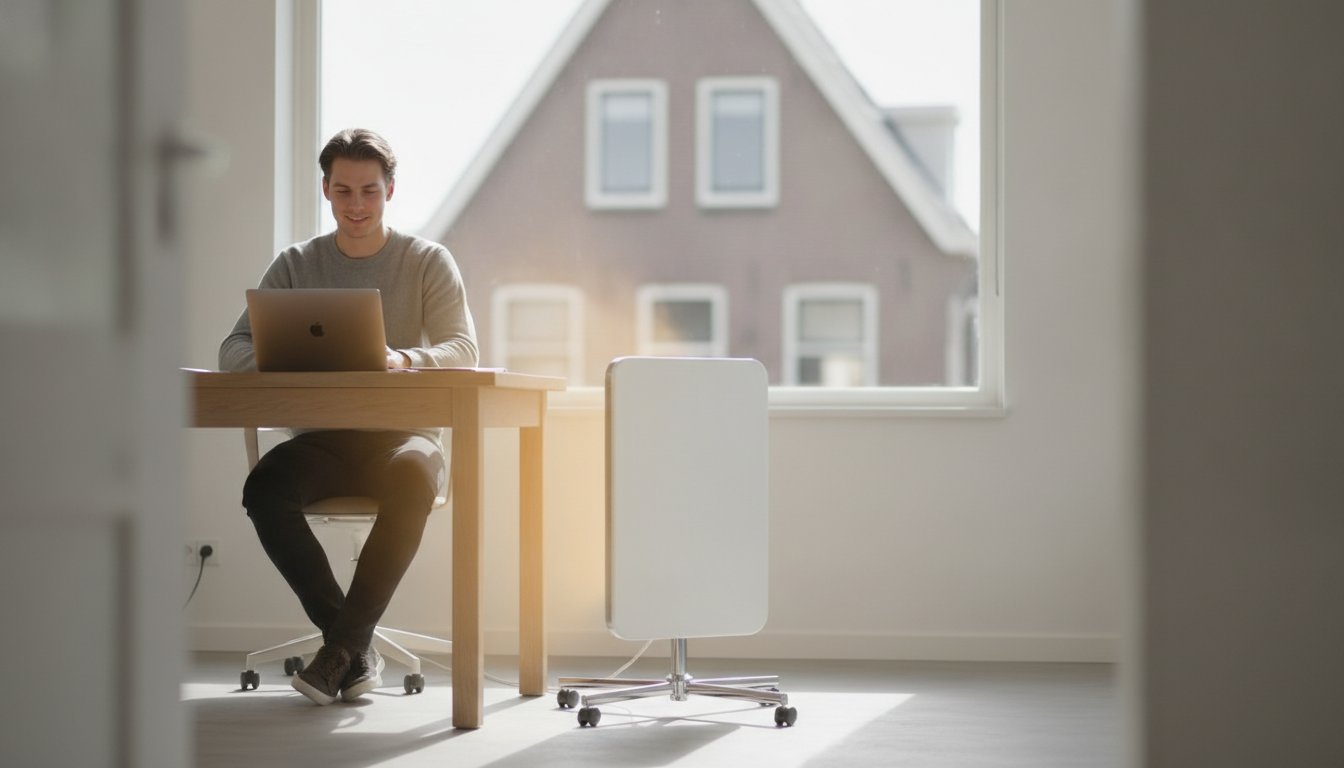
Illustration: the yellow glow beside the panel has been added; infrared radiation itself is not visible.
Want to move an infrared panel from your workstation to the seating area? Use a mobile version with a suitable stand. A setup at a desk is not automatically suitable beside a sofa, in a bedroom or workshop. At every new position, check floor, clearance, cable and risk of contact.
This guide follows use from choosing and positioning to moving and storage. We advise private and business end users and work with installers and wholesalers on suitable mobile solutions.
Key points
Use only the approved panel-and-stand combination. Cool and disconnect as prescribed before moving. A wide base or protection code does not prove every surface or room suitable. Ask about coverage, heat sensation and consumption for your situation rather than expecting fixed square-metre coverage.
Which infrared panels may be moved?
This is a panel with a purpose-designed carrying or floor arrangement permitted for use in several locations. Not every wall model offers this. The warm surface releases radiation and convection; people and objects may absorb energy and air also warms. Moving does not change the principle, but changes which spot receives radiation.
What can a local comfort zone do?
Targeted heat may feel pleasant at a seat while other areas are less used. This does not guarantee lower total costs: existing heating and added electricity count. Ventilation losses, cold surfaces and draughts still matter. A mobile panel does not treat pain, fatigue or respiratory complaints either.
Output and consumption with changing use
Compare version data: input power, dimensions, weight, mounting and controls. A measurement standard or marking is not a general performance promise for every room. Ask what property was measured, under which conditions and whether it applies to the offered model. Origin alone does not guarantee higher efficiency.
A 350-watt panel operating continuously at full power for two hours uses about 0.7 kWh. Cost is consumption multiplied by your tariff. A thermostat may create off-time, but does not imply fixed thirty-percent savings. Assess possible savings with total heating use before and after the change.
Check the panel together with its stand
Consider the appliance with feet or wheels, not just panel size. Can it stand stably on your floor, is weight manageable and are there intended handles? Check fixings and any brakes. Tip-over protection may be an added provision but does not make a wobbly setup suitable.
Define the desired heating zone and daily use too. Fixed wattage per desk or square metre is not a reliable selection aid for all rooms. Distance, direction, insulation and obstacles matter. Full room heating needs a heat-loss calculation and a permitted appliance application that fits.
Connection and external controls
Check supply, cable, permitted extensions and connection load. Use an external thermostat, timer or smart plug only with confirmed compatibility. Some electronics respond differently after interruption. The sensor must represent the new location, not just heat immediately beside the panel.
Moving and repositioning an infrared panel
Place the appliance outside walkways near a seat or workstation and ensure cables are not trapped or pulled taut. Keep clothing, paper and furniture outside prescribed clearance. Only a purpose-designed version may stand under a desk. Moving a chair or opening a door must not knock over or cover the panel.
Before moving, switch off, disconnect and cool as prescribed. Use handles and do not lift by the cable or a hot edge. Recheck stability and distances at the new position. For storage, the appliance must be cool and dry; follow cable-storage and damage-protection instructions.
Special rooms are not automatically permitted
A hobby room may contain dust or vapours requiring a different appliance. Bathroom use needs product permission, moisture exposure, placement and electrical installation to align. An isolated IP code or safe-looking housing is insufficient. Moving to another room therefore means reassessing too.
Our advice on a suitable mobile version
Tell us which places you want to use and send photos, dimensions and existing-heating details. We help private and business customers compare and coordinate products and documents with installers and wholesalers. Ask about the specific foot or wheel version, overall size and available parts. Check the manual for floors and setups suitable for the stand.
Moving an infrared panel: plan every setup
A mobile panel offers flexibility if every setup is suitable. Ask us for advice or a quotation specifying stand, controls and conditions alongside output.
Frequently asked questions
Can a child safely touch a mobile panel?
Do not assume so. Hot surfaces can cause burns even after brief contact. Prevent accidental touching and follow supervision and positioning instructions. Tip-over or temperature protection does not automatically make a hot surface touch-safe.
Is a mobile panel primary heating and maintenance-free?
For primary heating, the complete system must match heat demand and project requirements. Have this assessed for your building. A mobile appliance also needs cleaning and checks of cable, stand, connections and controls. Warranty, expected lifespan and maintenance are separate conditions to review per model.