
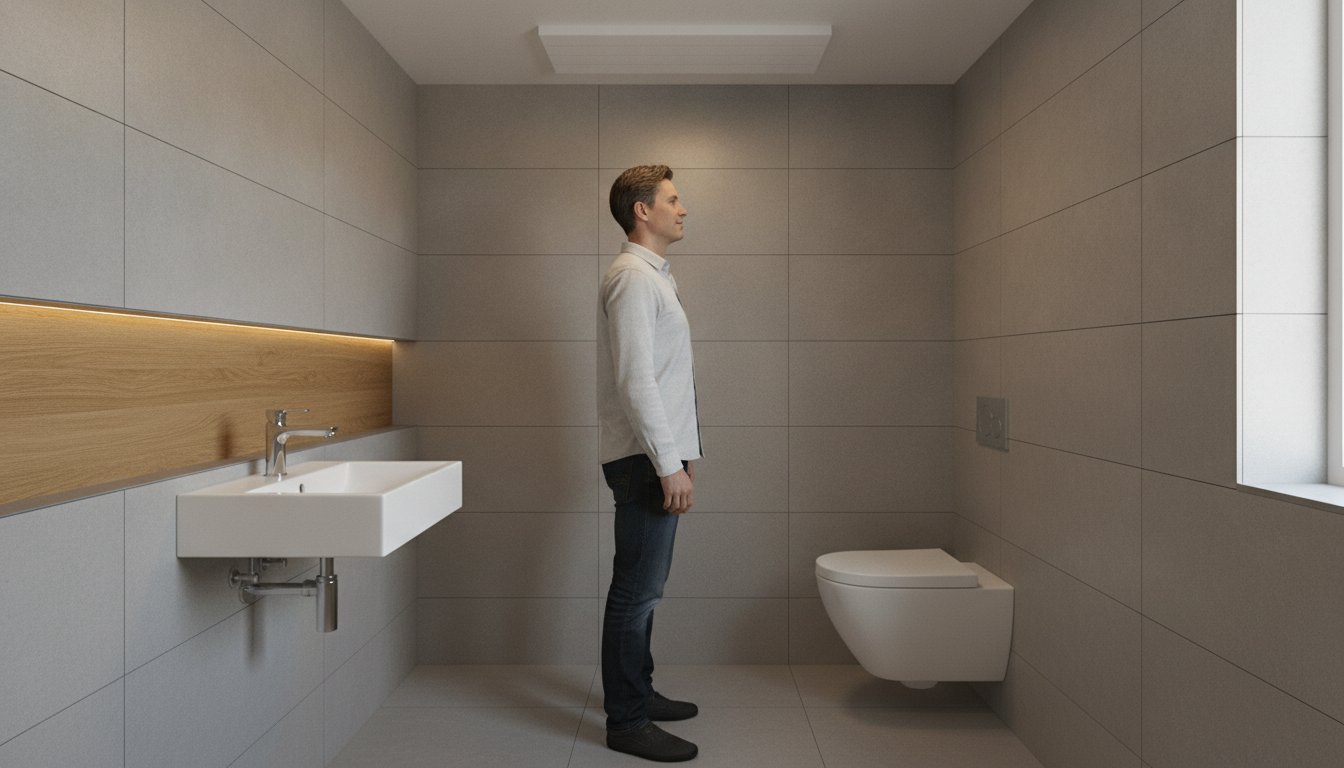
An infrared panel can heat a toilet room without radiator pipework. In a compact room, location is especially important: safe clearances to users, doors and fittings must remain. Start by assessing available wall or ceiling space, heating needs and electrical connections.
A toilet visit often lasts less time than a cold panel or room needs to warm up. Starting heat only when the door opens therefore does not automatically provide immediate comfort. This guide considers realistic controls and mounting without fixed promises about consumption, hygiene or warm-up speed.
Key points
Check approved mounting and clearances in the small room. Choose output according to heat loss and use, not floor area alone. Match timers or presence controls to warm-up time. Maintain ventilation and have electrical safety assessed.
When does a panel suit a toilet room?
A wall or ceiling panel can leave the floor clear if approved for that mounting. In a narrow toilet, doors, basin, cupboards or towels can affect heat and safe placement. Ceiling mounting is not always best: consider height, fixings and distance to the head. A mirror panel may combine functions but needs sufficient output and an approved position.
Warmth without hygiene promises
The panel transfers radiant heat to people and surfaces and convective heat to air. It does not prevent draughts through doors or ventilation. Heated materials can store heat and release it later, but that energy was supplied earlier. Thermal mass does not eliminate heat loss.
A heating panel does not sterilise the room or guarantee absence of dust, bacteria or mould. Ventilate and clean according to the room’s needs. Warmer surfaces may reduce condensation under certain conditions, but recurring damp needs investigation. A windowless toilet still requires appropriate ventilation.
Assessing the required output
Dimensions, insulation, external walls, glazing, ventilation and target temperature determine demand together. Consider permissible cooling when unused and desired warm-up speed. A standard 250- or 300-watt panel is not automatically sufficient. Nor should extra capacity be chosen without assessment on the assumption that switching off sooner always saves energy.
Position matters alongside output. Check whether heat reaches the user without obstruction or excessive local intensity. A panel behind a door or above a tall cupboard may lose coverage. Ask for advice using a plan and photographs before deciding on wattage alone.
Installation and realistic controls
Match fixings to weight, substrate and mounting instructions. Supplied plugs do not fit every construction. Maintain material clearances and prevent contact with hot surfaces. Even brief contact can burn. Have fixed electrical connections and alterations carried out by a qualified installer.
A toilet room may have different requirements from a bathroom with a bath or shower. Have the actual room and any special conditions assessed. Check permitted use, IP protection, connection positions and electrical protection together. A general IP rating does not replace specific requirements.
Timer or presence sensor?
First check panel and room warm-up time. A sensor starting only on entry may be too late for a short visit. A fixed five-to-ten-minute overrun is not automatically necessary or economical. Choose controls matching use and appliance, and ensure seated users are detected. Do not disable ventilation to warm up faster.
Design and advice for your toilet room
We advise private and business end users and also supply installers and wholesalers. Photographs, dimensions, ceiling height and ventilation details help us advise. We compare approved wall, ceiling or mirror versions. Colours, lighting and controls depend on the model and are checked for each proposal.
Check comfort and consumption after installation
Test controls during typical use. Check timely warmth and unintended continued operation. Clean as instructed after switching off and cooling. Periodically check fixings, cable and controls and have damage assessed. Low maintenance does not mean inspections or replacement parts are never needed.
Frequently asked questions
What is monthly consumption?
Multiply power input in kilowatts by actual heating hours. As an example, 300 watts for half an hour daily over thirty days uses about 4.5 kWh. This is not a prediction for your toilet: starting temperature, controls and use may substantially change running time. Multiply by your tariff.
Is extraction still needed?
Yes, maintain appropriate ventilation. Removing warm air affects heat demand even with infrared heating. A panel does not make ventilation energy-neutral. Assess ventilation or heating changes together with use and moisture levels.