
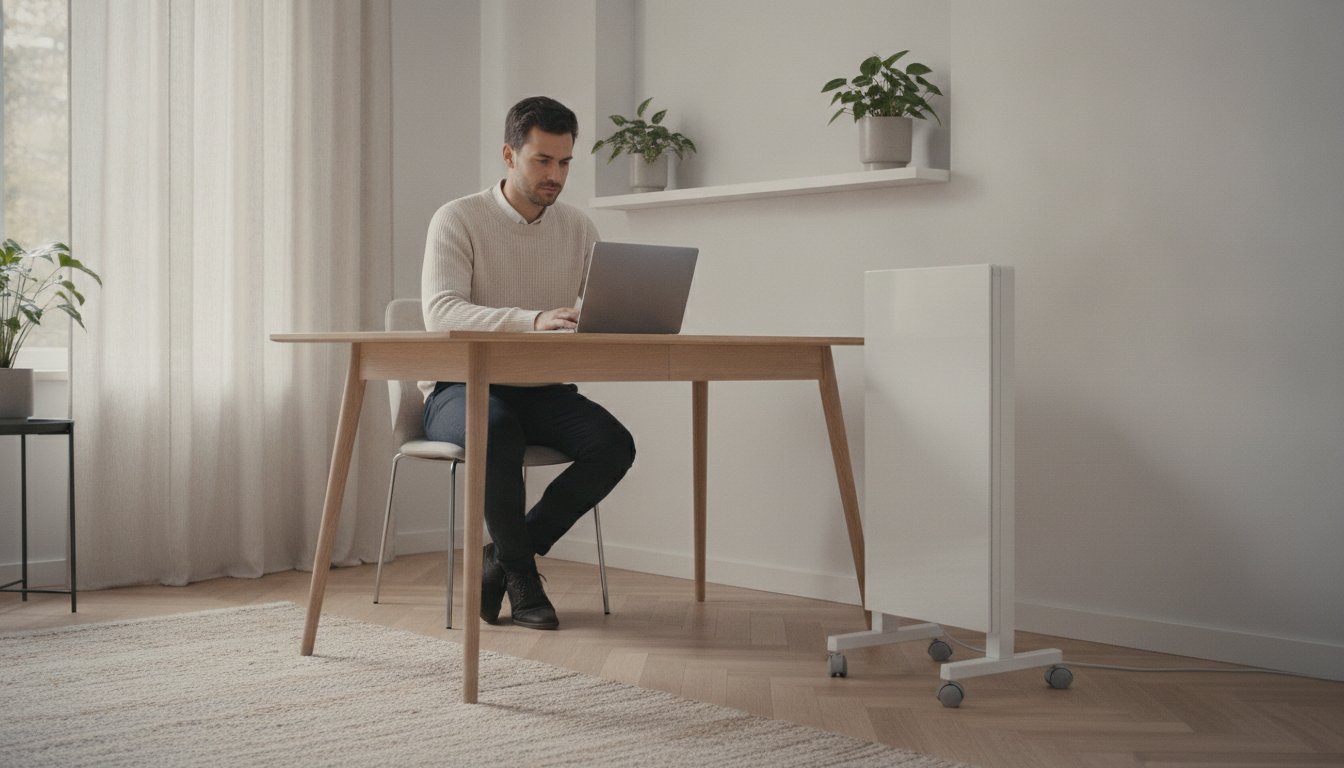
An infrared panel on wheels can provide extra warmth at a desk or seating area and then be moved to another suitable position. First check that the panel and base are approved together for mobile use. Adding wheels does not automatically turn a wall panel into a safe mobile appliance.
This guide covers operation, consumption, positioning and controls. We help private and business end users, installers and wholesalers choose a suitable configuration.
Key points
Choose an approved combination of panel, frame and wheels. Match output and controls to the intended use. Maintain the specified clearances, prevent trip hazards and move the appliance according to its manual. Suitable use may save energy, but savings are not guaranteed.
What is an infrared panel on wheels and how does it work?
Electricity heats the element and panel surface. The warm surface releases energy through infrared radiation and natural convection. People and surfaces absorb some of the radiation and subsequently exchange heat with their surroundings. The panel therefore does not heat people exclusively or eliminate losses through ventilation or poor insulation.
A portable appliance can avoid permanent mounting, which may be useful in rented accommodation or a temporary workspace. Nevertheless, check the electrical connection, base assembly and permitted operating position. A plug does not mean that every appliance can be used anywhere without further checks.
Why choose a mobile infrared solution?
The main benefit is flexibility: extra heat can be directed towards the place you use. Comfort depends on the appliance, distance, orientation, obstructions and other heating. A mobile panel does not solve draughts, damp problems or inadequate ventilation. A fanless model creates no forced fan airflow, but natural convection and dust movement remain possible.
Consumption and potential savings
A 500-watt appliance running continuously at full power for four hours uses approximately 2 kWh. Multiply actual consumption by your electricity tariff to calculate running costs. A thermostat may reduce operating time, but the reduction depends on heat demand. Compare the total consumption of all heating before and after the change. Adding electric heat while leaving the main heating unchanged may increase costs.
Almost all electricity consumed by an electric resistance heater ultimately becomes heat in the room. This does not indicate how much radiant warmth reaches your seat or which system has the lowest costs. A heat pump can deliver more heat per kWh of electricity. Solar electricity can contribute when generation and use coincide; winter heat demand does not automatically match available generation.
Uses for portable infrared panels
Possible uses include extra warmth when working from home, at a seating area or in an occasionally used room. In an office, positioning must suit workstations, circulation routes and company policies. Large halls, draughty reception desks and workshops require a separate assessment: a domestic mobile panel is not automatically suitable for industrial use. Consider dust, moisture, collision hazards and any special risks before choosing an appliance.
Positioning beside a sofa or desk
Consider the direction of the radiating surface and furniture that intercepts its radiation. Do not put the appliance under a desk or close to a sofa unless the manual permits that arrangement and all clearances can be maintained. Curtains, paper and clothing must not cover the panel. Keep escape routes and access to the socket clear.
Important specifications when choosing
Check the model number, rated power, weight and approved mounting method. Material alone does not determine how quickly a panel warms up or retains heat: mass, construction and controls also matter. Ask which safeguards are fitted, which IP rating applies and whether the appliance is permitted in the intended room. An IP rating alone does not make an appliance suitable for every wet area or outdoor location.
Output, range and primary heating
There is no universal wattage per square metre or fixed range that applies to every mobile panel. Local supplementary heating depends on factors including distance, posture and the existing temperature. Heating an entire room requires a heat-loss calculation. Whether a mobile model is suitable depends on that calculation, permitted operating duration, positioning and controls. Do not choose solely on a promised heated floor area.
Base, wheels and cable
Use only a compatible approved base and assemble it as instructed. Check load capacity, fastenings, stability and any wheel brakes. Suitability for parquet, laminate, tiles or carpet varies by wheel design. Check beforehand; scratch-free movement or stability on thick carpet cannot be assumed. Route the cable away from walkways and avoid trapping, tension and contact with hot parts.
Controls and maintenance
Check that built-in controls or a plug-in thermostat are compatible with the appliance, including switching capacity and any conditions. The sensor must measure a representative temperature rather than just the warmth beside the panel. App control or a timer is suitable only if the manufacturer permits it. Remote switching requires particular attention to obstacles and an unchanged safe setup.
Low maintenance does not mean maintenance-free. Follow the manual for cleaning and inspecting the cable, plug, panel, frame and wheels. Stop using the appliance if it is damaged or unstable. Lifespan, warranty and repair options vary by product; we make no blanket promise about them.
A suitable mobile heating solution from us
Tell us where you need extra warmth, how long you use it and which heating is already present. Photos, dimensions and a floor plan help us advise you. We can discuss a suitable configuration and controls. For installers and wholesalers, we also cover available product documentation, application conditions and supply for their project.
Make an informed choice
Compare suitability, positioning, controls and expected running costs as well as the purchase price. Ask us for personal advice or a quote before combining a panel and base whose compatibility has not been confirmed.
Frequently asked questions about mobile infrared panels
Can a mobile panel be left unattended?
Do not assume this is permitted because an overheat cut-out is fitted. Follow the manufacturer’s conditions for supervision, timer use and remote control. A safeguard does not replace safe positioning. Consider children, pets and people who may have difficulty avoiding hot surfaces.
Can I move the appliance while it is hot?
Follow the manual. Switch the appliance off, disconnect it and allow it to cool sufficiently where required. Use only the intended handles and never pull the cable. After moving it, check stability, wheel brakes, cable routing and clearances again.
Does the back become warm too?
That depends on the construction. The back, edges and frame can also become warm. Do not assume the back stays cool, and maintain the manual’s clearances on every side. Do not use the panel as a drying rack.