
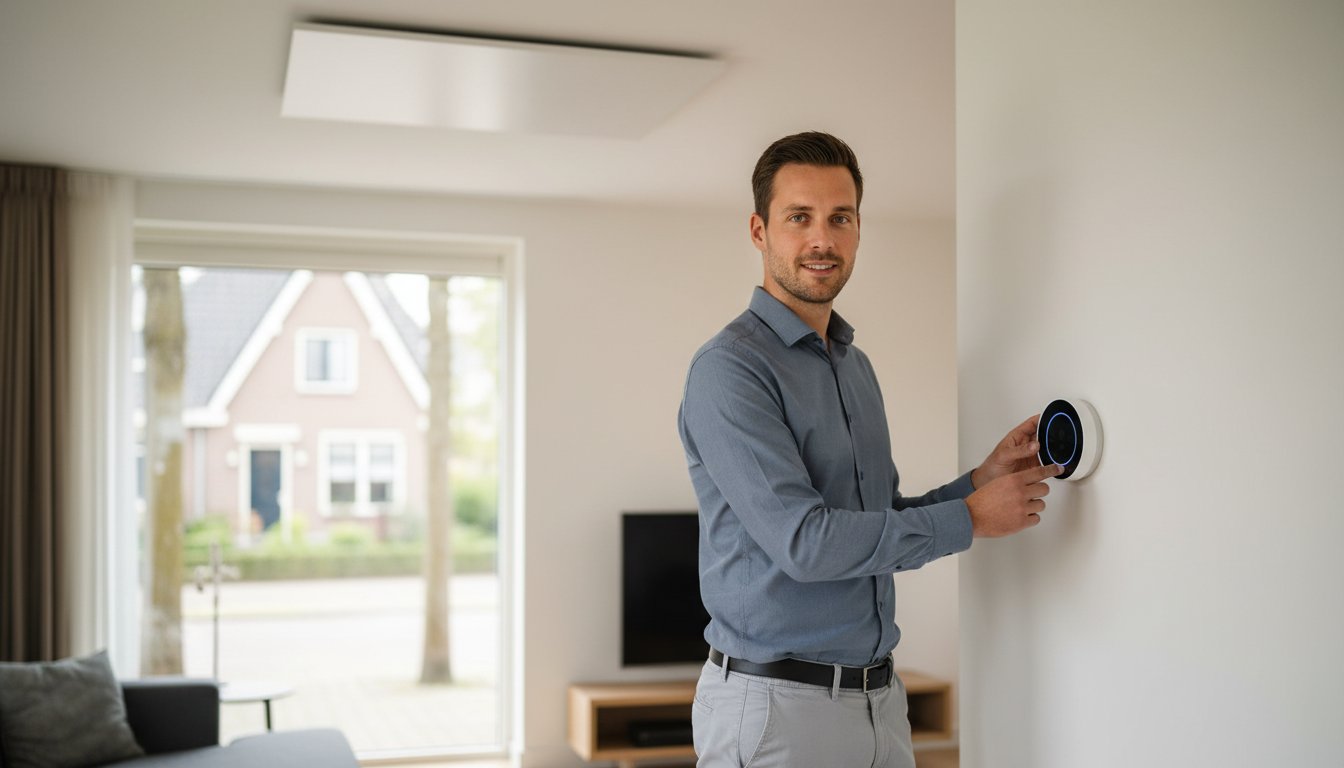
An infrared panel with thermostat combines heat source, sensing and controls. The term may mean built-in controls or a separate controller and receiver. This guide identifies what is included and how components should work in your room.
Key points
Check included controls, receivers and sensors and their compatibility. Distinguish measured air temperature from perceived warmth. Choose a representative sensing point and check load and installation. Wi-Fi or built-in sensing guarantees no fixed accuracy, savings or comfort.
Why choose panel and controls together?
Schedules and settings may reduce unnecessary heating if sensing and outputs suit the use. Not every panel modulates, and simple on/off thermostats can be part of good design. Smart branding alone proves no better operation.
Panels emit radiant and convective heat. Switching changes surface temperature. This does not mean thermostats guarantee constant radiation or equal comfort for everyone. Response depends on appliance and room.
What does the sensor actually measure?
Many room thermostats measure air at the sensor. Comfort also depends on surrounding radiation, air movement, clothing and activity. Operative temperature combines air and radiant effects; it is not a simple arithmetic mean under every condition.
Ordinary air sensors do not automatically measure mean radiant temperature or wall heat content. Built-in and external sensors can be influenced differently; follow model instructions. No fixed 2–4 degree error applies to all built-in thermostats.
Outputs and algorithms vary. PWM, PID and differential switching are not universal infrared-control features. Check receiver load and load type. Do not assume 16 A or a specific accuracy without product data.
Built-in, plug-in, RF or Wi-Fi
Plug-in solutions may suit appropriate sockets, loads and locations. Separate RF transmitters can measure at a useful spot while receivers switch near the heater. Test final-site range; frequency does not guarantee 30 metres through every wall.
Compare our thermostats and controls by function, connection method and compatibility with your panel.
Wi-Fi and smart-home links depend on model. Check gateway, accounts, internet and offline operation. Not every controller supports Matter or Zigbee or real energy metering. Ask what is included before choosing.
Position, connect and check
Choose representative sensing locations and follow the manual. Sun, draughts and panel heat affect readings. One 1.5 metre distance or ideal height does not suit every configuration. Keep receivers and connections accessible as required and avoid excess heat.
Have load and protection competently assessed, especially for several panels or fixed wiring. Added relays need a suitable design. Test pairing and programmes by product procedure rather than universal test settings.
Bathrooms need assessment of device, zone, water and electrical installation together. IP44 controls alone do not make the system safe. Heated mirrors also require clear understanding of demisting and separate control where provided.
Our advice for the complete combination
We help private and business end users, installers and wholesalers. Send brand, type, power and quantity plus photographs and zones. We advise suitable controls and mounting based on actual documentation and compatibility.
For installers, we discuss selection and technical points around the project. Ask about documentation and support. This builds an informed plan without assuming standard protocols, automatic integration or guaranteed accuracy.
Controls with realistic expectations
Schedules may limit unnecessary hours but do not reduce building heat loss. Calculate kW times actual on-hours and compare equal use. Thermostats do not establish fixed savings, carbon neutrality or payback.
Questions about panels with thermostats
Is built-in control always worse than external?
No. Assess designed sensing, placement and model information. External sensing can offer a useful location but can also be misplaced. Check actual behaviour in the room.
How do I maintain the combination?
Follow cleaning, battery and inspection instructions. Relays, sensors and connections can fail; expected life is not a warranty. Have damage or incorrect switching investigated and prevent hot-surface contact.