
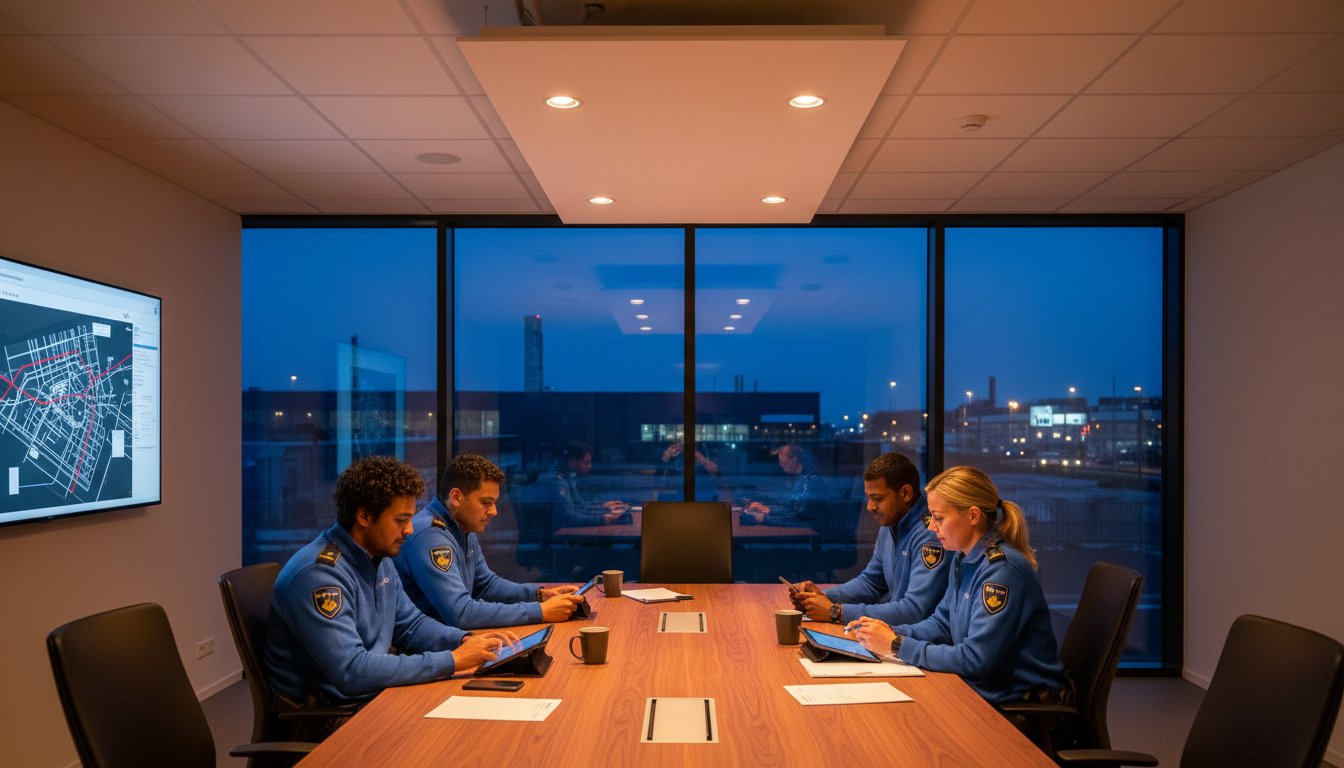
A police station may operate continuously while occupancy varies greatly between rooms. Infrared heating decisions therefore involve continuity, management and room-specific requirements as well as comfort and consumption. Local warmth may supplement the building system; suitability needs assessment by zone.
Key points
Distinguish public counters, offices, briefing rooms, control rooms and secure spaces. Check schedules, heat loss, accessibility and controls. A standard panel is not automatically suitable for a custody cell or another environment with special safety requirements. Assess such applications with the responsible building and security specialists.
Map occupancy and continuity needs
Record occupancy and any conditions needed even when rooms are empty. Include shift changes and unplanned meetings. An occupancy sensor alone may be insufficient. Agree schedules, manual operation and exceptions with building managers and users.
Do not assume an empty room needs no heating or that a panel permits unlimited continuous operation. Check model operating limits and required resilience. Define responses to appliance, power or control failure and responsibility for restoration.
Technology and sizing by zone
A panel radiates towards people and surfaces it can reach and also produces convection. Desks, screens and cabinets can obstruct radiation. Ceiling mounting therefore does not automatically cover every corner. Determine output and distribution from heat loss, ventilation, target temperature and actual layout.
Compare mounting approval, material, mechanical exposure, moisture and visitor access. Hot surfaces can injure; internal thermal protection does not remove that risk. An IP code or country of origin does not prove vandal resistance or suitability for special institutional rooms.
Building controls and access permissions
Check whether each controller supports the building system and which functions it exchanges. KNX, Modbus, Wi-Fi and apps are not interchangeable features. Agree network use, permissions, logging and local controls with technical and IT managers. Test behaviour after connection loss too.
Compare with the existing installation
Compare primary heating, local supplementation and alternatives at the same occupancy and comfort target. Panel response and whole-room warm-up are different things. Fixed warm-up minutes or guaranteed lower operating costs cannot be established without project data.
Budget equipment, installation, electricity, controls, inspection and replacement. Low maintenance does not mean no checks: fixings, cables and switching parts still need attention. Assess incentives against current official rules and the client’s eligibility; a general scheme or budget guarantees no contribution.
Different functions within the building
At a public counter, local warmth may help staff, but a panel is not an air curtain stopping draughts through an open door. Assess doors, ventilation and staff positions. Review accessible surfaces, clear routes and fixings for public-area conditions.
In briefing and interview rooms, consider seating and preparation time. Where recordings matter, check noise from the whole installation, including relays; fanless does not automatically mean silent. Control rooms also require attention to screens, electronics and individual needs during prolonged seated work.
Desk heating needs a model approved for under-desk mounting with adequate leg and cable space. In changing and shower areas, assess model, moisture and full connection together. Heating does not replace ventilation or treatment of damp problems.
Secure spaces require separate approval
Do not select equipment for custody cells or secure zones from general panel features. Have responsible specialists establish all applicable operational, construction and safety requirements and assess the complete installation. No specific model has been verified here for this application.
Product advice and project coordination
We support private and business end users, installers and wholesalers with infrared heating selection and supply. For police buildings, product information must align with requirements defined by the client and responsible specialists. Share only necessary heating information through an appropriate channel.
Commission for everyday operation
Test selected zones in representative use and collect feedback across shifts. Check manual controls, schedules, restart and fault reporting. Hand over settings and maintenance arrangements and reassess after layout changes. Product choice becomes part of a working system only when management is organised too.
Police station heating questions
Can a saving be guaranteed beforehand?
No. Compare heat loss, schedules, actual operating time and existing systems. A trial can help but must represent occupancy and season. Lower gas costs alone do not prove lower total energy costs when electricity use rises.