
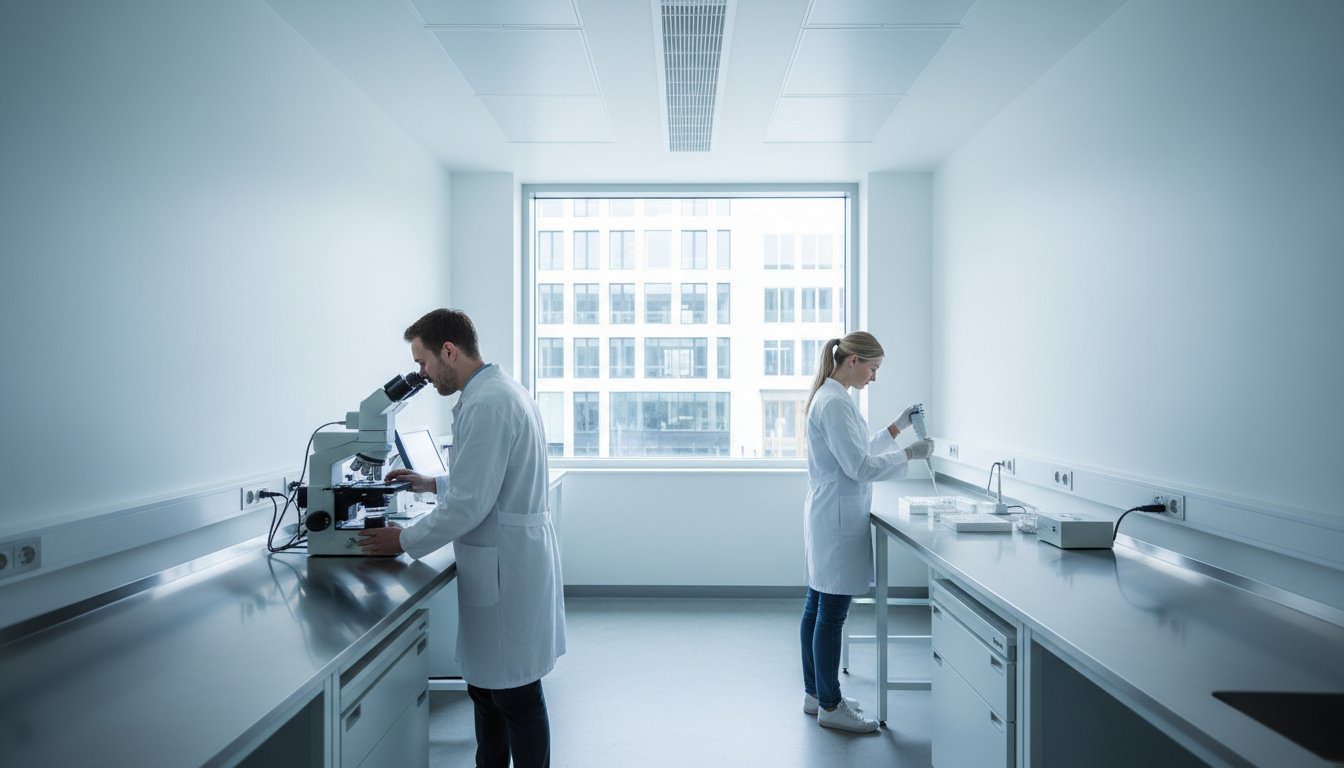
Infrared heating may be an option for thermal comfort in a laboratory. Whether a panel is suitable depends on the process, required temperature stability, air handling, substances and equipment. Radiant heating does not replace ventilation, filtration or cleanroom systems. Assess heating as part of the complete installation design.
We help gather product data and discuss placement and controls. Have the responsible specialists establish requirements for occupational safety, measurement conditions, explosion protection and hygiene. A standard for measuring panel performance or a general quality label does not prove that a device is suitable for every laboratory.
Key considerations
Assess radiant heating together with the required air handling; a panel does not prevent air movement or particle dispersal.
Assess heating and air handling together
Infrared panels transfer heat by radiation to people and surfaces. Convection also occurs and the air warms up. Temperature distribution and air movement also depend on placement, ventilation and room layout. A panel does not make a laboratory free of air movement or particles.
Model selection and cleanability
For a laboratory project, discuss finish, mounting and cleaning methods before choosing a model. Available colours and custom options vary by product. Do not assume resistance to chemical vapours, corrosion or aggressive cleaning agents without model-specific confirmation. We can coordinate the available product information with your installer or project consultant.
Radiant heating does not replace HVAC
Ventilation, filtration, pressure differences, cooling and humidity control may remain necessary for the process and users. Compare heating options within the same installation design and under the same indoor conditions. Less heating equipment does not automatically mean that air handling can be omitted.
Placement, zoning and controls
Determine the required capacity through a heat-loss calculation, considering operating hours, ventilation and the desired temperature. Install panels only according to the mounting instructions and assess clearances, accessibility, cables and electrical load. Coordinate sensor placement with workstations and temperature-sensitive processes. A panel thermostat does not replace validated process control.
Where flammable substances or a potentially explosive atmosphere are present, have the permitted equipment assessed beforehand. A CE marking, temperature sensor or quality label alone does not establish suitability for an ATEX zone. Check the applicable zoning and model-specific documentation with a competent specialist. We can discuss the product information available for your project.
Product information and project consultation
We supply private and business end users, installation companies and wholesalers. For a laboratory, we can discuss the intended application with the installer and consultants involved. Include floor plans, operating conditions and special requirements for a focused assessment of the available range.
Compare costs and maintenance carefully
Electricity consumption depends on power and operating time: kW × hours = kWh. Multiply this by your electricity tariff for energy costs. Include installation, controls, maintenance and necessary air handling in any comparison. Without a project calculation, we cannot promise savings or a payback period. Follow the chosen device’s inspection and cleaning instructions; few moving parts do not make checks unnecessary.
Frequently asked questions about laboratory heating
Suitable around flammable chemicals?
Not every infrared panel is suitable for environments containing flammable or volatile substances. A temperature sensor does not rule out ignition hazards. Have the substances, any ATEX zone and permitted equipment assessed beforehand by a competent specialist. Use only a model whose documentation permits the specific application.
Effects on measuring equipment?
Assess effects on measuring equipment for the specific setup. Radiant heat and temperature differences may affect processes or temperature-sensitive measurements. The electrical installation and controls must also be compatible with the equipment. Consult the instrument supplier and test the combination against the required measurement conditions; we do not give a blanket guarantee of unaffected measurements.
Suitable for a cleanroom?
An infrared panel is not automatically suitable for a cleanroom up to ISO Class 5. ISO 14644-1 classifies air cleanliness by airborne particle concentration. Assess the specific device for particle release, cleanability, mounting and effects on the air management system, among other factors. Have the responsible cleanroom specialist establish suitability for your room and process.
Can I clean it with alcohol or solvents?
Use only cleaning agents and methods permitted by the manufacturer for the specific model. Where required, let the device cool and switch it off according to the manual. Without product-specific confirmation, we cannot guarantee chemical resistance.