
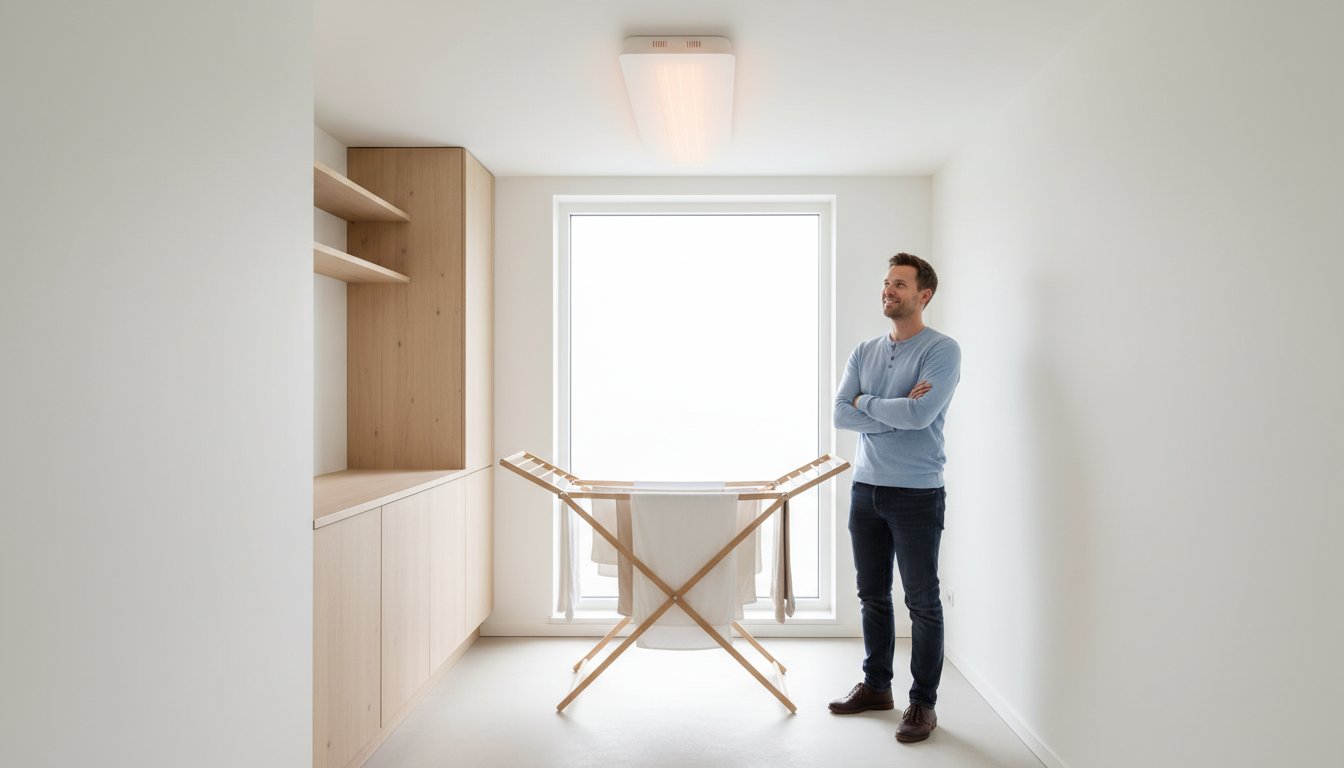
A laundry room needs to be usable and able to handle moisture from wet clothes. An infrared panel can add warmth but does not remove water vapour. Plan heating together with ventilation, any dehumidification, machines and drying racks. A panel is not a tumble dryer or a standalone damp treatment.
Key points
First decide whether you need room comfort or to solve a drying problem. These are different questions. Choose a model suited to moisture exposure and mounting, keep laundry clear and compare all energy needed for the same quantity of dry clothing.
The panel’s role in the laundry room
The warm surface radiates towards people and surfaces it can reach, while convection and air warming also occur. Machines and racks can obstruct radiation. Wall or ceiling positions must therefore suit the actual layout. Neither automatically gives uniform temperatures behind equipment or between closely hung clothes.
Heat can support evaporation, but the released moisture then enters the air. It must be removed or collected to prevent accumulation. Drying time also depends on spinning, textiles, load, spacing and ventilation or dehumidification capacity. A fixed drying time cannot be promised.
Measure moisture and investigate causes
Observe when condensation, musty smells or damp patches occur and whether they disappear after drying. Check ventilation and incoming air. Investigate leaks or structural damp when problems persist. A panel does not repair a thermal bridge or remove a building defect.
Warmer surfaces may be less prone to condensation, depending on temperature and humidity. This does not guarantee freedom from mould, odour or damage. A panel does not disinfect laundry or treat allergies or asthma. Machines and drains still need cleaning and maintenance.
Compare energy and drying methods fairly
Compare with a tumble dryer using the same load and drying result. Include the panel, ventilation, dehumidifier if used and other room heating. A wattage-and-hours example does not prove that laundry dries within that time. Different dryer types also have different consumption data.
Calculate electricity costs from actual input, operating time and your tariff. Where possible, measure a representative period with suitable equipment. A thermostat can control temperature but does not inherently measure humidity or remove moisture. Check the functions actually provided.
Choose output and schedules from room demand and use. More power does not automatically lower total consumption. Ensure heating and ventilation work together. Assess incentives and building performance against current conditions; a panel alone does not demonstrate project compliance.
Mounting around machines and drying racks
Determine required protection from the model, moisture exposure, position and complete connection. The room’s name alone does not determine the required protection. Also check available electrical capacity alongside the washer, dryer and other appliances.
Choose a position where doors, baskets and unfolded racks cannot fill required clearances. Do not hang clothes over or against the panel or use it to support a washing line. A universal rack distance is insufficient: follow the manufacturer and consider moving or sagging fabric.
Check structure and fixings for wall or ceiling mounting. Recessed or grid installation needs an approved version. Keep cables clear of heat, water and trapping points and preserve inspection and maintenance access.
Advice for your laundry room
We help private and business end users choose products and support installers and wholesalers with supply. Share dimensions, photos, ventilation and room use, and describe the problem. Heating and any additional measures can then be assessed separately.
Finishes, lighting, mirror versions, warranties and parts vary by model. Choose them alongside technical suitability and agree supply, mounting and connection clearly. A panel does not guarantee a permanently clear mirror or longer machine and textile life.
Test and adjust after installation
Check several normal laundry days for comfort, condensation, humidity and total energy. If problems persist, investigate rather than merely increasing temperature. Follow maintenance instructions for the panel, controls, machines and ventilation. Have damaged connections or loose fixings assessed before further use.
Laundry room questions
Is a panel always more economical than a dryer?
No. Compare the complete arrangement with the specific dryer at the same load and result. No general saving follows without measurements or calculations for both. Include the time and space indoor drying needs.
Can a towel rail help?
Only a designated rail or radiator may be used for its permitted textile function. Do not turn an arbitrary panel into a drying rack or add homemade holders. Follow load and operating limits and continue removing released moisture.