
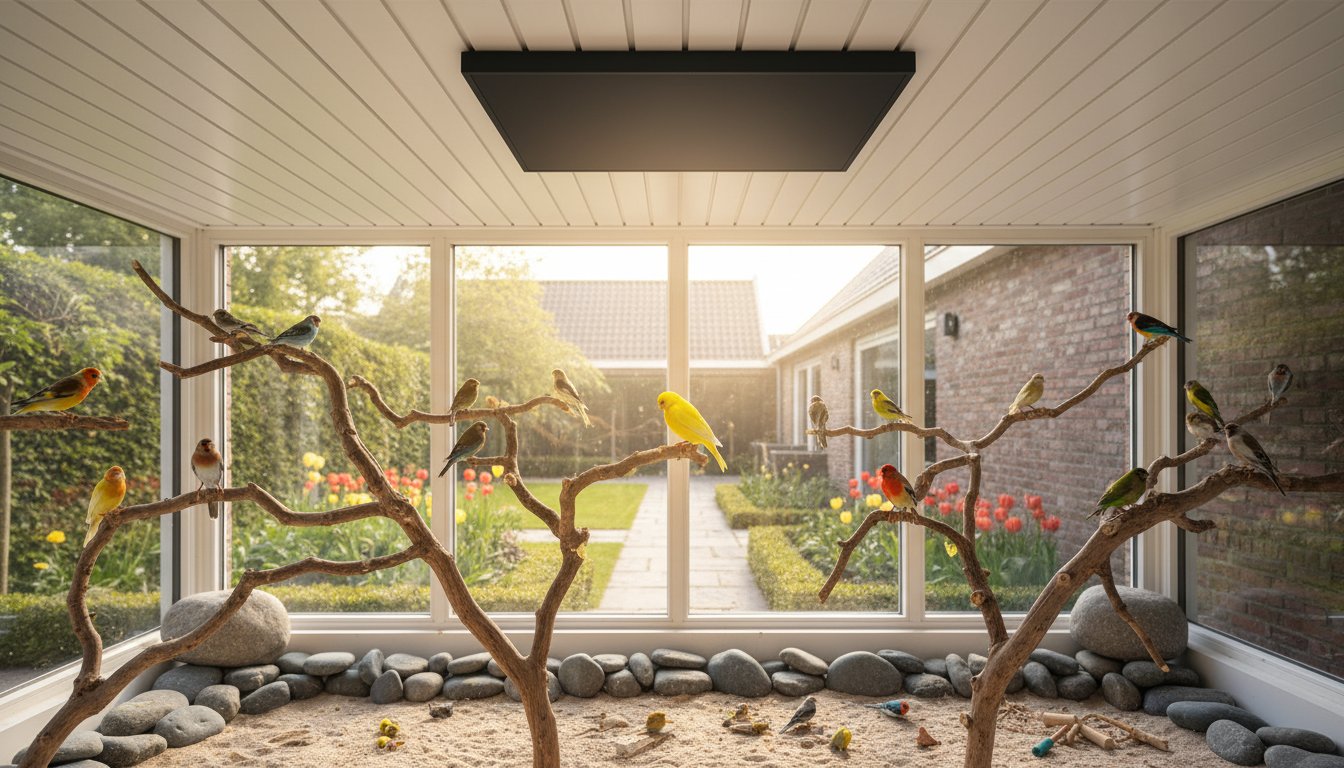
An aviary needs more than a wattage choice. Birds can fly, land, chew and approach a heater closely. First establish whether the manufacturer permits this specific application. A domestic panel is not automatically suitable for an aviary.
Key considerations
Establish the needs of the species kept with qualified guidance. Then assess permitted use, access to hot parts and cables, dust, moisture and cleaning. Heating does not guarantee reduced disease, better breeding or medical effects. An IP rating or metal casing does not prove bird resistance.
Start with the enclosure’s requirements
A sheltered indoor enclosure differs greatly from an open outdoor aviary. Record dimensions, insulation, glazing, openings, ventilation and occupancy. Define which areas need heat. Suitable temperatures and welfare require species-specific knowledge; no single temperature advice fits every bird.
Moisture, contamination and ventilation remain separate concerns. Heating does not remove parasites or infection causes and does not replace cleaning. Have health problems assessed by a veterinarian. Natural air movement and bird activity can move dust and feathers even without a fan.
What a panel does technically
An electric panel emits radiant and convective heat. Surfaces within its coverage can warm, but not every object receives equal heat. Infrared heating is not sunlight provision or a species-specific animal lamp. The label IR-C does not establish safety for every bird’s eyes, skin, feathers or health.
Ventilation, wind and openings still cause heat loss. Radiation is not simply blown away, but air movement can cool warmed surfaces. Heating does not guarantee elimination of downdraughts or frost risk. A warm sensor does not prove that drinking water and every enclosure location remain warm enough.
Selecting an appliance for the actual environment
Ask for explicit suitability for the animal enclosure and its conditions. Moisture, dust, feathers, dirt and cleaning agents can affect appliance and installation requirements. IP classification covers certain protection tests, not permission for spraying, chewing or animal contact. Metal is not automatically indestructible.
Size power from heat loss and the defined goal. Fixed watts per cubic metre or extra capacity cannot prove frost protection or economy. Assess electrical capacity alongside other equipment. Do not select a version solely through a calculation if its suitability is not established.
Planning mounting, protection and monitoring
Prevent access to hot surfaces, connections and cables through an assessed design. A fixed distance from a perch does not establish safety for free-flying birds. Additional guards must not obstruct operation and need manufacturer approval. Have protection and fixings assessed rather than choosing universal materials or distances.
Choose suitable controls and check sensor location. An app or Wi-Fi link is not independent safety monitoring. Discuss power failure, sensor faults and lost connections, and how conditions can be checked. Do not automatically use the lighting schedule as the heating schedule.
Our product advice for an aviary
We help private and business end users, installers and wholesalers with technical product selection. Share photos, a plan, usage and conditions. We discuss information and manufacturer confirmation needed. Product advice does not replace species-specific welfare advice or imply every panel in our range suits birds.
An evidenced plan and regular maintenance
Document appliance, controls, mounting and responsibilities. Follow cleaning and inspection instructions; dust and feathers do not justify calling a heater maintenance-free. Calculate electricity from kilowatts and actual hours. A 300-watt panel running at full power for four hours uses 1.2 kWh; this predicts neither temperature nor fixed savings.
Frequently asked questions
Is infrared heating automatically safe for birds?
No. It requires confirmed product suitability and a design accounting for accessible hot parts, behaviour, dust, moisture and controls. Without that evidence there is no general safety or welfare promise. Have welfare and technical installation assessed by the appropriate specialists.