
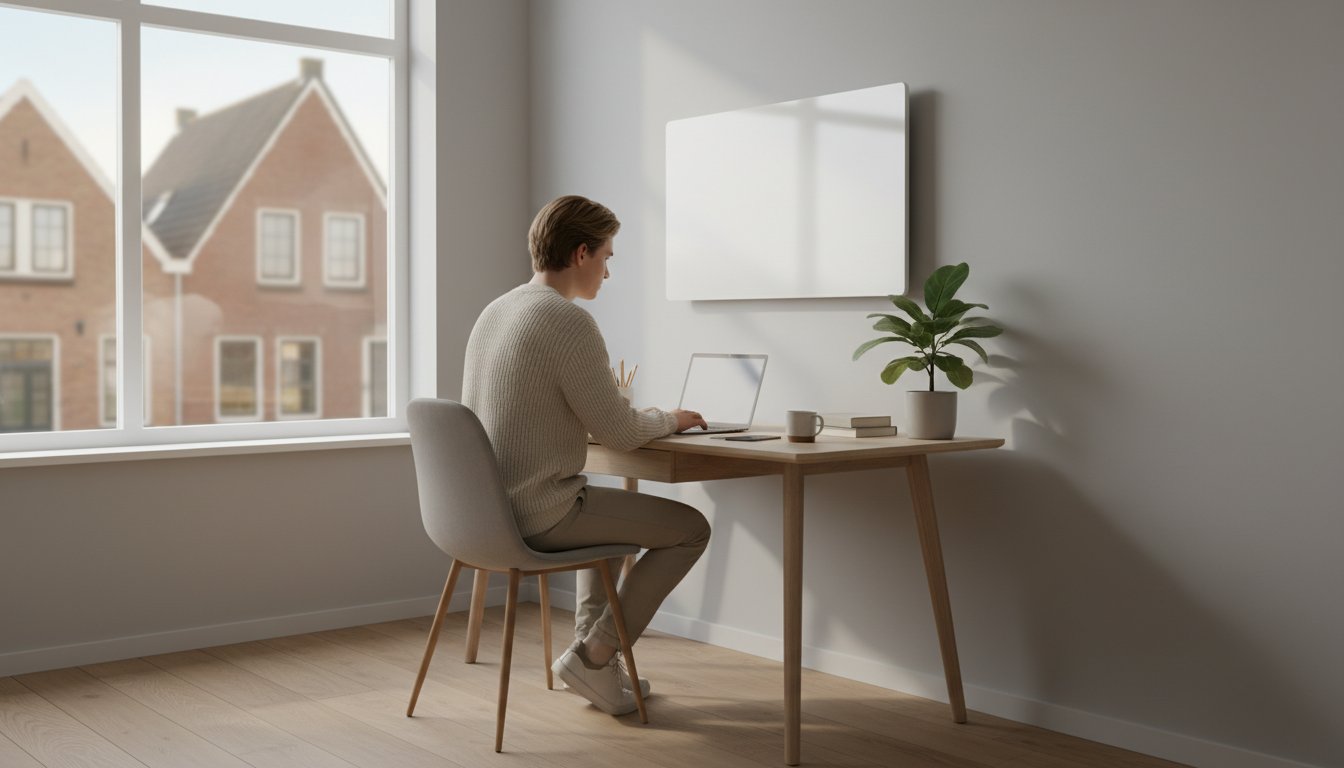
Student rooms often combine sleep, study and relaxation in little space. An infrared panel may add warmth but must suit the layout, existing heating and house arrangements. Before buying, also check who pays for electricity and whether mounting or electrical alterations are permitted.
Key points
Distinguish desk warmth from heating the whole room. Tall cupboards, loft beds and clothes racks may obstruct radiation or come too close. Choose an approved arrangement and assess total energy. A panel does not automatically compensate for poor insulation or ventilation.
Start with the room and house arrangements
Check when the room feels cold and whether existing heating works. Incorrect settings, blocked radiators or draughts may need another solution. Discuss problems with the landlord or manager before replacing primary heating or altering installations. Record mounting, ownership and reinstatement arrangements.
Personal controls may offer flexibility with shared heating, but billing matters. Check tenancy terms, house rules and supplementary electric heating agreements. Do not assume a lower central setting reduces your bill if cost allocation stays unchanged or electricity is added.
Local warmth or whole-room heating?
A panel radiates towards accessible people and surfaces, also producing convection and warming air. Desk and bed positions, distance and obstructions affect comfort. It does not prevent heat loss through gaps, walls, roofs or ventilation.
A suitable local solution may warm a study position. Primary heating needs sufficient output and distribution for the whole room’s heat loss. Assess dimensions, insulation, glazing, ventilation and target temperature. A fixed wattage per volume does not prove one panel is enough.
A panel does not treat allergies, asthma or damp and guarantees no better study performance. Continue ventilation and cleaning and investigate mould or condensation causes. A warmer surface may condense less but does not make the room automatically dry or dust-free.
Compare alternatives and real costs
Compare panels, convectors and alternatives for comfort, permitted operation, noise, space and safety. Resistance heating ultimately converts almost all electricity to heat, but distribution and controls differ. Lower rated wattage alone does not prove lower consumption for the same result.
Calculate costs from input kW, actual operating hours and your tariff. Include existing heating and compare a normal week, not just a short test. With thermostatic control, heating hours may differ from connected hours. Expect no fixed payback without those data.
Safe placement in a small room
Check wall or ceiling strength and use specified fixings. Use only mounting modes approved for the model. A loft bed can bring a seemingly inaccessible ceiling panel within reach. Observe manual clearances from bedding, curtains, posters, clothes and racks.
For shared circuits, assess total load alongside other house equipment. An empty socket does not prove spare capacity. Keep cables out of walkways, trapping points and hot surfaces. Check that any extension or multiway arrangement is permitted for the appliance.
Choose suitable controls and a representative sensor. Apps, window and occupancy functions must be supported by the combination. Prevent unintended changes by housemates and explain manual off. Test power-cut behaviour and recheck measurement after moving a sensor.
Choose a version for living or rental
We advise private and business end users, including students and managers, and support installers and wholesalers. Share dimensions, photos, existing heating and allowed mounting. Across multiple rooms, consistent controls, documentation and resident handover may matter more than extra app features.
Mirror or chalkboard finishes may be useful where designed and used accordingly. Not every panel may be written on or touched during operation. Choose finish and size alongside heating need and safety and check warranty and replacement parts.
Arrangements for daily use and moving out
Test during study, sleep arrangements and normal movement. Agree cleaning, checks and fault reporting. At move-out, decide whether the appliance leaves, how fixings are removed and who reinstates damage. Do not continue using damaged equipment without assessment.
Student room questions
Can it stay on while I am out or asleep?
Follow model permissions and house arrangements. A thermostat or thermal protection is no blanket guarantee for unattended operation. Preserve clearances despite moved bedding or clothes and switch off after damage, faults or doubt.
Is it always cheaper than existing heating?
No. It depends on tariffs, heat loss, use and billing arrangements. Assess the total effect while retaining comfort and suitable conditions. Avoiding gas in your room alone does not prove a lower total bill.